Open-Weight Models Are Catching Up: What Kimi K3 and DeepSeek V4 Mean for Enterprise Buyers
Open-Weight Models Are Catching Up: What Kimi K3 and DeepSeek V4 Mean for Enterprise Buyers
August 14, 2026· min read·#AI#Tech·Reviewed by Plavno AI Engineering Team
Enterprises can now consider self‑hosted LLMs like Kimi K3 and DeepSeek V4 as cost‑effective alternatives to closed‑model APIs when token usage exceeds a few million per day.
Share this post
Enterprises looking to replace proprietary LLM APIs with self‑hosted alternatives face a moving target: today’s “open‑weight AI models enterprise” are no longer a budget‑only option but a competitive contender on capability, latency, and cost. The July 2026 release of Moonshot AI’s Kimi K3 and DeepSeek’s V4 series has narrowed the performance gap to just a few months of ECI lag, while shifting the cost‑per‑token curve dramatically. Understanding when the financial break‑even point occurs—and how to architect a robust, secure deployment—determines whether an organization can truly own its AI stack.
QUICK ANSWER
Self‑hosting open‑weight models like Kimi K3 or DeepSeek V4 becomes cost‑effective when usage exceeds roughly 2‑5 million tokens per day, or when data residency, custom fine‑tuning, or zero‑vendor lock‑in outweigh the higher per‑token price. At that scale, the total cost can drop 70%‑80% versus closed‑model APIs.
Legacy closed‑model APIs lock enterprises into per‑token pricing that scales linearly with usage, making large‑scale workloads prohibitively expensive.
Data residency regulations (GDPR, CCPA, sector‑specific rules) forbid sending confidential documents to external providers.
Vendor lock‑in prevents deep domain adaptation—fine‑tuning on proprietary corpora is either unavailable or requires costly private instances.
Operational predictability suffers because usage‑driven pricing hides true CAPEX vs. OPEX trade‑offs.
Security audits struggle to validate third‑party model behavior, leading to compliance gaps.
Technical architecture and how open-weight AI models enterprise works in practice
Deploying an open‑weight model like Kimi K3 or DeepSeek V4 in an enterprise environment follows a layered pattern that isolates model inference, data governance, and application semantics.
API Gateway: A Cloud‑native ingress (Envoy or Kong) terminates TLS, enforces OAuth2 scopes, and rate‑limits per‑client tokens.
Orchestration Layer: Kubernetes (or Amazon EKS) runs a service mesh (Istio) that coordinates micro‑services built with LangChain or LlamaIndex for RAG pipelines, CrewAI for multi‑agent coordination, and AutoGen for tool‑use loops.
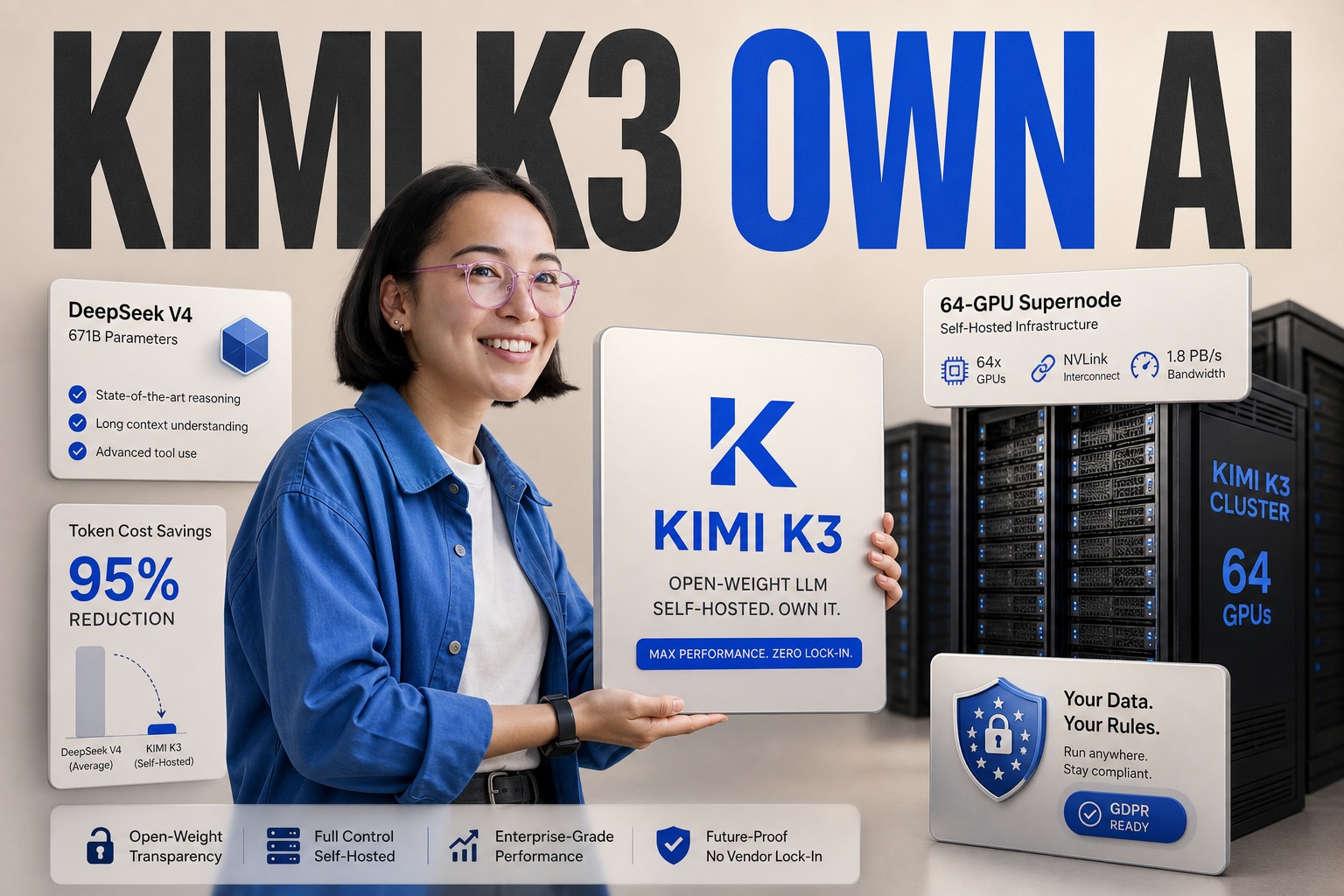
Model Service: Containerised inference pods host the model weights (e.g., 1.4 TB MXFP4 checkpoint for Kimi K3) on a super‑node of 64+ accelerators (NVIDIA H200/H100) as recommended by Moonshot’s technical note lumiere-research.com. Each pod exposes a gRPC endpoint for low‑latency token streaming.
Vector Store & Retrieval: FAISS or Milvus holds embeddings generated by a lightweight encoder (e.g., MiniLM) for fast similarity search; retrieval results flow to the model via a fast‑path HTTP/2 channel.
Cache Layer: Redis or DynamoDB Accelerator caches recent query embeddings and model responses, reducing repetitive token consumption by up to 30 %.
Persistence & Audit: PostgreSQL stores request metadata; immutable logs are shipped to an ELK stack for compliance tracking.
Event Bus: Kafka streams user intents and model‑generated actions to downstream services (CRM, ERP) using idempotent consumer groups with exactly‑once semantics.
Data flow example: a sales rep invokes a “price‑quote” assistant via a GraphQL mutation. The gateway validates the JWT, forwards the request to the orchestration service, which triggers a LangChain RAG chain. The chain pulls relevant contract clauses from the vector store, passes them to Kimi K3 for generation, and streams the answer back through the gateway to the UI. All while audit logs capture prompt‑response pairs for regulatory review.
4 months
Average capability lag of open‑weight models behind frontier closed models as of July 2026, per Epoch AI’s ECI gap analysis.
The real cost advantage of open‑weight models emerges only when you factor in data‑sovereignty and fine‑tuning flexibility, not just per‑token price.
Business impact & measurable ROI
Token‑cost reduction: DeepSeek V4 Pro’s $0.87 / M output tokens vs. $15 / M for Kimi K3 yields up to 94 % savings for high‑volume chat or coding workloads. At 5 M output tokens/day, annual spend drops from ~$5.5 M (closed‑model) to <$300 k (open‑weight) – a 95 % OPEX cut.
Break‑even threshold: Studies show self‑hosting becomes cheaper than closed‑API pricing at 2‑5 M tokens per day when accounting for hardware amortisation (≈$150 k for a 64‑GPU supernode) and operational staff (~$200 k/yr) lumiere-research.com.
Compliance savings: Avoiding third‑party data transfer eliminates GDPR fines (up to 4 % of global revenue) and reduces audit effort by an estimated 30 %.
Time‑to‑value: Fine‑tuning on proprietary datasets can be completed in 48 hours using LoRA adapters, cutting model adaptation cycles from months (closed‑model black‑box) to weeks.
Scalability: Horizontal scaling via Kubernetes auto‑scalers maintains sub‑200 ms latency at 10 k RPS, while built‑in circuit‑breakers prevent cascade failures under load spikes.
When the per‑token price gap is small, the decisive factor becomes the total cost of ownership—including GPU racks, engineering time, and governance.
Implementation strategy
Run a feasibility pilot on a 2‑node GPU cluster (8 × H200) using the open‑source LLM checkpoint for Kimi K3.
Instrument the pilot with end‑to‑end tracing (OpenTelemetry) and cost‑monitoring (Prometheus + Grafana) to capture actual token usage.
Validate data residency by running all retrieval against an on‑prem vector store.
Iterate on LoRA fine‑tuning with domain‑specific documents; freeze the base model to keep upgrade path clean.
Scale to a supernode configuration (64 + accelerators) once daily token volume exceeds the 2‑5 M break‑even point.
Establish governance: OAuth2 scopes per business unit, immutable audit logs, and periodic model‑behavior reviews.
Common pitfalls
Under‑estimating GPU memory; MXFP4 weights for Kimi K3 require ~1.4 TB VRAM, so insufficient hardware leads to OOM crashes.
Assuming 100 % GPU utilisation; real‑world loads often sit at 20‑30 % resulting in a 5‑10× cost inflation per token lumiere-research.com.
Neglecting caching of embeddings; without it, retrieval overhead can double token consumption.
Skipping security hardening of the inference endpoint; exposure can lead to model‑exfiltration attacks.
AI AUTOMATION
Ready to own your LLM stack?
Let Plavno design, deploy, and manage a self‑hosted open‑weight solution that meets your compliance and cost goals.
Plavno combines deep systems engineering with AI‑first product design. Our teams have built large‑scale RAG pipelines for financial services, integrated autonomous agents for telecom operations, and hardened inference clusters to meet ISO 27001. By leveraging open‑source LLMs, we give you:
Full control over model weights (Kimi K3, DeepSeek V4) – no vendor‑side policy overrides.
Custom LoRA fine‑tuning pipelines built on LangChain and CrewAI, delivering domain‑specific accuracy within weeks.
Enterprise‑grade deployment templates (Kubernetes Helm charts, Terraform modules) that provision 64‑GPU supernodes on any major cloud or on‑prem datacenter.
Observability stack (OpenTelemetry, Loki, Grafana) that surfaces token‑level cost, latency, and compliance metrics.
Governance frameworks (OAuth2, OPA policies, immutable audit logs) aligned with GDPR, HIPAA, and SOC‑2.
Our proven delivery model means the transition from proof‑of‑concept to production can happen in 4‑6 weeks, dramatically shortening the typical 3‑month vendor lock‑in cycle.
EXAMPLE USE CASE
An enterprise deployed an AI‑powered internal knowledge assistant for policies and documentation to centralize enterprise knowledge access and cut repetitive support requests. After integrating Plavno's solution, the team achieved 60% faster internal information retrieval and a 40% reduction in HR support tickets.
Open‑weight AI models enterprise have matured from niche research artifacts to mainstream, cost‑competitive alternatives. With Kimi K3 delivering top‑tier capability and DeepSeek V4 offering ultra‑low token pricing, the former four‑month capability gap has shrunk to a narrow, manageable margin. When token volume crosses the 2‑5 million‑per‑day threshold, the total cost of ownership—hardware, engineering, and compliance—favors self‑hosting, delivering both financial savings and strategic control. Partnering with Plavno gives you the engineering rigor, governance framework, and rapid delivery needed to seize this opportunity now.
Share this post
Contact Us
This is what will happen, after you submit form
Plavno experts contact you within 24h
Discuss your project details
We can sign NDA for complete secrecy
Submit a comprehensive project proposal with estimates, timelines, team composition, etc
Need a custom consultation? Ask me!
Plavno has a team of experts ready to start your project. Ask us!