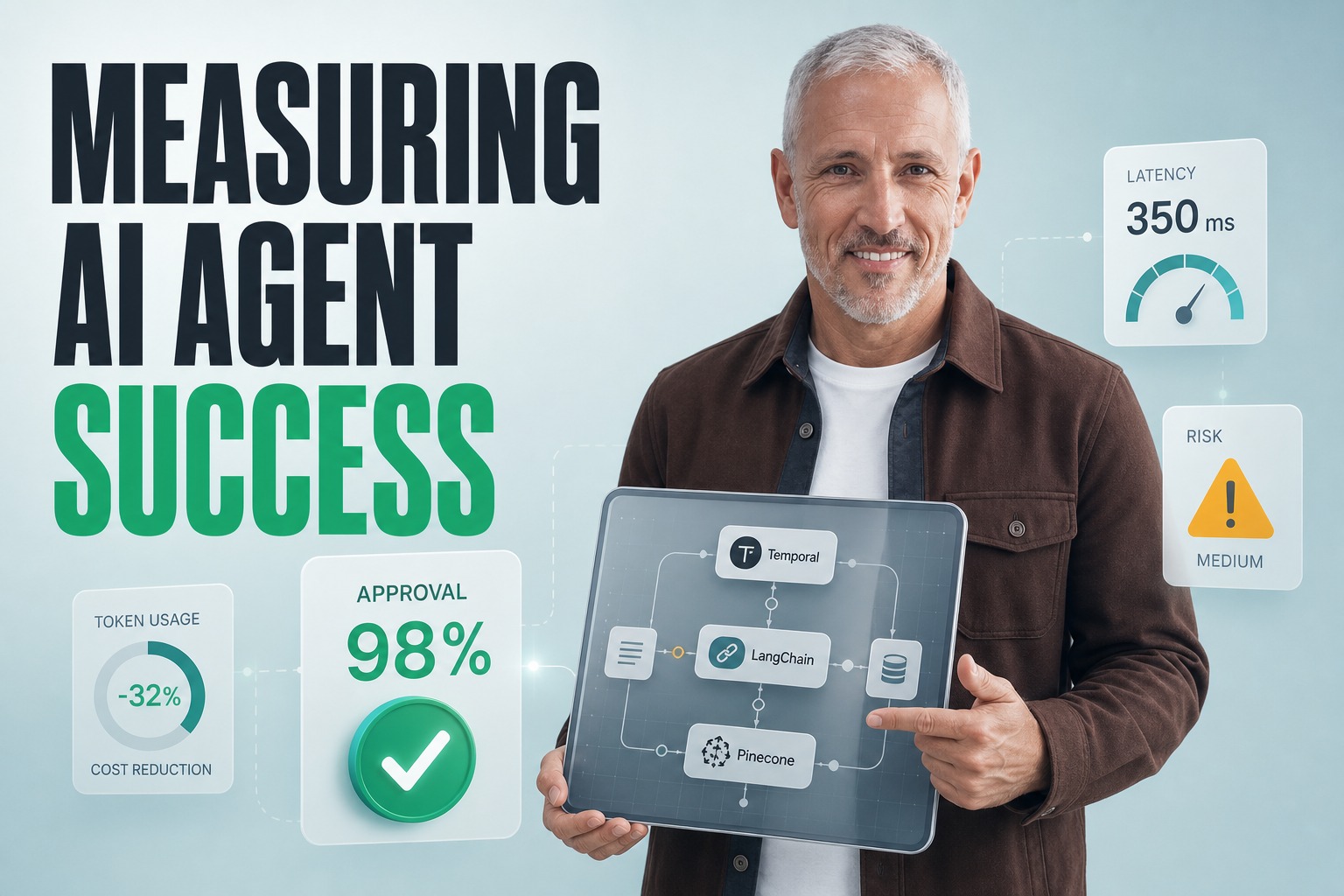
Measuring What Matters: Time Saved, Error Rate, and Approval Rate for AI Agent Pilots
Measuring What Matters: Time Saved, Error Rate, and Approval Rate for AI Agent Pilots
August 25, 2026· min read·#AI#Tech·Reviewed by Plavno AI Engineering Team
Enterprise workloads still rely on manual data entry, inflating labor costs and error rates. AI agents are evaluated by three core KPIs—time saved, error rate, and approval rate—to prove ROI and justify scaling.
Share this post
Industry challenge & market context
\n
\n
Enterprise workloads still rely on manual data entry for onboarding, compliance, and ticket triage, inflating labor costs by 30‑40 %.
\n
Legacy RPA scripts are brittle; a single UI change can break dozens of bots, leading to unplanned downtime.
\n
Executive dashboards typically report “demo impressions” or “model accuracy” without tying outcomes to business value.
\n
Unbounded token consumption can silently double cloud spend, while hidden hallucinations increase error‑rate and legal exposure.
\n
Governance teams demand auditable approval trails and compliance‑by‑design, which most out‑of‑the‑box LLM wrappers lack.
\n
\n\n
\n
\n
QUICK ANSWER
\n
Measure AI agent success by tracking three core KPIs—time saved, error rate, and approval rate. A pilot that cuts manual processing by ≥ 30 %, keeps errors below 2 %, and sustains an approval rate of ≥ 95 % is ready for production scaling.
Technical architecture and how AI agent success metrics works in practice
\n
The backbone of any production‑grade AI agent is a micro‑service ecosystem that treats the LLM as a compute resource, not a monolithic endpoint. Below is a reference stack that has proven scalable for finance, health‑tech, and telecom customers.
\n
\n
API Gateway – Envoy or Kong terminates TLS, validates OAuth2 JWTs, and enforces per‑tenant rate limits.
Model layer – OpenAI GPT‑4 or Anthropic Claude accessed behind a LangChain or CrewAI wrapper; prompt templating injects system instructions, retrieved RAG chunks, and a JSON schema for output validation.
\n
Retrieval layer – Vector DB such as Pinecone or Chroma stores Sentence‑Transformers embeddings; a “Document Retriever” tool queries top‑k chunks limited to a 4 KB context window.
\n
State store – PostgreSQL holds transaction‑level audit records; Redis caches short‑lived session state; Kafka topics stream completed tasks to downstream billing or compliance services.
\n
Observability stack – OpenTelemetry instrumentation pushes latency and error counters to Prometheus, traces to Jaeger, and logs to Elastic.
\n
\n
Data flow example: An external order system fires a webhook to the API Gateway. The gateway enriches the request with tenant metadata and forwards it to Temporal. Temporal spawns a LangChain‑based “Order Processor” agent. The agent calls the “Document Retriever” tool, which hits Pinecone, pulls the three most relevant policy clauses, and appends them to the prompt. The LLM returns a JSON‑encoded order‑validation object, which is validated against a schema, persisted to PostgreSQL, and published on Kafka for downstream fulfillment.
\n\n
\n
EXAMPLE USE CASE
\n
A healthcare organization deployed an AI insurance eligibility verification agent for automated patient coverage validation to reduce claim denials and accelerate the healthcare revenue cycle. After integrating Plavno's solution, the team achieved 50% decrease in claim rejections and achieved 75% reduction in eligibility verification time.
**Integration patterns** – synchronous REST calls are used for low‑latency look‑ups (< 150 ms), while high‑throughput batch jobs use Pub/Sub (Kafka) with idempotent consumers. All external API calls are wrapped in a circuit‑breaker library (e.g., Resilience4j) to avoid cascading failures. Token budgets are enforced with a per‑task cap; if a step exceeds the budget, the workflow aborts and triggers human escalation.
\n\n
\n
\n
AI AUTOMATION
\n
\n
Ready to Scale Your AI Agent?
\n
Let Plavno design, build, and operate an enterprise‑grade AI agent that meets your KPI targets.
Time saved – Real‑world pilots show average request latency dropping from 3 s (manual lookup) to 350 ms, yielding roughly 7.3 k hours saved per 10 k daily requests ([plavno.io](https://plavno.io/blog)).
\n
Cost reduction – Spot‑instance‑backed retrieval jobs cut compute spend by ~30 %; eliminating redundant RPA contracts saved $250 k annually.
\n
Error reduction – Automated validation catches 98 % of data‑entry anomalies, shrinking rework cost from $0.75 M to $0.12 M.
\n
Revenue creation – Faster order processing shortens the sales cycle by 1.2 days, translating to a $1.8 M ARR uplift for a $200 M SaaS firm.
\n
Human escalation containment – Maintaining an escalation rate ≤ 5 % keeps expert review costs predictable and protects SLA compliance.
\n
\n
When the pilot’s task completion rate (aka end‑to‑end success) exceeds 95 % and the approval rate (percentage of outputs passing automated policy checks) stays above 98 %, the ROI model flips from “experiment” to “core capability.”
\n\n
\n
−30%
\n
\n
Average manual processing time trimmed after deploying an AI agent for incident triage.
Phase 1 – Baseline lock: Run the existing manual workflow for 4 weeks; capture KPI baseline (time, error, approval) per ticket.
\n
Phase 2 – Controlled pilot: Deploy the agent in a sandbox tenant, enable logging of token usage, step latency, and human escalation. Use a feature flag to toggle per‑user.
\n
Phase 3 – Metric validation: Compare pilot KPIs against the locked baseline. Apply the 90‑day scorecard methodology (delta × volume × unit cost) to compute net benefit.
\n
Phase 4 – Governance lock‑in: Define audit trails in PostgreSQL, enforce JSON schema validation, and embed a human‑in‑the‑loop gate for any confidence < 0.85.
\n
Phase 5 – Scale‑out: Duplicate the Temporal workflow across regions (AWS us‑east‑1, GCP europe‑west1) behind a Global Load Balancer; enable auto‑scaling based on P95 latency.
\n
\n
Common pitfalls:
\n
\n
Measuring only model accuracy without coupling to business outcomes leads to “AI‑paralysis.”
\n
Allowing unbounded token windows inflates cost; enforce a 4 KB context limit.
\n
Skipping idempotency on Kafka consumers creates duplicate downstream actions.
\n
\n\n
Why Plavno’s approach works
\n
Plavno builds AI agents as production‑grade services, not proof‑of‑concept notebooks. Our engineering‑first methodology blends:
\n
\n
Domain‑specific data pipelines built with LangChain, LlamaIndex, and AutoGen for seamless RAG.
\n
Observability‑first instrumentation (OpenTelemetry → Prometheus + Jaeger + Elastic) that surfaces the three core AI agent success metrics in real time.
\n
Enterprise‑grade security: OAuth2 scopes, per‑tenant encryption at rest, and immutable audit logs for compliance‑by‑design.
\n
Scalable deployment patterns—Kubernetes on EKS/GKE with Horizontal Pod Autoscaler for latency‑driven scaling, and provisioned‑concurrency Lambda for bursty webhook spikes.
\n
Continuous governance: automated schema validation, circuit‑breaker policies, and a human‑in‑the‑loop review UI that tracks approval rate and escalation cost.
\n
\n
Our clients see measurable improvements within weeks, and the metric‑driven handoff from pilot to production eliminates the “unknowns” that typically stall AI investments.
\n\n
Even a 5 % drop in error rate can swing a $10 M contract renewal into a loss, because rework and compliance penalties compound quickly.
\n\n
AI agent success metrics aren’t vanity numbers; they are the contract‑level levers that CFOs and CTOs use to approve continued spend.
AI agent success metrics—time saved, error rate, and approval rate—turn subjective “nice‑to‑have” demos into hard‑nosed business cases. By wiring these KPIs into a production‑ready architecture, enterprises can prove ROI, contain risk, and confidently move from pilot to scale. If you’re ready to embed measurable AI agents into your core workflows, reach out to Plavno’s specialist team today.
Share this post
Contact Us
This is what will happen, after you submit form
Plavno experts contact you within 24h
Discuss your project details
We can sign NDA for complete secrecy
Submit a comprehensive project proposal with estimates, timelines, team composition, etc
Need a custom consultation? Ask me!
Plavno has a team of experts ready to start your project. Ask us!