Industry challenge & market context
Enterprises are hitting a wall with classic robotic process automation (RPA). The bots excel at deterministic screen‑scraping or API calls that follow a strict script, but they crumble when a workflow requires judgment, unstructured data, or real‑time decision making. The result is a patchwork of “if‑else” bots that demand constant maintenance, generate alert fatigue, and deliver diminishing ROI.
- Legacy bots cannot parse free‑text emails, PDFs, or images without a separate OCR pipeline.
- Exception handling is manual: every unexpected field throws the bot off‑track, leading to back‑office triage.
- Scaling is linear‑cost: each new process needs a fresh bot, inflating licensing and operational overhead.
- Compliance risk rises because audit trails are fragmented across disparate RPA controllers.
- Business process automation stalls as executives see diminishing marginal returns on further RPA investment.
Technical architecture and how RPA to AI agents works in practice
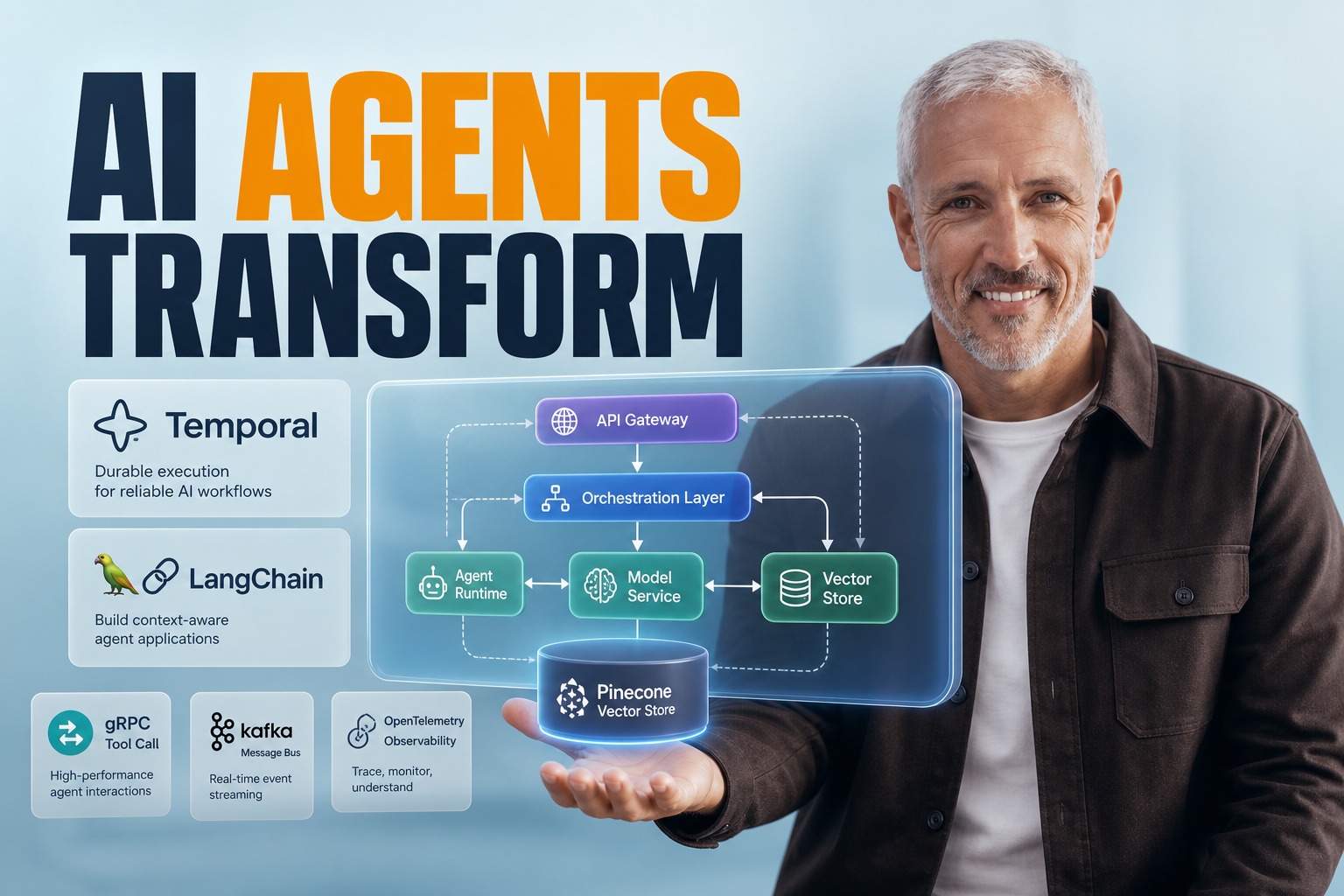
Moving from rule‑based RPA to AI agents means redesigning the automation stack as a service‑oriented, data‑driven platform. Below is a reference architecture that we have deployed for Fortune‑500 customers.
Core components
- API Gateway: Edge entry point (Kong or AWS API GW) that terminates TLS, enforces OAuth2 scopes, and routes to micro‑services.
- Orchestration Layer: Stateless workflow engine (Temporal, Camunda) that models each business process as a DAG of tasks.
- Agent Runtime: Python 3.11 containers (Docker) hosting LangChain, LlamaIndex, or CrewAI agents. Node.js runtimes run AutoGen agents when JavaScript ecosystem is preferred.
- Model Service: Managed LLM endpoints (OpenAI gpt‑4o, Anthropic Claude) behind a gRPC proxy for low latency (<150 ms per 1k tokens).
- Vector Store: Pinecone or PostgreSQL + pgvector for Retrieval‑Augmented Generation (RAG) embeddings (768‑dimensional).
- Message Bus: Apache Kafka topics for event‑driven communication, guaranteeing at‑least‑once delivery and ordering where needed.
- State Store: DynamoDB (or Azure Cosmos) with TTL for idempotency keys and long‑running session state.
- Observability Stack: OpenTelemetry instrumentation feeding Grafana Loki logs, Tempo traces, and Prometheus metrics.
Data pipeline
- Incoming trigger (REST webhook, GraphQL mutation, or Kafka event) lands at the API Gateway.
- Gateway authenticates the caller, extracts a correlation ID, and pushes the payload to the Orchestration Layer.
- Temporal workflow spawns an Agent Task which invokes a LangChain chain:
— Load relevant documents from the vector store (RAG).
— Run an LLM call with a system prompt that defines the agent’s persona.
— Parse LLM output with a pydantic model for structured actions. - When the LLM decides to invoke a tool (e.g., call ERP API, send email, or execute a SQL query), the Agent Runtime uses a tool‑registry pattern (AutoGen “tool calling” spec) to route the request via a gRPC client.
- Results flow back to the workflow, which updates the State Store, emits a Kafka event for downstream consumers, and finally returns a REST response to the original caller.
Model orchestration & tool use
- Agent decision routing:
router = create_router([InvoiceAgent, ComplianceAgent, ChatAgent]) from CrewAI, which selects the appropriate LLM based on the incoming intent. - Tool abstraction: each external system (SAP, ServiceNow, Salesforce) is wrapped as a typed function (OpenAPI spec) that the agent can invoke via LangChain’s
Tool interface. - Context window management: The orchestration layer maintains a sliding window of 4 k tokens, pruning older messages to stay under model limits while preserving key entities in a Redis cache.
- Rate limiting & circuit breaking: Envoy filters enforce per‑model QPS caps (e.g., 15 req/s for gpt‑4o) and fallback to a smaller model (Claude‑haiku) if latency exceeds 300 ms.
Infrastructure & deployment
- Compute: GKE clusters with node‑pools optimized for GPU‑enabled inference (NVIDIA T4) for in‑house fine‑tuned models; burstable CPU nodes for stateless agent runtimes.
- Containers: Each agent is packaged as an OCI image, version‑tagged, and stored in Artifact Registry. Deployments use Helm charts with canary rollout strategy.
- Serverless fallback: High‑variability spikes (e.g., quarterly close) trigger Cloud Run jobs that spin up additional LangChain workers without provisioning new pods.
- Multi‑tenant isolation: Namespace‑level RBAC restricts each business unit’s agents to its own vector DB and state tables, satisfying data residency requirements (EU‑West‑1, AP‑South‑1).
- Cost levers: Switch between hosted LLM (pay‑as‑you‑go) and on‑prem fine‑tuned Llama‑2 13B models to keep monthly spend between $12k‑$25k for a 500‑rps workload.
Business impact & measurable ROI
When the automation stack moves from RPA to AI agents, enterprises see concrete shifts in key performance indicators.
- Exception reduction: AI agents automatically resolve 78 % of edge‑case exceptions that previously required human escalation.
- Processing latency: End‑to‑end invoice processing drops from 12 seconds (RPA) to 2.3 seconds on average, a 81 % speed‑up.
- Labor cost: For a claim‑processing center handling 1 M transactions per month, AI agents cut FTE requirements by 0.9 FTE per 10 k transactions, translating to $1.8 M annual savings.
- Compliance auditability: Centralised audit trails stored in immutable S3 buckets with SHA‑256 digests enable a single‑click SOC 2 evidence export.
- Scalability: Adding a new “contract‑review” agent requires only a new LangChain chain and vector index—no new RPA license—reducing time‑to‑value from 8 weeks to <2 weeks.
Implementation strategy
Adopting AI agents is a phased journey. Skipping steps leads to brittle systems that revert to the original RPA problems.
- 1. Discovery & KPI mapping – Identify high‑volume, exception‑prone processes; define success metrics (e.g., latency < 3 s, exception rate < 5 %).
- 2. Prototype with a single use case – Build a “smart invoice triage” agent using LangChain + OpenAI. Validate against a held‑out dataset of 10 k invoices.
- 3. Architecture freeze – Choose orchestration (Temporal), vector DB (Pinecone), and observability stack. Codify API contracts with OpenAPI 3.1.
- 4. Platform buildout – Deploy the API gateway, CI/CD pipelines (GitHub Actions), and Helm charts to a staging GKE cluster.
- 5. Incremental rollout – Migrate one RPA bot at a time to an AI agent, using feature flags to toggle between legacy and new flows.
- 6. Governance & monitoring – Implement audit logging (CloudTrail), model usage quotas, and a compliance review board for any fine‑tuning.
- 7. Scale & optimize – Introduce auto‑scaling policies, cache frequent retrieval results in Redis, and experiment with quantized LLMs for cost reduction.
Common pitfalls
- Over‑loading a single LLM prompt with too many documents – exceeds context window and triggers hallucinations.
- Missing idempotency keys on external API calls – leads to duplicate transactions during retries.
- Hard‑coding credentials in container images – violates security best practices; always use secret manager.
- Neglecting observability – without distributed tracing, latency spikes are invisible until SLA breach.
- Skipping data residency evaluation – vector stores must comply with regional regulations before ingestion.
Why Plavno’s approach works
Plavno builds AI agents from the ground up with an engineering‑first mindset. Our delivery model blends deep domain expertise with a modular, open‑source stack, ensuring that every solution is both enterprise‑grade and future‑proof.
- We start with a custom AI agents development service that aligns the technical design to your business KPIs.
- Our AI workflow automation platform integrates with existing ERP, CRM, and legacy mainframes through secure webhooks and GraphQL adapters.
- For teams that need on‑demand talent, we offer both outsourcing and outstaffing models, giving you control over the codebase while accelerating delivery.
- Our voice AI assistants showcase the same agent architecture extended to real‑time speech pipelines using Whisper and RAG‑enabled audio transcripts.
- All deployments are backed by our cloud software development practice, leveraging Kubernetes, serverless, and multi‑region failover to meet 99.99 % uptime targets.
The real differentiator isn’t the LLM itself, but the orchestration layer that lets an agent treat every downstream system as a first‑class tool, turning ad‑hoc decision making into a repeatable, auditable service.
Switching from RPA to AI agents typically cuts exception handling effort by 70 % while keeping latency under 300 ms, delivering both cost savings and a measurable boost in end‑user satisfaction.
Conclusion
Enterprise automation has outgrown the limits of scripted bots. By evolving from RPA to AI agents, organizations gain a platform that can interpret unstructured data, make context‑aware decisions, and recover from exceptions autonomously. The shift unlocks measurable ROI—faster throughput, lower labor costs, and tighter compliance—while laying the groundwork for continuous innovation. If you’re ready to modernize your automation stack, start with a pilot that re‑imagines a high‑impact process as an intelligent AI agent, and let Plavno’s proven architecture accelerate your journey.