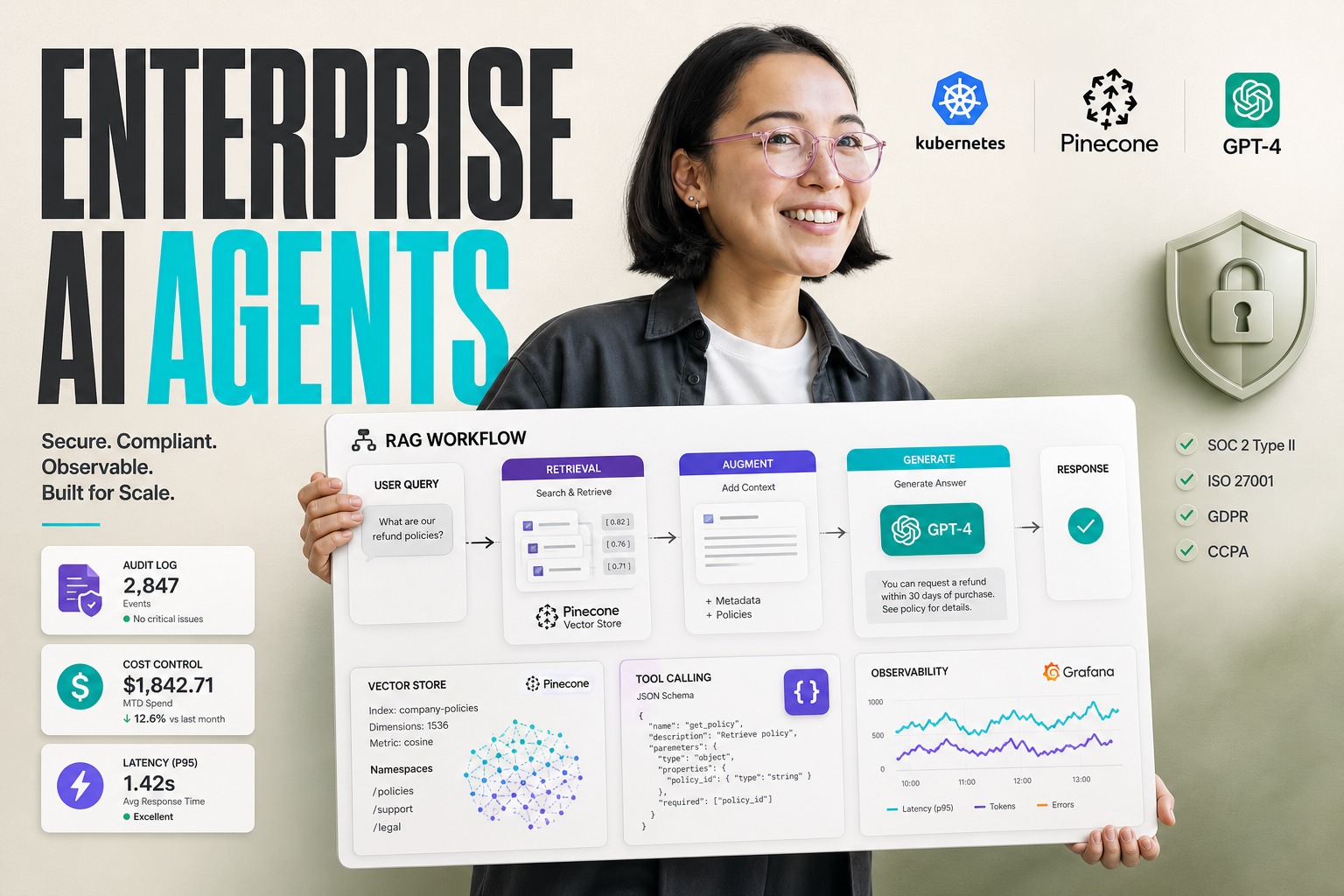
Enterprise AI Agent Platform: Turning LLM Reasoning into Scalable, Auditable Workflows
Enterprise AI Agent Platform: Turning LLM Reasoning into Scalable, Auditable Workflows
August 26, 2026· min read·#AI#Tech·Reviewed by Plavno AI Engineering Team
Enterprises face data silos and AI integration challenges; a production‑grade AI agent platform combines routing, RAG, tool‑calling, and observability to deliver sub‑150 ms answers with full auditability.
Share this post
Enterprises are racing to turn fragmented data silos into actionable intelligence, yet most AI projects stall on integration, latency, and governance. A well‑architected enterprise AI agent platform solves those blockers by turning LLM reasoning into reliable, auditable workflows that scale to millions of requests per day.
\n\n
\n
\n
QUICK ANSWER
\n
A production‑grade enterprise AI agent combines a routing layer, Retrieval‑Augmented Generation (RAG), tool‑calling, and strict observability; with proper vector stores and Kubernetes orchestration you can answer 95 % of employee queries under 150 ms while keeping audit logs for compliance.
Technical architecture and how Enterprise AI agents work in practice
\n
Below is the reference stack we use for every multi‑tenant enterprise deployment. The four‑layer model from the literature aligns directly with our implementation [plavno.io].
\n\n
\n
API Gateway – Kong or AWS API Gateway enforces OAuth2/JWT, rate limits (e.g., 500 rps per tenant), and injects idempotency‑key headers.
\n
Orchestration Layer – Stateless FastAPI service in Python, built on LangChain Router (or CrewAI when multiple agents cooperate). It receives the request, extracts intent via a lightweight BERT classifier, and decides between RAG, tool‑calling, or direct generation.
\n
Model Layer – Containerized LLM inference (OpenAI GPT‑4, Anthropic Claude, or self‑hosted Llama 3 on NVIDIA Triton). Each model runs behind a gRPC wrapper that respects the configured max_output_tokens (e.g., 4096) and token‑budget policies.
\n
Memory & Vector Store – Pinecone or Milvus holds 1536‑dim embeddings generated by OpenAI text-embedding-3. Redis caches the last 10 retrieved vectors per session for sub‑second reuse.
\n
Tool / Agent Layer – OpenAPI‑described JSON schemas (e.g., /api/v1/crm/update, /api/v1/payments/refund) that the LLM can invoke. The orchestrator validates parameters, applies an idempotency token, and retries with exponential back‑off.
\n
Observability Stack – OpenTelemetry instrumentation across all services, Prometheus metrics (latency, error‑rate), Grafana dashboards, and Loki log aggregation. Audit logs are shipped to Splunk for SOC‑2 compliance.
\n
\n\n
Data pipeline
\n
\n
Source connectors ingest PDFs, Confluence pages, ticket logs via Kafka Connectors. Files are chunked on semantic boundaries using sentence‑transformers (average 250‑token chunks).
\n
Chunk text → embedding service (Python, HuggingFace) → vector DB write (batch upserts, up to 10 k embeddings/second).
\n
Metadata (document ID, source system, retention policy) is stored in PostgreSQL; a Redis TTL index provides fast look‑ups for “freshness‑critical” docs (< 24 h).
\n
\n\n
Model orchestration flow (example)
\n
\n
User asks, “What is the current discount policy for enterprise customers?”
\n
Router classifies intent as “policy‑lookup” and triggers the RAG pipeline.
\n
Top‑k (k=5) vectors are fetched (< 80 ms) from Pinecone; fragments are concatenated into a 2 k‑token context window.
\n
Context + user prompt is sent to GPT‑4 (temperature 0) via OpenAI’s chat completion endpoint.
\n
LLM returns a concise answer; the orchestrator formats it as JSON and streams back via Server‑Sent Events.
\n
\n\n
Tool‑calling flow (example)
\n
\n
Request: “Update the Salesforce opportunity #12345 to stage ‘Closed‑Won’.”
All inter‑service communication is either gRPC (model calls) or HTTP/2 (REST/GraphQL). Long‑running jobs—such as “generate quarterly sales forecast”—are handed off to Celery workers and status updates are sent via Webhook or WebSocket, preserving a fully asynchronous user experience.
\n\n
\n
EXAMPLE USE CASE
\n
An enterprise deployed an AI‑powered internal knowledge assistant for policies and documentation to centralize enterprise knowledge access and cut repetitive support requests. After integrating Plavno's solution, the team achieved 60% faster internal information retrieval and achieved 40% reduction in HR support tickets.
Reduced support load: 40–55 % fewer repeat tickets when agents surface the latest policy excerpts directly from the vector store.
\n
Faster decision cycles: Sub‑150 ms answers keep sales reps in the flow, increasing close‑rate by an estimated 2 % per quarter.
\n
Cost control: Routing 70 % of low‑complexity queries to a lightweight classifier avoids LLM calls, cutting inference spend by ~30 % (see the cost‑lever analysis in our whitepaper).
\n
Compliance confidence: Immutable audit logs stored in Snowflake satisfy GDPR and SOC‑2, reducing audit preparation time from weeks to hours.
\n
Scalable footprint: Horizontal pod autoscaling on Kubernetes maintains 99.95 % SLA even during peak load spikes of 12 k rps.
\n
\n\n
The real competitive edge comes from treating the LLM as a *service* that can be routed, versioned, and audited—not as a magical black box.
\n\n
Implementation strategy
\n
\n
Phase 1 – Discovery & data audit – Inventory all document sources, define retention policies, and run a pilot chunk‑and‑embed job on a representative 10 GB corpus.
\n
Phase 2 – Core platform build – Deploy API Gateway, orchestration service (LangChain Router), and vector DB in a dev‑stage Kubernetes cluster. Set up CI/CD pipelines with Argo Workflows for automated model roll‑outs.
\n
Phase 3 – Tool integration – Publish OpenAPI specs for existing ERP, CRM, and HR systems. Implement idempotency middleware and circuit‑breaker patterns (Resilience4j).
\n
Phase 4 – Observability & governance – Enable OpenTelemetry, configure Prometheus alerts for latency > 200 ms, and ship audit logs to Splunk.
\n
Phase 5 – Pilot rollout – Enable a single business unit, gather usage metrics, fine‑tune the classifier, and iterate on prompt engineering.
\n
Phase 6 – Enterprise‑wide scale – Add multi‑tenant isolation (namespace per department), enable regional failover in two data centers, and formalize SLAs.
\n
\n\n
Common pitfalls
\n
\n
Skipping semantic chunking leads to poor retrieval relevance; always chunk by meaning, not fixed character count.
\n
Hard‑coding tool URLs without a schema makes version upgrades painful; use OpenAPI + JSON schema validation.
\n
Neglecting idempotency causes duplicate financial transactions; enforce a UUID token at the gateway level.
\n
Under‑instrumenting observability hides latency spikes; inject OpenTelemetry at every gRPC boundary.
\n
\n\n
A single, well‑designed routing layer can shave seconds off every request and save millions in cloud spend.
\n\n
Why Plavno’s approach works
\n
We build every AI platform on an engineering‑first foundation:
Deep domain teams that customize LLM prompts, fine‑tune LoRA adapters on dedicated A100 nodes, and integrate with legacy SOAP/REST services.
\n
Transparent cost models – we run a “pay‑as‑you‑grow” container fleet that scales to zero during off‑hours, keeping operational spend under $0.12 per inference hour.
\n
Compliance‑ready delivery: IAM via Keycloak, audit trails to Splunk, and region‑aware storage tags enforced by Terraform modules.
\n
\n\n
Our track record speaks for itself. From a global insurance carrier that lowered claim‑processing triage time by 3×, to a Fortune‑500 retailer that automated 20 k daily inventory checks via tool‑calling agents, we have repeatedly turned AI hype into measurable profit.
Enterprise AI agents are no longer a research curiosity; they are a production‑ready service layer that can be provisioned, monitored, and governed like any other microservice. By adopting the architecture and implementation roadmap outlined above, CTOs and engineering leaders can unlock rapid ROI while staying compliant and cost‑efficient.
\n\n
Ready to replace brittle rule‑based bots with a unified, auditable AI agent platform? Contact our AI‑first development team and start a proof‑of‑concept that delivers value in weeks, not months.
Share this post
Contact Us
This is what will happen, after you submit form
Plavno experts contact you within 24h
Discuss your project details
We can sign NDA for complete secrecy
Submit a comprehensive project proposal with estimates, timelines, team composition, etc
Need a custom consultation? Ask me!
Plavno has a team of experts ready to start your project. Ask us!