Data Residency and Sovereignty for Enterprise AI Agents Operating in Europe
Data Residency and Sovereignty for Enterprise AI Agents Operating in Europe
August 13, 2026· min read·#AI#Tech·Reviewed by Plavno AI Engineering Team
European enterprises must keep AI agent data within the EU to meet GDPR and the AI Act, avoiding costly cross‑border transfers and latency penalties.
Share this post
European enterprises are racing to ship AI‑driven agents that handle customer queries, internal support, and automated decision‑making, but a single misstep—exposing personal data to a non‑EEA service—can trigger hefty GDPR fines and stall product launches. The new EU AI Act and stricter data‑sovereignty expectations make “AI data residency Europe” not a nice‑to‑have attribute but a hard requirement for any production‑grade agent.
Industry challenge & market context
Legacy monolithic AI stacks route every LLM request to US‑based endpoints, violating GDPR Article 12 audit‑log mandates.
Hybrid cloud deployments often store embeddings in US‑region vector stores, creating hidden cross‑border transfers.
Vendor DPAs list “EU” in the headline but omit sub‑processor locations, leading to non‑compliant data paths.
Failure to segment logs and observability data by jurisdiction creates a single point of regulatory exposure.
Latency spikes of 30‑150 ms when calls cross continents add hidden cost to real‑time voice agents.
QUICK ANSWER
AI data residency Europe means that every piece of personal data—raw inputs, embeddings, logs, and model outputs—must be stored, processed, and observed within an EU or EFTA jurisdiction. Compliance is achieved by routing LLM calls to EU‑hosted endpoints, hosting vector databases on EU data centers, and keeping audit trails on sovereign cloud services.
Technical architecture and how AI data residency Europe works in practice
Below is a reference stack that satisfies the EU AI Act, GDPR, and typical enterprise SLAs. All data‑paths stay within the EEA, and every third‑party contract explicitly lists the region.
API gateway – Azure API Management (EU Central) with mutual TLS and OAuth2 token introspection.
Orchestration layer – Kubernetes cluster (AKS) in France Central, running the cloud software development runtime. Helm charts deploy langchain and llamaindex services as side‑cars.
Agent executor – Python 3.11 containers hosting AI agents built with LangChain, CrewAI, or AutoGen. Each executor runs inside a dedicated namespace to enforce tenancy isolation.
Model layer – EU‑resident LLM endpoints: Azure OpenAI (Germany West Central), Anthropic EU, Mistral (France). Calls are made over HTTPS; the request header includes a X-Region tag for audit.
Embedding service – On‑premise or EU‑hosted inference (e.g., HuggingFace text‑embedding‑inference) that writes vector representations to a regional vector store such as Qdrant in Sweden Central or Pinecone EU.
Vector database – Stores embeddings, document chunks, and metadata. All shards reside in the same region as the orchestrator; replica failover stays within the EU (logitelia.com).
Cache layer – Redis Enterprise in EU (Azure Cache for Redis, West Europe) for session state and token‑budget tracking.
Message bus – Apache Kafka (Confluent Cloud EU) for async tool‑call events, guaranteeing at‑least‑once delivery with idempotent consumer logic.
Audit & observability – Elastic Stack deployed in EU, with immutable log indices signed by a SHA‑256 chain. Azure Monitor is configured to route all metrics to the same EU region.
Data‑loss prevention – Pre‑router PII detector (spaCy + custom regex) that redacts personal identifiers before the prompt hits the LLM. The redaction layer logs the original token hash for later re‑injection after model response.
Data flow diagram (simplified):
User request → API gateway (TLS) → Orchestrator (K8s)
Orchestrator invokes AgentExecutor (LangChain)
Agent decides: search knowledge base → calls embedding service → writes vectors to EU‑hosted vector DB
Agent builds prompt, passes through PII redactor → EU LLM endpoint → receives response
Response is post‑processed, original PII tokens re‑injected, then sent back through gateway.
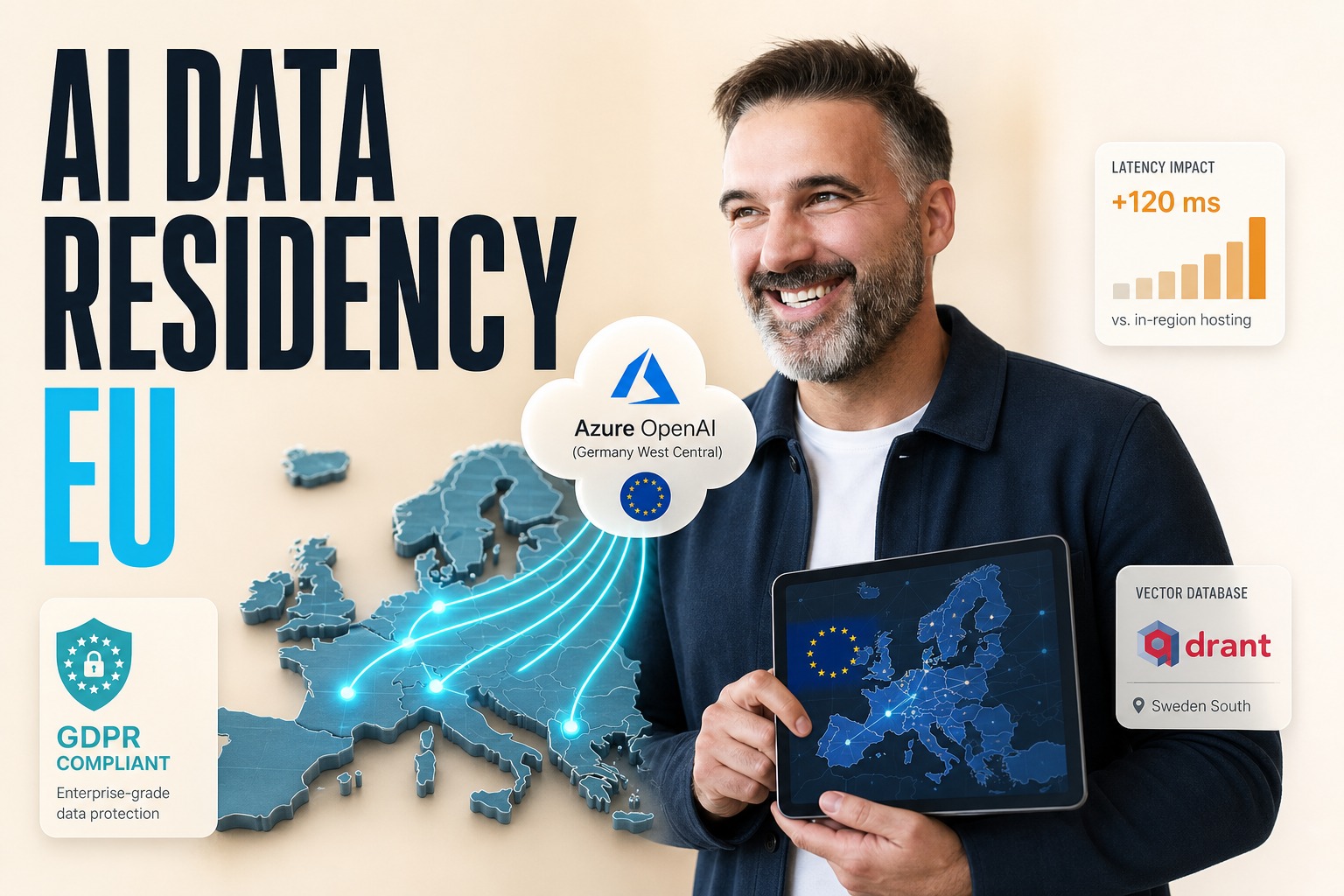
+120 ms
Average added latency when a cross‑region LLM call is forced, compared with an in‑region endpoint.
Because inference latency for typical RAG pipelines is dominated by model size (2‑4 seconds) rather than network hops, the 30‑150 ms cross‑region penalty is usually invisible to end users, but it becomes critical for sub‑second voice assistants (agent-works.ai).
EXAMPLE USE CASE
An enterprise deployed an AI‑powered internal knowledge assistant for policies and documentation to centralize enterprise knowledge access and cut repetitive support requests. After integrating Plavno's solution, the team achieved 60% faster internal information retrieval and achieved 40% reduction in HR support tickets.
Regulatory risk reduction – Zero‑cross‑border transfers eliminate potential GDPR fines (up to 4 % of annual turnover) and simplify EU AI Act documentation.
Operational cost control – EU‑resident LLMs cost ~10‑15 % more per 1 M tokens than US counterparts, but avoiding data‑transfer fees and legal remediation yields a net‑benefit of 2‑3 × on average (gravity.fast).
Latency compliance – Keeping the entire call‑stack in the same region keeps end‑to‑end latency under 2 s for 95 % of requests, meeting SLA thresholds for real‑time voice assistants.
Scalable governance – Immutable audit logs stored on a sovereign cloud enable on‑demand compliance exports, cutting audit preparation time from weeks to hours.
Vendor lock‑in mitigation – Explicit DPA region clauses and sub‑processor lists let enterprises swap model providers (e.g., from Anthropic US to Mistral EU) without architectural rewrites.
Most compliance failures aren’t about the model itself; they stem from hidden data paths in logging, caching, or vector stores that silently cross borders.
Implementation strategy
1. Assess data taxonomy – Classify inputs, embeddings, and logs; label each as personal or non‑personal.
2. Choose sovereign providers – Select EU endpoints for LLMs (Azure OpenAI Germany, Anthropic EU) and EU‑hosted vector stores.
3. Deploy a region‑locked Kubernetes cluster – Use Azure Policy to enforce node pools in a single EU region.
4. Integrate PII redaction – Insert a preprocessing micro‑service that masks identifiers before model calls.
5. Instrument immutable audit trails – Enable Elastic index sealing and forward logs to an EU‑only SIEM.
6. Run a compliance pilot – Execute a limited‑scope RAG agent for internal HR queries; validate that every HTTP request lands on an EU IP (use curl -v with --resolve).
7. Scale & monitor – Add horizontal pod autoscaling, set circuit‑breaker thresholds (e.g., 5 xx errors → fallback to cached answers).
8. Governance hand‑off – Provide the DPO with a “region matrix” document that lists every vendor, endpoint, and storage location.
Common pitfalls:
Storing embeddings in a default US‑region vector DB while the rest of the stack is EU‑hosted.
Relying on vendor‑provided observability stacks that ship logs to a global region (Azure Monitor’s abuse‑monitoring service).
Assuming “EU” in a DPA covers sub‑processors; always request a sub‑processor list with explicit region tags.
Why Plavno’s approach works
Plavno combines an engineering‑first methodology with enterprise‑grade contracts. We:
Build agents on proven frameworks (LangChain, CrewAI, AutoGen) while keeping every dependency locked to EU‑hosted versions.
Provide a turnkey sovereign‑cloud pipeline—Kubernetes in Azure EU, Qdrant in Sweden, Elastic in Germany—backed by a comprehensive DPA that names each region.
Deliver end‑to‑end auditability: every prompt, tool call, and vector write is logged in an immutable EU log sink, satisfying Article 12 of the EU AI Act.
Offer flexible delivery models (outsourcing, outstaffing, product‑development) that let you scale teams without compromising residency (services).
Leverage our proven AI‑agent use cases (knowledge assistants, voice banking, legal‑tech) to accelerate time‑to‑value while staying compliant.
A single‑region, EEA‑resident architecture eliminates the need for complex transfer mechanisms and becomes a “compliance‑by‑design” baseline for any high‑risk AI system.
AI data residency Europe is no longer an optional checkbox; it determines whether an enterprise AI agent can be deployed at scale, stay within GDPR and the EU AI Act, and meet performance expectations. By anchoring the entire stack—model endpoints, vector stores, logs, and observability—in sovereign cloud zones, organizations eliminate legal exposure, reduce latency, and retain full control over audit data. Plavno’s proven, region‑locked architecture turns these compliance mandates into a competitive advantage, delivering faster, safer AI agents that respect data sovereignty while driving measurable ROI.
Share this post
Contact Us
This is what will happen, after you submit form
Plavno experts contact you within 24h
Discuss your project details
We can sign NDA for complete secrecy
Submit a comprehensive project proposal with estimates, timelines, team composition, etc
Need a custom consultation? Ask me!
Plavno has a team of experts ready to start your project. Ask us!