Benchmarks Lie: How to Evaluate LLMs on Your Own Business Tasks Instead of Leaderboards
Benchmarks Lie: How to Evaluate LLMs on Your Own Business Tasks Instead of Leaderboards
August 18, 2026· min read·#AI#Tech·Reviewed by Plavno AI Engineering Team
Enterprises should evaluate LLMs on real business tasks, focusing on quality, latency, and cost rather than public leaderboard scores.
Share this post
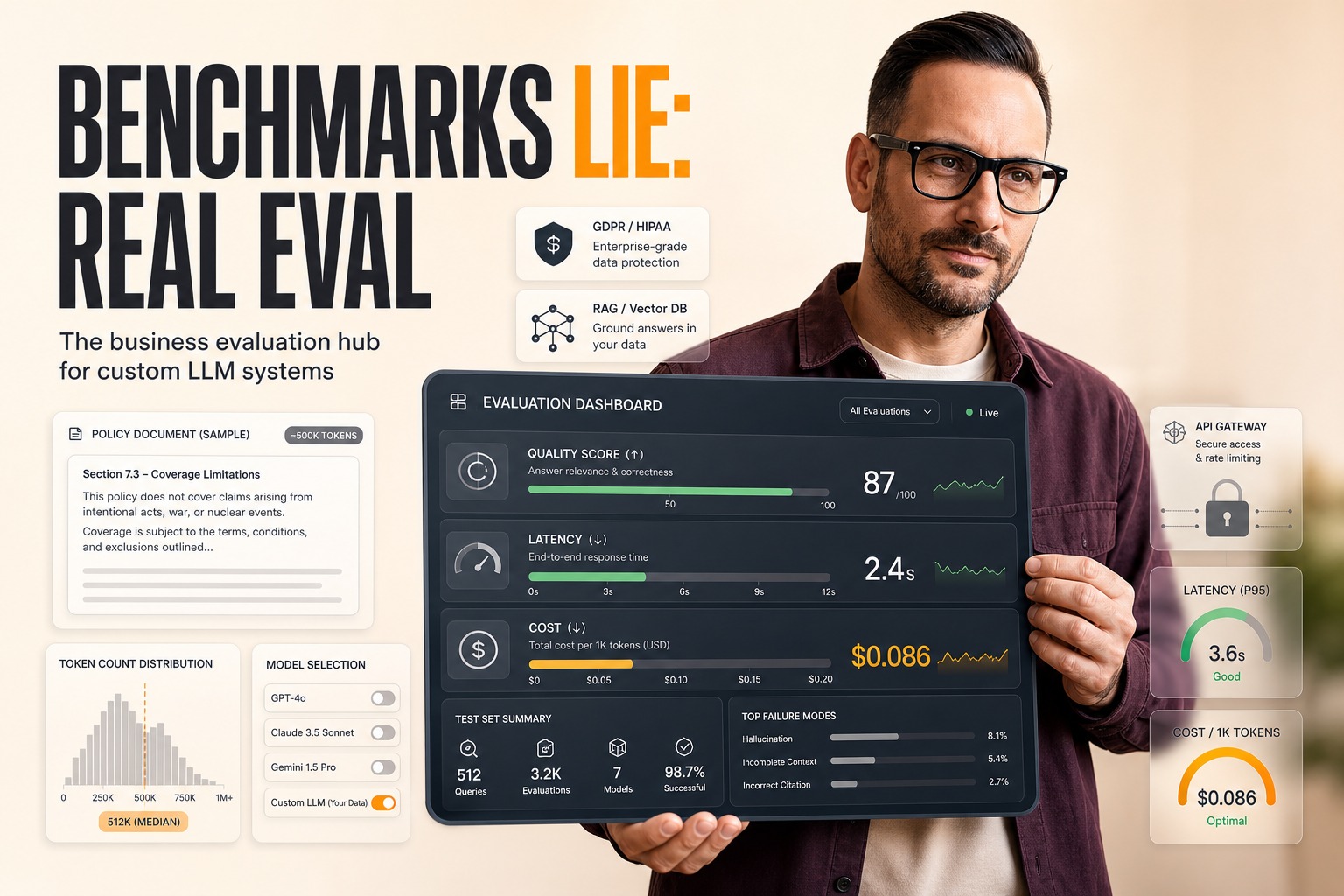
Enterprises are chasing headline scores from MMLU, HumanEval, or SWE‑bench, only to discover that the model that tops the leaderboard stalls when fed a half‑million‑token policy document or a proprietary SDK. The gap isn’t a fluke—it’s the result of clean benchmark data, static test sets, and a lack of business‑centric metrics. To get real value, you must replace leaderboard bragging with “LLM evaluation for business” that measures quality, latency, and cost on your own workloads.
QUICK ANSWER
Benchmarks lie because they test tidy, generic tasks; a proper LLM evaluation for business uses a 50‑200‑example eval dataset drawn from production, scores outputs on multiple quality criteria, and balances latency and cost to find the Pareto‑optimal model for your workflow.
Public benchmarks use curated, error‑free datasets that ignore enterprise document formats (PDF, XML, proprietary APIs).
Latency caps on leaderboards (e.g., 2 s P95) hide real‑world queuing, network hops, and vector‑search warm‑up times that push end‑to‑end latency to 5‑8 s.
Cost models on leaderboards ignore token‑bloat from retrieval‑augmented generation (RAG) and multi‑turn tool use, leading to 3‑5× higher spend in production.
Regulatory compliance (GDPR, HIPAA) is never part of a benchmark score, yet it drives architecture decisions for every enterprise.
Model updates happen daily; a leaderboard snapshot quickly becomes stale, causing drift between expected and observed performance.
AI AUTOMATION
Ready to test your own LLM?
Let Plavno build a custom AI benchmark that mirrors your most critical workflows and delivers measurable ROI.
Technical architecture and how LLM evaluation for business works in practice
API Gateway: Authenticated entry point (OAuth2, API keys) that routes requests to the orchestration layer and enforces rate limits.
Orchestration Layer: Built with LangChain or CrewAI, it composes retrieval, tool calls, and agent loops, exposing a single /evaluate endpoint.
Model Layer: Containerized LLMs (e.g., Meta‑Llama‑2‑70B, OpenAI gpt‑4o) behind a gRPC service, with per‑model latency and cost metrics collected via OpenTelemetry.
Data Store: PostgreSQL for metadata, Redis for request‑level caching, and a vector DB (Pinecone or Milvus) for embeddings.
Observability Stack: Loki for logs, Prometheus for latency & token‑count histograms, Jaeger for distributed tracing.
Data flow example: a user query arrives at the gateway, the request ID is logged, the orchestration layer pulls relevant chunks from the vector DB, assembles a context window (up to 32 k tokens), calls the chosen LLM, receives a response, and finally stores the outcome with a quality tag for later analysis.
Model orchestration patterns: RAG with Retriever → LLM → Post‑processor, tool‑use agents (e.g., code execution via Docker, database look‑ups via GraphQL), and fallback routing based on confidence scores.
APIs / Integrations: REST for external callers, GraphQL for selective field retrieval, and webhook callbacks for async token‑budget alerts.
Infrastructure: Kubernetes clusters (EKS/GKE) with HPA scaling based on P99 latency, Docker images built per model version, serverless functions (AWS Lambda) for lightweight preprocessing, and message queues (Kafka) for batch evaluation jobs.
Deployment topology:
Single‑tenant VPC per enterprise for data residency compliance.
Multi‑region active‑active failover using Cloudflare Load Balancer.
Canary releases with traffic split (80% stable, 20% candidate) for continuous evaluation.
EXAMPLE USE CASE
An enterprise deployed an AI‑powered internal knowledge assistant for policies and documentation. After integrating Plavno’s solution, the team achieved 60% faster internal information retrieval and a 40% reduction in HR support tickets.
A model that tops MMLU can underperform on your contract‑review workflow by more than 30 % because the benchmark never sees your proprietary clause taxonomy.
Business impact & measurable ROI
Quality gains of 1–2 percentage points on task‑specific metrics translate into 10‑20 % fewer support tickets.
Latency improvements of 200‑500 ms reduce average handling time, unlocking up to 1.5× higher throughput per agent.
Cost optimization via token‑efficient prompting and model routing typically cuts monthly LLM spend by 25‑40 %.
Risk mitigation: audit‑ready logs and data‑residency controls keep you compliant with GDPR and industry‑specific regulations.
80M+
daily LLM inference requests processed by the leading evaluation platform, highlighting the scale at which custom benchmarks become indispensable.
Step 2 – Build eval datasets: Pull 500 recent production traces, cluster by intent, sample 10‑20 per cluster, and annotate expected behavior (not exact output).
Step 3 – Run AI model testing: Execute each candidate on the dataset, score with rule‑based metrics, LLM‑as‑judge, and a short human review loop.
Step 4 – Record latency & cost: Capture P50/P95 latency, token count, and provider‑specific cost per 1 k tokens.
Step 5 – Pareto analysis: Plot quality vs. latency vs. cost to select the model on the optimal frontier.
Step 6 – Deploy & monitor: Canary release through the API gateway, automated drift detection, and continuous re‑evaluation every 2 weeks.
Common pitfalls
Using synthetic data only – it hides noise that drives real‑world failures.
Scoring a single metric (e.g., accuracy) – ignores latency and cost trade‑offs.
Neglecting version control for eval datasets – causes reproducibility gaps.
Skipping governance – no audit trail means compliance gaps later.
Why Plavno’s approach works
Plavno builds evaluation pipelines that start from your production traffic, not from a public leaderboard. Our teams use LangChain‑based orchestration, Kubernetes‑native scaling, and OpenTelemetry observability to give you:
End‑to‑end latency visibility (P50 ≈ 250 ms, P95 ≈ 650 ms) on the same hardware you’ll run in production.
Token‑level cost breakdown per request, enabling automatic model‑switching when the estimated spend exceeds a policy threshold.
Compliance‑first data handling – all logs encrypted at rest, audit logs stored in immutable S3 buckets, and role‑based access enforced via IAM.
Continuous evaluation loops that retrain or fine‑tune your chosen model as your data distribution shifts.
Our AI agents development practice delivers tool‑aware agents that respect your internal SDKs, while our AI automation platform ties evaluation results directly to cost‑governance policies.
Ready to replace leaderboard hype with data‑driven confidence? Let’s design a custom AI benchmark that speaks your language.
In short, “LLM evaluation for business” is not a checkbox—it’s a disciplined, repeatable process that aligns model choice with the three levers that matter to enterprises: quality, latency, and cost. By building a small, representative eval set and embedding continuous monitoring, you turn a risky AI experiment into a predictable, ROI‑positive asset.
Share this post
Contact Us
This is what will happen, after you submit form
Plavno experts contact you within 24h
Discuss your project details
We can sign NDA for complete secrecy
Submit a comprehensive project proposal with estimates, timelines, team composition, etc
Need a custom consultation? Ask me!
Plavno has a team of experts ready to start your project. Ask us!