Enterprises are betting on AI to unlock new revenue streams, but the cost of a full‑scale rollout can dwarf the budget of even the most well‑funded department. An AI MVP development cycle lets you test the hypothesis, prove the data pipeline, and surface a measurable business outcome before committing to a multi‑million‑dollar project.
Industry challenge & market context
- Legacy data warehouses are siloed, making it hard to feed fresh embeddings into a retrieval‑augmented generation (RAG) engine.
- Traditional proof‑of‑concepts often stop at a notebook, lacking production‑grade observability, auth, and scaling.
- Regulatory compliance (GDPR, HIPAA) forces enterprises to validate data residency and audit trails before any model can see production traffic.
- Vendor lock‑in risk: building on a single LLM API without an abstraction layer makes future cost‑optimization impossible.
- Time‑to‑value pressure: CEOs expect a pilot within 90 days, yet many AI product development teams need 6‑12 months to ship a usable demo.
Technical architecture and how AI MVP development works in practice
A production‑grade AI MVP is a collection of well‑defined services that can be swapped, scaled, and monitored independently. Below is a reference architecture that we have used for multiple AI startup MVPs and enterprise pilots.
Core components
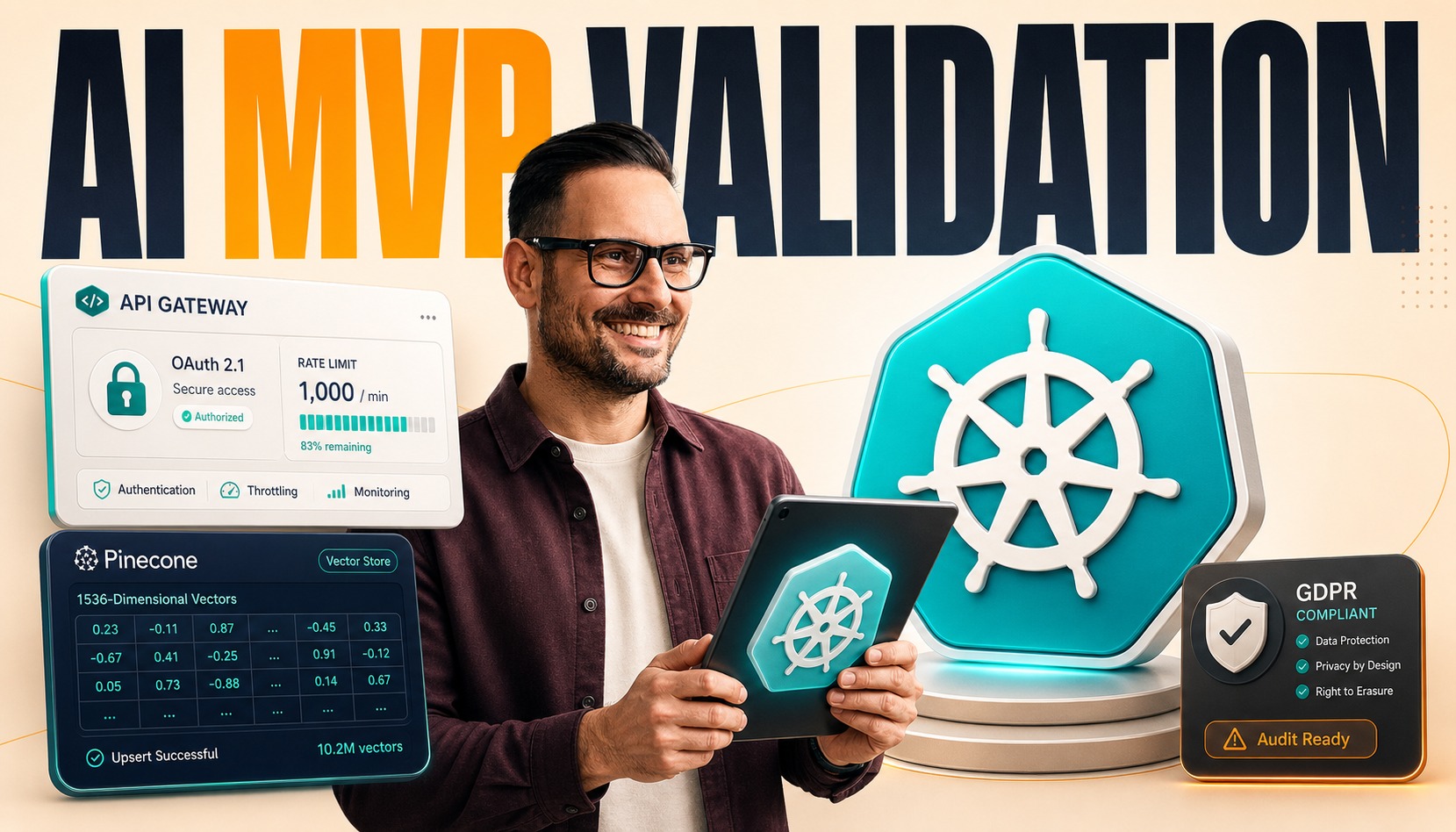
- API Gateway – Handles inbound REST/GraphQL requests, enforces OAuth2, rate limits, and routes to the orchestration layer.
- Orchestration Layer – A Python FastAPI service (or Node.js NestJS) that runs the LangChain or CrewAI workflow, decides which tool or agent to invoke, and maintains idempotent state via Redis.
- Model Layer – Stateless containers running LLM inference (e.g., OpenAI gpt‑4o, Anthropic Claude) behind a Kubernetes Deployment with horizontal pod autoscaling (HPA) targeting 70 % CPU.
- Vector Store – Pinecone or Milvus for embeddings; stores 1536‑dimensional vectors with an average retrieval latency of 120 ms.
- Data Ingestion Pipeline – Airflow DAGs or Prefect flows that pull data from enterprise ERP (via OData), transform with Pandas, and push embeddings to the vector store.
- Message Queue – Kafka topics for async events (e.g., “document indexed”, “model response ready”) with exactly‑once semantics.
- Observability Stack – OpenTelemetry collectors feeding Prometheus + Grafana for metrics, Loki for logs, and Jaeger for distributed tracing.
Data flow example
- User sends a query to
/api/v1/assistant via the API Gateway. - Gateway validates the OAuth2 token, checks the rate‑limit bucket, and forwards the request to the Orchestration Layer.
- Orchestrator uses LangChain to generate an embedding of the query, then performs a similarity search against the vector store.
- Top‑k documents (k=5) are retrieved, concatenated, and fed to the LLM with a context window of 8 k tokens, respecting the model’s token limit.
- LLM returns a response; the orchestrator logs the interaction, stores the transcript in PostgreSQL, and publishes a “response.completed” event to Kafka.
- Downstream analytics consume the event to update a KPI dashboard (e.g., average handling time, conversion rate).
Infrastructure choices
- Cloud provider: AWS (EKS) or Azure (AKS) for managed Kubernetes; on‑premise clusters for data‑residency‑heavy workloads.
- Container runtime: Docker with OCI images, scanned by Trivy for vulnerabilities.
- Serverless fallback: AWS Lambda for webhook callbacks, keeping cold‑start latency under 150 ms.
- Cache layer: Redis Cluster for session state and token bucket counters.
- Failover: Multi‑region active‑active deployment with Route 53 latency‑based routing and a circuit‑breaker pattern in the orchestrator.
Security and governance
- OAuth2 + PKCE for client apps; API keys for internal services.
- Audit trail stored in immutable S3 with bucket versioning enabled.
- Data residency enforced by tagging vectors with region metadata and routing queries to the appropriate vector store.
- Compliance checks (PCI‑DSS, GDPR) integrated as pre‑deployment policies in GitHub Actions.
A well‑engineered AI MVP is not a “quick demo” – it is a production‑ready microservice that can be measured, scaled, and retired without leaving technical debt.
Business impact & measurable ROI
When the MVP is built on the architecture above, the business can start quantifying value from day one.
- Cost levers: Using serverless for low‑traffic endpoints reduces compute spend to <$0.02 per 1 k requests; Kubernetes autoscaling caps peak spend at $5 k per month for a 500 QPS workload.
- Operational gains: Automated document retrieval cuts manual search time from 12 minutes to < 30 seconds, a 96 % efficiency boost.
- Risk reduction: Early AI validation (A/B test with 5 % of traffic) surfaces model hallucination rates (e.g., 2.3 % vs 0.5 % after fine‑tuning) before full rollout.
- Time‑to‑value: A typical AI startup MVP can go from data ingestion to a live chatbot in 6 weeks, compared to 4–6 months for a monolithic proof of concept.
- Revenue impact: A pilot in a B2B SaaS support channel increased upsell conversion by 1.8 % (≈ $250 k annualized) after integrating a retrieval‑augmented assistant.
Implementation strategy for AI MVP development
- 1. Define success metrics – e.g., reduce ticket resolution time by 30 %, achieve < 2 % hallucination rate, or generate $X revenue per month.
- 2. Build a data proof of concept – ingest a representative slice of data, generate embeddings with OpenAI’s
text‑embedding‑ada‑002, and store in a vector DB. - 3. Prototype the RAG pipeline – use LangChain or LlamaIndex to wire retrieval, prompt engineering, and LLM inference together.
- 4. Harden the API – add OAuth2, rate limiting, and idempotent request IDs; expose both REST and GraphQL endpoints.
- 5. Deploy to a staging environment – use Docker Compose locally, then promote to a Kubernetes namespace with canary rollout.
- 6. Run a controlled pilot – route 5 % of production traffic via a feature flag; collect latency, token usage, and business KPIs.
- 7. Iterate on model and prompts – fine‑tune on domain‑specific data, adjust context window, and monitor token consumption (≈ 0.10 USD per 1 k tokens).
- 8. Scale out – enable HPA, add a second region, and switch to a multi‑tenant architecture if needed.
Common pitfalls
- Skipping data quality checks – noisy embeddings produce irrelevant retrieval results.
- Hard‑coding API keys – leads to credential leakage and compliance violations.
- Ignoring token limits – prompts that exceed the model’s context window cause truncation and hallucinations.
- Under‑estimating latency – network hops between vector store and LLM can push end‑to‑end latency beyond 500 ms, breaking SLA.
- Not instrumenting observability – without tracing you cannot pinpoint bottlenecks in the RAG flow.
Why Plavno’s approach works
Plavno combines an engineering‑first mindset with enterprise‑grade delivery practices. Our teams build AI MVPs on top of proven microservice patterns, then evolve them into full‑scale AI product development initiatives.
- We design AI agents using CrewAI and AutoGen, ensuring tool use and function calling are first‑class citizens.
- Our automation services integrate with existing ERP and CRM systems via GraphQL and webhooks, reducing manual effort by up to 80 %.
- For data‑intensive workloads we provision vector databases and cloud‑native infrastructure that scale on demand.
- Our consulting practice embeds security and compliance early, delivering audit‑ready pipelines that satisfy GDPR and HIPAA.
- Through our outsourcing and outstaffing models we provide dedicated AI engineers who can ship a pilot in 4–6 weeks, then transition to a permanent product team.
Investing in an AI MVP lets you treat the model as a configurable service, not a black‑box, which is the only way to achieve predictable cost and compliance at enterprise scale.
Conclusion
AI MVP development is the disciplined path from hypothesis to validated AI product. By constructing a production‑grade microservice stack, measuring concrete business outcomes, and iterating on data and model quality, enterprises can de‑risk the AI journey and allocate capital where it truly moves the needle. Ready to turn your AI idea into a measurable pilot? Contact Plavno today and let our engineering‑first team guide you from proof of concept to full‑scale AI product development.