AI in Energy and Utilities: Demand Forecasting, Grid Monitoring, and Outage Response
AI in Energy and Utilities: Demand Forecasting, Grid Monitoring, and Outage Response
September 25, 2026· min read·#AI#Tech·Reviewed by Plavno AI Engineering Team
Utility operators face rising pressures from renewable volatility, reliability standards, and outage liabilities. AI can boost load‑forecast accuracy by 10‑20% and cut outage detection latency from minutes to seconds, delivering up to a 30% reduction in restoration cost.
Share this post
Utility operators today face a triple pressure: volatile renewable output, tighter reliability standards, and increasingly complex outage liabilities. When a transformer overheats or a storm knocks down a feeder, the cost of a delayed response can exceed $1 million per incident, while customer churn climbs 5 % for each hour of outage. AI in energy and utilities offers a way to flip the model from reactive firefighting to proactive, data‑driven stewardship.
QUICK ANSWER
AI boosts load‑forecast accuracy by 10‑20 % and cuts outage detection latency from minutes to seconds, delivering up to a 30 % reduction in restoration cost for midsize utilities.
Legacy SCADA and OMS remain siloed, forcing operators to stitch together CSV exports for every analysis gigawatt.ai.
Peak‑load forecasting still relies on linear regression, yielding >15 % error during heat waves.
Outage communication pipelines use batch SMS blasts; customers learn of a blackout hours after crews arrive.
Regulatory penalties for SAIDI > 1 hour have risen 30 % YoY in North America.
Asset health data (temperature, vibration) is collected but never correlated with weather or load patterns, limiting predictive maintenance.
A common mistake is treating AI as a plug‑in; without unified data streams the model never sees the whole picture.
Technical architecture and how AI in energy and utilities works in practice
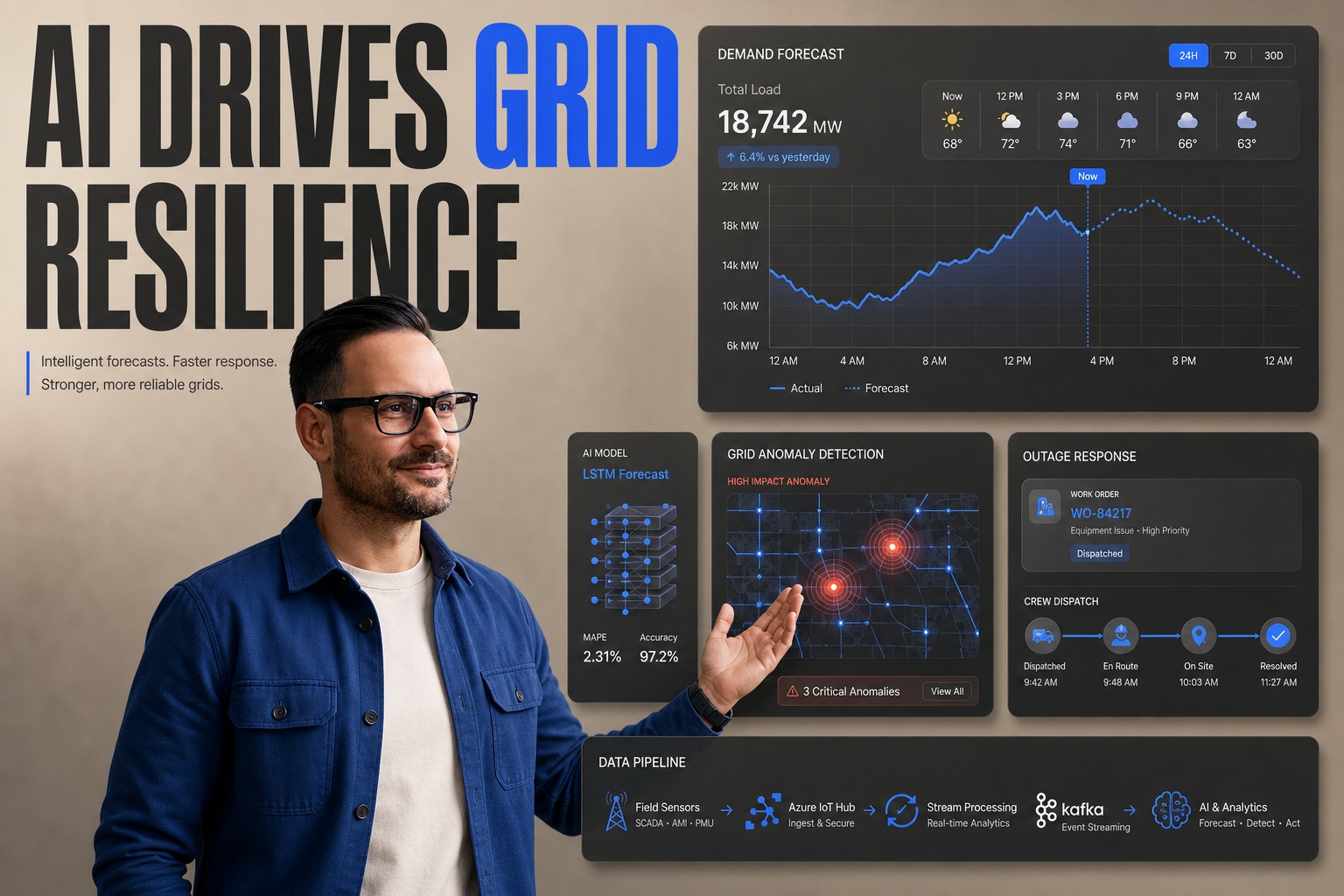
At the core is a composable pipeline that ingests telemetry, enriches it with external signals, and routes it to a model‑orchestration layer. The diagram below (textual) outlines the end‑to‑end flow.
API Gateway: Kong or AWS API Gateway terminates external REST/GraphQL calls from SCADA, GIS, and weather services.
Ingestion Layer: Azure IoT Hub or Confluent Kafka streams PMU, AMI, and smart‑sensor data at 1‑kHz cadence.
Streaming Processor: Flink jobs normalize timestamps, apply unit conversion, and write to a time‑series store (TimescaleDB) and a vector DB (Pinecone) for embeddings.
Feature Store: Feast serves pre‑computed aggregates (30‑minute load, 6‑hour temperature lag) to downstream models.
Model Layer:
Demand forecasting uses a transformer‑based LSTM (PyTorch) fine‑tuned on 5 years of load + weather data.
Grid anomaly detection runs an Isolation Forest on embeddings generated by a Sentence‑Transformer that ingests raw sensor vectors.
Outage risk agent is built with LangChain + OpenAI GPT‑4, orchestrated by CrewAI to call weather, vegetation, and asset‑condition APIs.
Agent Orchestration: AutoGen or CrewAI coordinates multiple tool‑use calls – e.g., fetch forecast, query the feature store, run the anomaly model, and synthesize a risk score.
Decision Service: A FastAPI service evaluates risk thresholds, adds business rules (crew availability, regulatory limits) and emits events to Azure Service Bus.
Automation Layer: Power Automate (or custom Azure Functions) creates a work order in Dynamics 365 Field Service, attaches the fault classification, and notifies customers via Twilio webhook.
Observability: OpenTelemetry captures traces across Kafka → Flink → FastAPI → Azure Functions; Grafana dashboards display latency (average 420 ms end‑to‑end) and error rates.
All services run in Kubernetes (AKS or GKE) with Helm charts per component, enabling blue‑green deployments and per‑tenant isolation. Stateful services (TimescaleDB, Pinecone) use Persistent Volumes with zone‑redundancy; stateless agents scale horizontally behind an HPA targeting 70 % CPU.
EXAMPLE USE CASE
A telecom operator deployed an AI predictive analytics agent for network optimization to predict issues and improve service quality and efficiency. After integrating Plavno's solution, the team achieved 70% faster network optimization and achieved 30% cost reduction.
Investing in a unified data fabric is the single biggest lever for unlocking AI’s ROI in the utility sector.
Implementation strategy
Phase 1 – Data consolidation: Build a data lake on Azure Data Lake Storage, ingest SCADA, GIS, AMI, and weather APIs. Deploy Feast as a feature store.
Phase 2 – Pilot models: Train a short‑term load forecast (15 min–48 h) using PyTorch Lightning; evaluate on a held‑out 6‑month slice. Simultaneously launch an anomaly detection proof‑of‑concept on one high‑risk feeder.
Phase 3 – Agent orchestration: Wrap the models in LangChain agents, connect to Azure Functions for tool use, and expose a risk‑score REST endpoint.
Phase 4 – Automation integration: Hook the risk endpoint to Dynamics 365 Field Service via webhook, configure Power Automate flows for customer SMS alerts, and set up circuit‑breaker logic for idempotent work‑order creation.
Phase 5 – Scale & governance: Horizontal autoscaling, multi‑region failover, OAuth2 + Azure AD authentication, and automated audit‑log export to Azure Sentinel for compliance.
Common pitfalls
Skipping schema alignment between SCADA timestamps and weather forecasts leads to mis‑aligned features.
Hard‑coding API keys; use Azure Key Vault and rotate secrets every 90 days.
Neglecting model drift monitoring; set up daily drift metrics and automated retraining pipelines.
AI AUTOMATION
Ready to automate your grid?
Leverage Plavno’s AI‑agents platform to turn sensor streams into proactive field orders.
Plavno builds AI solutions on an engineering‑first foundation: we start with data readiness, deliver production‑grade pipelines, and embed governance from day one. Our services—ranging from AI agents development to AI automation—are delivered via reusable micro‑services that can be deployed in multi‑tenant Kubernetes clusters or on‑prem private clouds. We have a proven track‑record integrating SCADA, GIS, and ERP systems without locking customers into a single vendor stack.
With Plavno’s end‑to‑end AI platform, utilities can move from fragmented alarm‑centers to a unified, proactive control room that automatically predicts load, detects anomalies, and dispatches crews before a fault becomes an outage.
In short, AI in energy and utilities is no longer a research project; it is a production capability that delivers measurable reliability gains, regulatory compliance, and cost savings. Contact Plavno to architect, build, and operate the next‑generation AI stack for your grid.
Share this post
Contact Us
This is what will happen, after you submit form
Plavno experts contact you within 24h
Discuss your project details
We can sign NDA for complete secrecy
Submit a comprehensive project proposal with estimates, timelines, team composition, etc
Need a custom consultation? Ask me!
Plavno has a team of experts ready to start your project. Ask us!