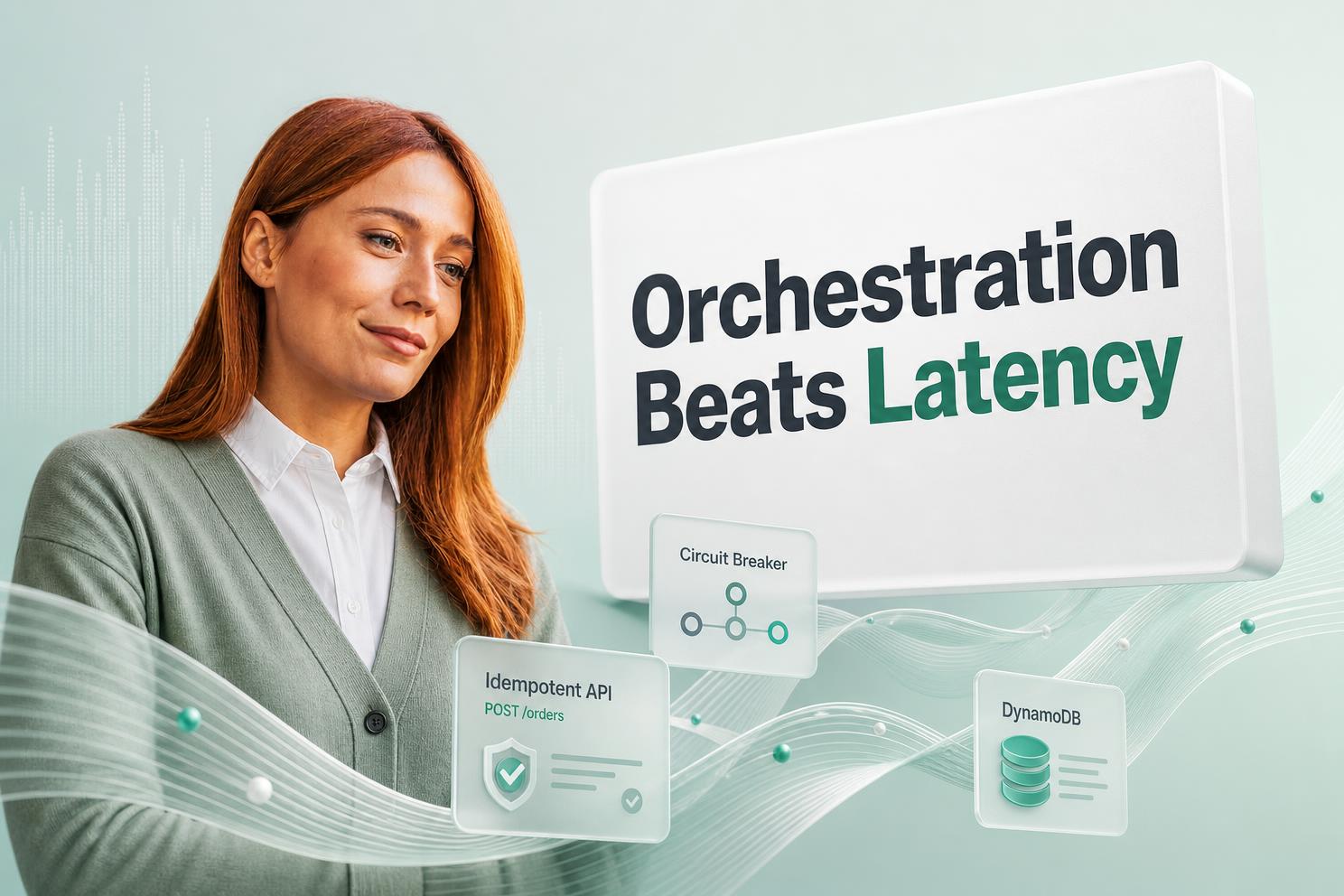
What is the core challenge when building AI agents on AWS Bedrock? The difficulty lies in coordinating multiple services, not picking the right LLM.
Will Bedrock Agents replace custom prompt engineering? They reduce prompt churn but still require disciplined orchestration.
Can we rely on Bedrock’s managed security for enterprise AI? Managed controls help, yet integration points remain vulnerable.
Should we invest in new orchestration tooling now? Yes, because the next performance ceiling is in workflow reliability.
What does this mean for our AI roadmap this quarter? Shift budget from model licensing to orchestration platforms.
Quick Answer
Enterprises that adopt AWS Bedrock Agents should treat orchestration as the primary engineering focus. The model layer is now a commodity; the real risk of failure comes from how agents invoke other AWS services, handle state, and recover from errors. Building resilient orchestration—through idempotent APIs, explicit state stores, and circuit‑breaker patterns—delivers far more reliability and cost predictability than obsessing over which LLM version powers the agent.
The Bedrock Agent Paradigm Shifts the Engineering Lens
When AWS announced Bedrock Agents, the headline was the ability to create autonomous agents that can call other AWS services, retrieve data, and execute actions without writing custom glue code. On the surface, this appears to be a model‑centric innovation: pick a more capable LLM, and the agent will be smarter. In practice, the shift is architectural. Bedrock abstracts the prompt‑to‑action pipeline, but the agent still needs to invoke services like DynamoDB, S3, or Step Functions. Those calls introduce latency, failure modes, and cost spikes that dwarf the differences between GPT‑4‑Turbo and Claude‑3.5.
For a CTO evaluating Bedrock Agents, the question becomes: Where does the system break under load? The answer is at the orchestration boundary—where the agent decides which AWS resource to call, how to serialize state, and how to handle retries. This is why the engineering focus must move from model selection to workflow design.
Orchestration Is the New Performance Frontier
Latency Accumulation Across Service Calls
A typical Bedrock Agent workflow might retrieve a customer record from DynamoDB, enrich it with a third‑party API, and then write a summary back to S3. Each hop adds network latency (often 30‑150 ms per call) and introduces a potential failure point. In a batch of 1,000 requests, a 100 ms overhead per hop translates to a 10‑second increase in overall processing time. By contrast, switching from GPT‑4‑Turbo to Claude‑3.5 changes inference latency by only 10‑20 ms.
Cost Variability from Service Consumption
Bedrock charges per token, but the majority of the bill for an agent‑driven pipeline often comes from the downstream services. A single DynamoDB read/write can cost $0.00065 per 100 K reads, but at a scale of millions of calls, that becomes a non‑trivial expense. Orchestration that batches calls or caches results can reduce this cost by 30‑50 %.
Failure Propagation and State Inconsistency
If an agent retries a failed DynamoDB write without idempotency, duplicate records appear. Without a deterministic state store, the system can diverge, leading to data integrity issues that are far more damaging than a slightly less accurate LLM output.
Designing Resilient Orchestration for Bedrock Agents
Embrace Idempotent API Patterns
When an agent writes to a data store, the operation should be safe to repeat. Using DynamoDB’s conditional writes or Step Functions’ idempotent task tokens ensures that retries do not create duplicate state. This design choice eliminates a class of bugs that would otherwise surface only under load.
Centralize State in a Durable Store
Agents often need to remember context across multiple invocations. Storing session data in a purpose‑built state store such as Amazon Aurora Serverless or a dedicated Redis cluster provides low‑latency access and durability. The state store should be the single source of truth, rather than relying on the LLM to “remember” prior turns.
Apply Circuit‑Breaker and Bulkhead Patterns
If an external API becomes slow, the agent should back off rather than cascade failures through the entire pipeline. Implementing a circuit‑breaker (for example, via AWS AppConfig) allows the system to temporarily disable problematic calls and fallback to cached data. Bulkheads—isolating critical paths—prevent a single slow service from throttling the whole workflow.
Batch and Cache External Calls
When agents need to enrich data from a third‑party service, grouping requests into batches reduces per‑call overhead. Caching recent responses in Amazon ElastiCache can cut latency by 40‑70 % and also lower downstream API costs.
Plavno’s Perspective on Orchestration‑First AI
At Plavno, we have helped enterprises adopt generative AI while keeping the underlying infrastructure stable. Our experience shows that teams that invest early in orchestration tooling—such as custom Step Functions workflows and robust state management—see a 2‑3× reduction in incident rates after moving to Bedrock Agents. Moreover, by treating the orchestration layer as a first‑class citizen, we can reuse components across multiple AI projects, accelerating time‑to‑value.
We recommend a phased approach: start with a proof‑of‑concept that focuses on a single orchestration pattern (e.g., idempotent writes), then expand to more complex multi‑service agents. This mirrors our successful engagements in the AI agents development practice, where we prioritize workflow reliability before model fine‑tuning.
Business Impact of an Orchestration‑Centric Strategy
When orchestration is engineered for resilience, the business reaps tangible benefits. First, the predictability of latency translates into better SLA adherence, which is critical for customer‑facing AI assistants in finance or healthcare. Second, cost containment becomes achievable; by reducing unnecessary service calls, enterprises can lower their monthly AWS bill by up to 25 % for high‑volume workloads. Third, the risk of data inconsistency diminishes, protecting brand reputation and compliance—especially in regulated sectors like banking and medical AI.
By shifting budget from model licensing to orchestration tooling, CTOs can also future‑proof their AI stack. As new LLMs become available, the orchestration layer remains stable, allowing a quick swap of the underlying model without re‑architecting the entire pipeline.
How to Evaluate Orchestration Readiness in Practice
The evaluation should begin with a realistic workload simulation. Deploy a representative Bedrock Agent that performs a read‑modify‑write cycle against DynamoDB and invokes a third‑party API. Measure end‑to‑end latency, error rates, and AWS cost breakdown. If more than 60 % of total latency comes from service calls, the orchestration layer is the bottleneck.
Next, audit the idempotency of each write operation. Verify that retries (simulated by forcing a failure) do not produce duplicate records. Assess state durability by introducing a forced outage of the state store and confirming that the agent can recover without data loss.
Finally, review the circuit‑breaker thresholds. Adjust the failure detection window until the system gracefully degrades under simulated API latency spikes. The goal is to keep the agent’s overall error rate below 1 % while maintaining sub‑second response times for the majority of requests.
Real‑World Applications Where Orchestration Wins
In a large retail chain, Bedrock Agents were deployed to automate inventory reconciliation. By centralizing state in Aurora Serverless and using idempotent DynamoDB writes, the solution reduced nightly processing time from 45 minutes to under 10 minutes, while cutting AWS spend by 18 %.
A financial services firm built a compliance‑monitoring agent that queried transaction logs stored in S3, enriched them with a risk‑scoring API, and wrote alerts to an internal dashboard. Implementing bulkheads prevented a temporary outage of the risk API from halting the entire monitoring pipeline, preserving regulatory reporting timelines.
Risks and Limitations of a Purely Orchestration‑Focused Approach
While prioritizing orchestration mitigates many operational hazards, it does not eliminate all challenges. Model hallucination remains a risk; if the LLM generates incorrect data, downstream services may still process it, leading to downstream errors. Additionally, over‑engineering orchestration can introduce unnecessary complexity, especially for low‑volume use cases where a simple Lambda function might suffice.
Another limitation is vendor lock‑in. Heavy reliance on AWS‑specific services like Step Functions or DynamoDB can make migration to multi‑cloud environments costly. Teams should abstract orchestration logic behind interfaces that could be re‑implemented on other clouds if needed.
Closing Insight
The launch of AWS Bedrock Agents marks a turning point: the AI model is now a plug‑in, and the orchestration layer is the engine. Engineers who treat orchestration as a secondary concern will find their agents brittle, costly, and hard to scale. By investing in idempotent APIs, durable state stores, and resilient patterns now, enterprises can unlock the true promise of autonomous AI agents—fast, reliable, and financially sustainable.
Explore our services such as AI agents development, cloud software development, AI voice assistant development, AI-powered telecom software development, FinTech solutions, software development consult, machine learning development, and see our case studies.
 Chat GPT
 Perplexity
 Claude
 Gemini