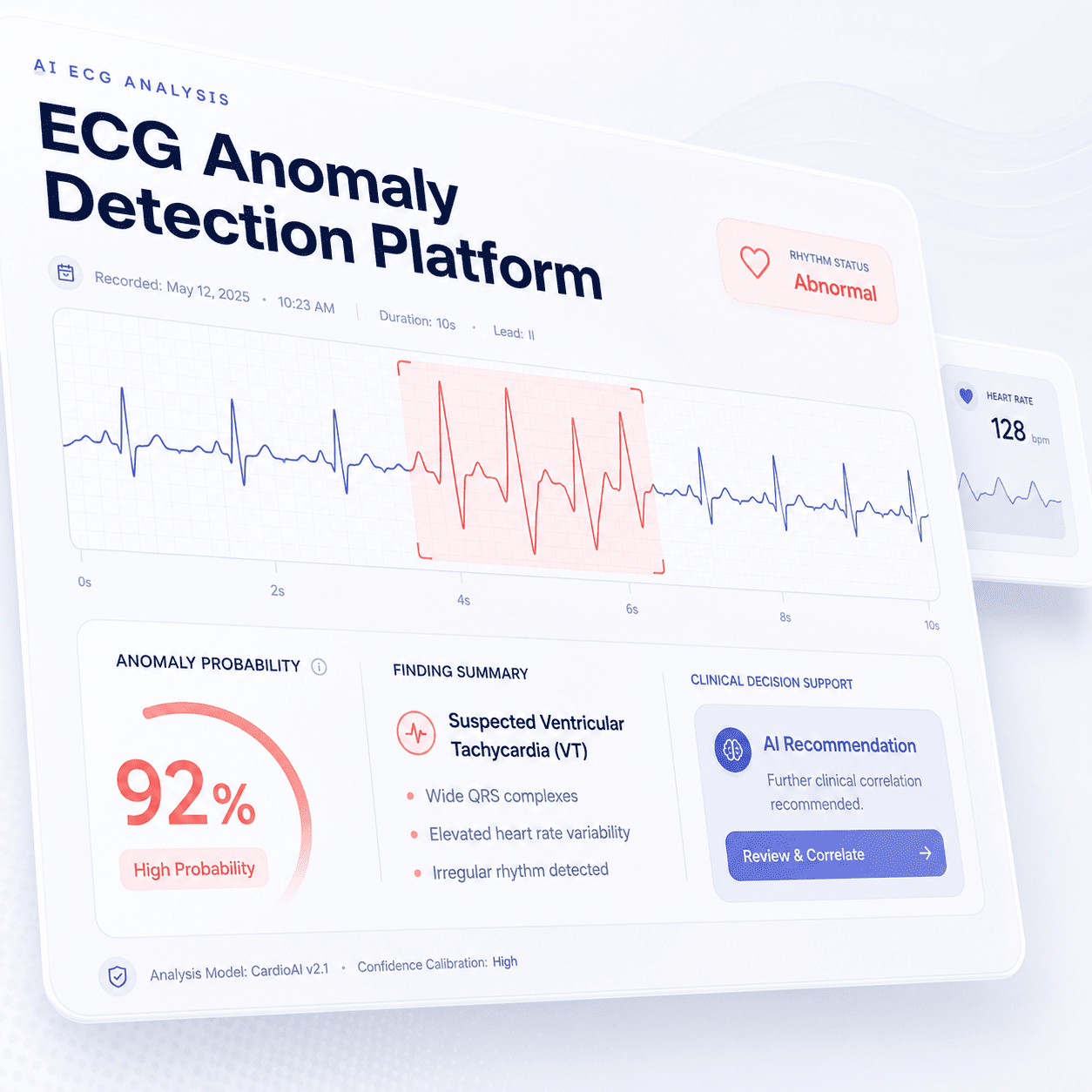
Plavno developed an AI-powered ECG analysis platform that helps healthcare organizations process ECG studies faster, detect potential abnormalities, and provide structured diagnostic support to clinicians.
Overview
The platform was designed as a scalable AI module for integration into HIMS, EHR/EMR systems, telemedicine platforms, diagnostic portals, and cloud healthcare environments. It ingests ECG files or signals, preprocesses and normalizes them, applies AI analysis, identifies suspicious patterns, generates structured reports, and returns results to clinicians through existing medical interfaces.
Faster processing of ECG studies across high-volume healthcare environments.
Better support for physicians interpreting large numbers of ECG recordings.
Lower risk of missing anomalies during primary ECG screening.
Better standardization of first-line ECG interpretation.
Stronger access to cardiology support in remote and underserved regions.
ECG interpretation is one of the most common but also one of the most demanding diagnostic workflows in medicine. Even with modern devices, clinicians face high workloads, large ECG volumes, risk of missed anomalies, differences in experience levels, and limited access to cardiologists in remote areas. Existing device-generated reports are often not reliable enough for real clinical practice.
The client needed an independent AI layer that could:
Improve interpretation speed and consistency
Help clinicians identify potentially abnormal ECG studies more quickly
Reduce the impact of human factors
Standardize the quality of primary ECG screening
Without a unified intelligence layer, customer success teams struggled to act early and consistently.

The platform needed to:
Ingest ECG files or signals from devices and medical systems
Preprocess and normalize incoming ECG data
Support multi-channel ECG analysis
Detect pathological patterns with AI models
Generate structured AI-assisted reports
Integrate into healthcare infrastructure without disrupting existing workflows
There were also important implementation constraints:
The system had to support historical review and repeated ECG analysis
It needed to work in HIMS, telemedicine, diagnostic, and cloud-health environments
The architecture had to remain scalable and secure for medical data handling
The AI module had to provide decision support without replacing physician judgment

Solution
Automating First-Line Interpretation with Structured Clinical Outputs and Seamless Integration.
AI analysis of multi-channel ECG data.
Automated first-line ECG screening for arrhythmias, conduction disorders, ST/T changes, and other suspicious cardiac patterns.
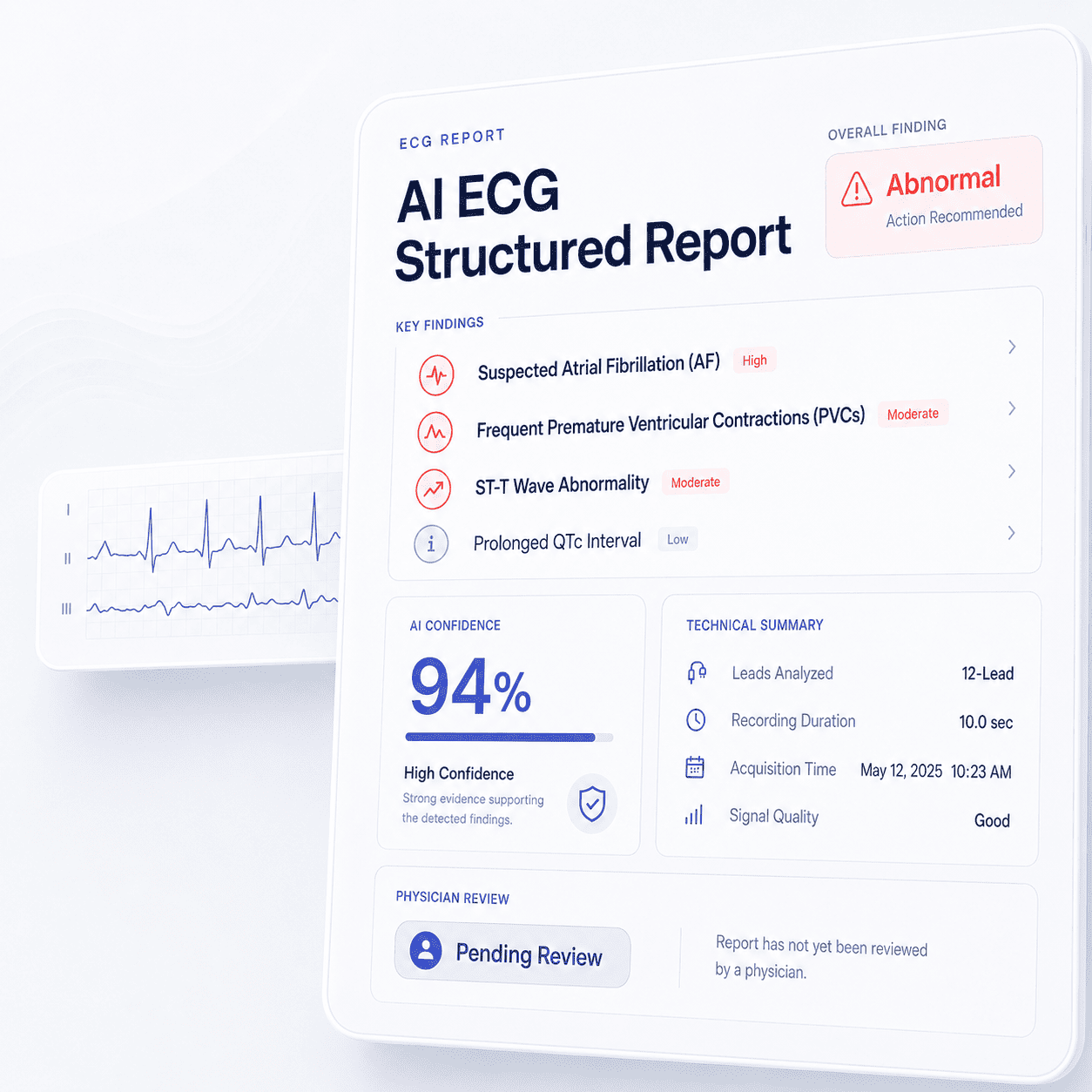
Structured AI-generated reports with summaries, anomaly findings, confidence level, and technical details.
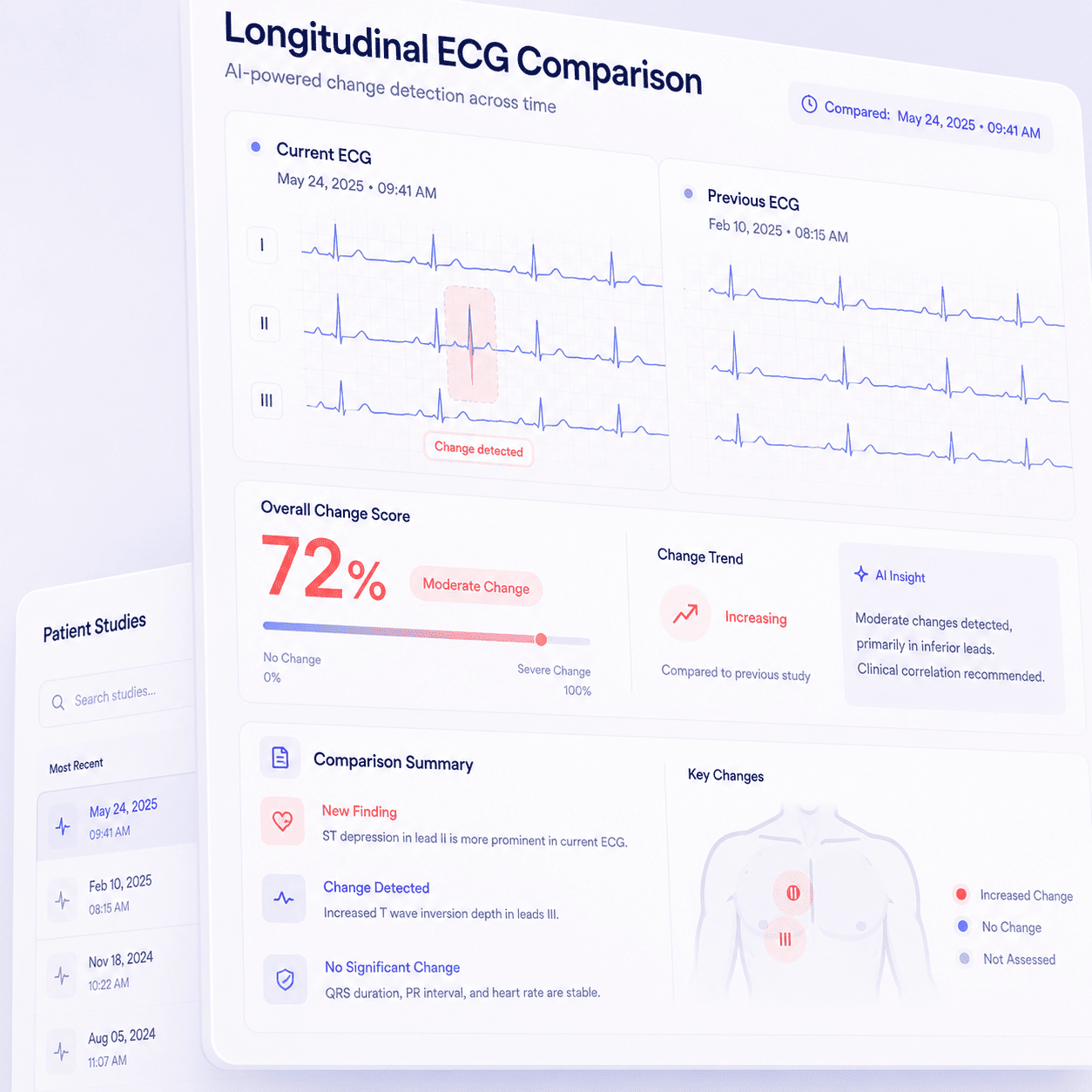
Upload, re-analysis, storage, and longitudinal comparison of ECG studies.
Integration with HIMS, EHR/EMR, telemedicine, diagnostic portals, and cloud healthcare services.
API support for AI analysis launch, result retrieval, report transfer, and metadata/history storage.
Scalable AI inference pipeline for enterprise healthcare deployment.
Ingest ECG Data: The platform receives ECG files or signals from medical systems or devices.
Preprocess & Normalize: ECG data is cleaned, normalized, and prepared for AI inference.
Analyze & Detect: AI models evaluate the ECG, detect suspicious patterns, and produce structured anomaly outputs with confidence indicators.
Review & Compare: Clinicians receive structured reports inside their medical system, while historical ECGs can be reviewed and compared over time for longitudinal monitoring.
Supports clinics, hospitals, cardiology centers, telemedicine services, diagnostic labs, mobile healthcare platforms, and remote medical points.
Works as an AI module inside broader healthcare ecosystems.
Handles high study volumes with scalable inference architecture.
Improves accessibility of cardiology diagnostics in resource-constrained settings.
Creates a reusable base for broader AI-assisted cardiology product development.
Architecture Overview
ECG Ingestion Layer: The platform accepts ECG signals and files from connected devices or healthcare platforms.
Preprocessing Layer: Signal normalization and preprocessing prepare the ECG for consistent AI inference.
AI Inference Layer: Machine learning models analyze ECG data, detect pathological patterns, and estimate anomaly probability.
Reporting Layer: The system generates structured AI reports with summaries, findings, confidence levels, and technical ECG details.
History & Comparison Layer: Historical ECG studies are stored, reanalyzed, and compared over time for longitudinal monitoring.
Integration Layer: APIs support report delivery, result retrieval, metadata storage, and integration into HIMS, EHR/EMR, telemedicine, and cloud healthcare systems.

Value
Delivering faster ECG screening, stronger anomaly detection support, and more reliable structured cardiology workflows
The platform accelerates the first layer of ECG review across large study volumes.
AI highlights suspicious cardiac patterns and helps clinicians find high-risk studies sooner.
Clinicians receive structured outputs rather than only raw waveforms or generic device reports.
The platform supports repeated analysis and comparison of ECG studies over time.
Benchmarks
Built to support high ECG volumes, enterprise healthcare integration, and scalable AI cardiology workflows
The platform supports rapid processing of large numbers of ECG studies.
The solution is built to work inside HIMS, EHR/EMR, telemedicine, and diagnostic systems.
The architecture was designed around secure handling of healthcare data and enterprise integration.
The platform is designed for future development of broader AI-assisted cardiology features.
Data Protection
Enterprise-grade protection for ECG studies, clinical reports, and medical system integrations
ECG files, reports, metadata, and patient study history are processed inside a healthcare-grade architecture.
AI analysis, results, and reports can be exchanged through structured API workflows.
Stored study history and structured reporting improve visibility across AI-assisted ECG workflows.
Innovative Experience
AI-assisted ECG analysis platforms for cardiology, diagnostics, and digital healthcare systems
Delivery Crew
High-performing developers for growing companies

Eugene Katovich
Sales Manager
Plavno builds AI healthcare systems that accelerate ECG screening, improve anomaly detection support, and integrate into modern diagnostic and telemedicine environments.
Talk to an ExpertCompetitive Ability
Demonstrating how Plavno transforms raw ECG studies into AI-assisted clinical decision support
Receive ECG File or Signal
Collect ECG data from devices or medical systems.
Normalize & Prepare the Study
Preprocess and standardize the signal for reliable AI inference.
Run AI-Based ECG Analysis
Detect suspicious patterns, estimate anomaly probability, and generate structured findings.
Deliver Structured Clinical Output
Return the AI report to the clinician through HIMS or the medical platform and enable historical comparison where needed.
Automated screening support.
Report generation.
API-driven result delivery.
Repeat analysis and history review.
High-volume ECG processing.
Enterprise healthcare integration.
Remote cardiology enablement.
Scalable AI cardiology infrastructure.
Multi-channel ECG analysis.
Pathology pattern detection.
Confidence scoring.
Structured diagnostic support.
Measurable outcomes delivered by an AI-powered ECG analysis platform
Healthcare organizations can analyze ECG studies more efficiently.
The platform improves diagnostic availability in remote and underserved care settings.
Doctors receive structured support that helps them work faster across high study volumes.
The solution supports expansion of digital cardiology services without proportional staffing growth.
The AI layer helps surface potentially suspicious studies earlier.
Tools We Used
Project Estimator
The estimated time to launch the product
Clear vision of functionality you need
15% discount on your first sprint

Frequently Asked Questions
Find answers to your common concerns
Yes. It is designed to process and interpret multi-channel ECG studies.
No. The AI serves as a clinical decision-support layer and does not replace physician judgment.
Yes. It produces AI-assisted structured reports with summaries, anomalies, confidence levels, and technical details.
Yes. The platform supports study history, repeated analysis, and comparison over time.
About Plavno

Senior engineers + proven AI components to accelerate time-to-value.

From MVPs to enterprise platforms at global scale.

From extension UX to GPU pipelines and global scale.
Testimonials
Contact Us
Discuss your project details
Plavno experts contact you within 24h
Submit a comprehensive project proposal with estimates, timelines, team composition, etc
We can sign NDA for complete secrecy
Plavno has a team of experts that ready to start your project. Ask me!

Vitaly Kovalev
Sales Manager

Fill in the form
to access the case study.