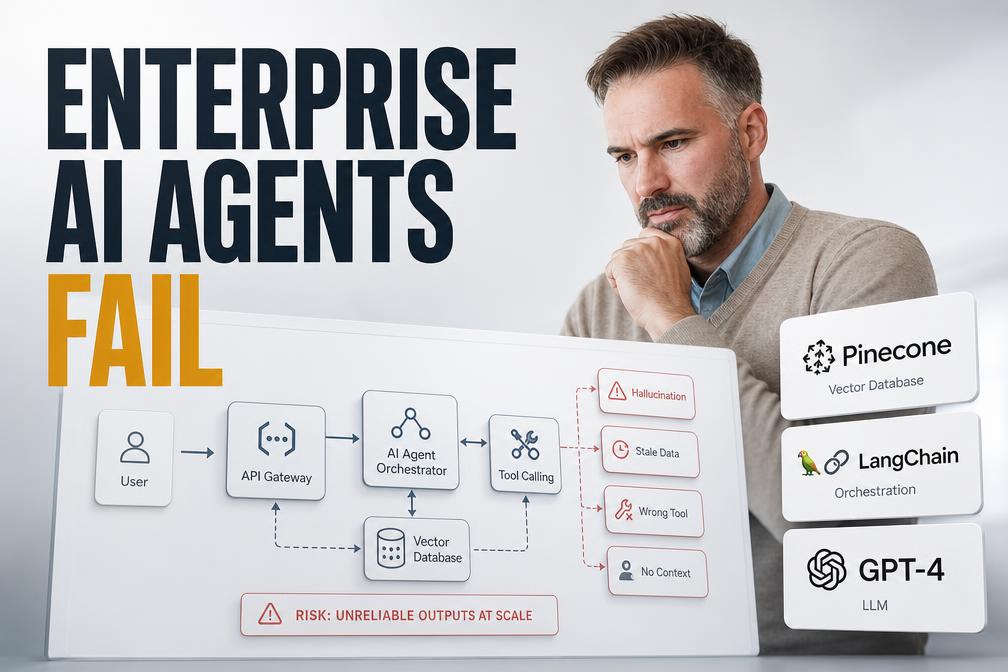
Why Most Enterprise AI Agents Fail After the Pilot StageThe demo looked perfect. The LLM answered every question, the prototype handled the edge cases, and the stakeholders nodded in approval. Three months later, the project is dead. It ran into data silos, API rate limits, hallucinated compliance risks, and a total lack of observability. This is the standard trajectory for enterprise AI agents: a spectacular pilot followed by a quiet production failure. The gap between a controlled notebook environment and a scalable, secure enterprise system is massive, and most organizations are not building the necessary plumbing to cross it.
Industry challenge & market context
The market is flooded with hype, but the engineering reality is stark. We see a repeatable pattern where organizations rush to AI implementation without treating it as a serious software engineering discipline. They treat the LLM as the product, rather than a single component in a distributed system. This leads to fragile architectures that cannot handle the rigors of enterprise operations.
- Data fragmentation: Enterprise data lives in legacy SQL databases, SaaS platforms (Salesforce, SAP), and unstructured blob storage. Pilots often use static, cleaned datasets, while production agents must query live, messy, and often conflicting data sources.
- Integration friction: Connecting an agent to internal tools via REST or GraphQL is rarely straightforward. Issues with authentication (OAuth2 scopes), idempotency in API calls, and handling network timeouts cause cascading failures in agentic loops.
- Unpredictable costs: In a pilot, token usage is a rounding error. In production, with thousands of concurrent users, unoptimized prompts and lack of caching can inflate cloud bills by 500% or more overnight.
- Security and governance: Pilots often run in isolated sandboxes. Moving to production requires strict adherence to data residency laws (GDPR), PII redaction, and audit trails that most prototype frameworks simply do not support out of the box.
- Reliability and latency: Enterprises expect 99.9% uptime. LLMs are non-deterministic and can suffer from high latency (2-10 seconds per inference). Without aggressive caching, streaming, and fallback mechanisms, the user experience degrades rapidly.
Technical architecture and how enterprise AI agents works in practice
To move beyond the pilot, you must stop thinking about "chatbots" and start thinking about event-driven, stateful microservices. A robust AI agent development lifecycle involves a complex stack of technologies that manage state, memory, tools, and observability. The agent is merely the orchestrator; the value lies in the connections it makes.
When a user triggers an agent, the system does not just "send text to GPT-4." It executes a complex pipeline. First, the request hits an API Gateway (like Kong or AWS API Gateway) for authentication and rate limiting. The request then moves to an orchestration layer—often built with frameworks like LangChain or LlamaIndex—which determines the intent. If the user asks for a refund, the agent needs to access order history. It must generate an embedding for the query, perform a similarity search in a Vector Database (such as Pinecone, Milvus, or pgvector), and retrieve relevant context. This context is injected into the prompt alongside the user's query.
However, retrieval is only half the battle. The agent must then decide which tools to use. This involves "tool calling" or function calling. The LLM outputs a structured JSON object representing a function call (e.g., {"name": "refund_order", "arguments": {"order_id": "123"}}). The backend infrastructure parses this, executes the actual API call against the internal ERP or CRM, and returns the result to the LLM for final synthesis. Throughout this flow, state must be managed—often using Redis or a durable workflow engine like Temporal—to handle long-running transactions without losing context if a connection drops.
- API Gateway & Security Layer: Handles initial ingress, OAuth2/JWT validation, and throttling. This is where you enforce RBAC (Role-Based Access Control) to ensure the agent doesn't perform actions the user isn't authorized for.
- Orchestration Layer: The brain of the operation. Frameworks like LangChain, AutoGen, or custom Python/Node.js runtimes manage the agent loop, prompt templates, and memory management (short-term conversation history vs. long-term vector store memory).
- Model Layer & Routing: Enterprises rarely use a single model. A router classifies the query complexity. Simple queries might go to a smaller, faster model (like Llama-3-8b or GPT-3.5-Turbo) to save costs, while complex reasoning tasks are routed to GPT-4 or Claude 3 Opus. This model routing is essential for cost control and latency management.
- Data & Retrieval Pipeline: This involves ETL pipelines that sync data from operational stores to a Vector DB. It must handle chunking strategies, metadata filtering, and hybrid search (combining keyword search with vector similarity) to ensure high precision.
- Tool & Integration Layer: A set of wrapper functions around internal APIs. These wrappers must handle error handling, retries, and circuit breakers. If the billing API is down, the agent needs to know to fail gracefully rather than spinning in a retry loop.
- Infrastructure & Observability: Deployed on Kubernetes (EKS/GKE) or serverless (AWS Lambda) for auto-scaling. Crucially, it requires deep observability using tools like OpenTelemetry, LangSmith, or Arize to trace token usage, latency, and the "reasoning traces" of the agent to debug why it took a specific action.
The failure of an AI pilot is rarely a failure of the model's intelligence; it is almost always a failure of the system's reliability and integration. The model is the engine, but without a transmission, wheels, and suspension, the car goes nowhere.
Business impact & measurable ROI
Why endure this complexity? Because when done correctly, enterprise AI agents unlock operational efficiency that traditional automation cannot touch. The ROI is not just in "faster responses" but in the deflection of high-cost human labor and the enablement of new services. However, to measure this, you must move beyond vanity metrics like "number of chats" to tangible outcomes.
A successful AI automation strategy targets specific, high-friction workflows. For example, in a supply chain context, an agent that can autonomously track shipments, predict delays based on weather data, and automatically rebook routes can reduce logistics overhead by 15-20%. In customer support, shifting Tier 1 queries (password resets, order status) to an agent with 95% accuracy can reduce support ticket volume by 40-60%, allowing human agents to focus on high-value revenue generation.
- Cost Reduction: Direct labor arbitrage. An agent handling 10,000 queries/month that would otherwise require 5 full-time employees represents a clear, quantifiable saving. However, you must factor in the infrastructure cost (GPU/CPU inference) and maintenance.
- Velocity: Drastically reducing the time-to-information. Internal knowledge agents can search technical documentation, Jira tickets, and Slack history in seconds, saving engineers 2-3 hours per week per person.
- Error Reduction: Unlike humans, well-governed agents follow strict SOPs (Standard Operating Procedures) encoded in their prompts and tools. This reduces compliance errors in finance or legal document review, potentially lowering regulatory fines.
- Scalability: Software scales infinitely; humans do not. During peak seasons (like Black Friday), an agent architecture can scale horizontally on Kubernetes to handle 100x traffic without a dip in performance, something a human workforce cannot match.
A production-grade agent requires the same operational rigor as a high-frequency trading platform: observability, strict latency budgets, and bulletproof error handling. If you cannot monitor it, you cannot run it in business.
Implementation strategy
Moving from a successful AI pilot to a production system requires a disciplined roadmap. You cannot simply "scale up" a prototype. You must refactor for resilience, security, and maintainability. This involves a shift in mindset from experimentation to engineering governance.
The first step is defining the "Golden Path" for integration. Do not try to connect the agent to every system immediately. Identify the highest-value, lowest-risk data source (e.g., a public knowledge base) and integrate that first. Once the retrieval mechanism is stable, add tool-calling capabilities for read-only operations. Only when the agent demonstrates high accuracy in read-only tasks should you grant it write-access or transactional capabilities.
- Discovery & Scoping: Identify a specific problem with clear success metrics (e.g., "Automate 80% of invoice processing errors"). Audit data availability and quality. If the data is not digitized or is extremely dirty, pause the AI project and fix the data engineering first.
- Architecture Design: Select the stack. Decide on your vector database, your hosting model (AWS/Azure/GCP vs. on-prem for data privacy), and your orchestration framework. Design the guardrails—how will you prevent prompt injection? How will you filter PII?
- Development & Testing: Build the RAG pipeline and tool wrappers. Implement rigorous testing. This includes unit tests for tools and "LLM-evals"—automated tests using another LLM to judge whether the agent's output is accurate and safe based on a golden dataset of questions and answers.
- Production Deployment: Deploy using a CI/CD pipeline. Start with a "shadow mode" where the agent generates answers but a human verifies them before they are sent to the user. Gradually increase autonomy as confidence scores improve.
- Continuous Improvement: Establish a feedback loop. Log user interactions (anonymized). Use these logs to fine-tune the system prompts, re-index the vector database, and refine the tool definitions.
Common pitfalls to avoid during this phase include neglecting the context window limits (trying to stuff too much data into the prompt), ignoring the "cold start" problem in vector databases, and failing to implement proper caching. Without caching (e.g., using Redis for frequent queries), you will pay for every identical query repeatedly. Another major pitfall is lack of human oversight; fully autonomous agents in high-stakes environments are a recipe for disaster. Always maintain a "human-in-the-loop" mechanism for low-confidence predictions.
Why Plavno’s approach works
At Plavno, we do not treat AI as a magic trick. We treat it as an engineering discipline. We specialize in AI agents development that is built for the harsh realities of the enterprise environment. Our approach is grounded in architectural rigor. We don't just wrap an API call to OpenAI; we build the surrounding infrastructure—vector databases, message queues, authentication layers, and observability stacks—that ensures the agent is reliable, secure, and scalable.
We understand that AI automation must integrate seamlessly with your existing stack. Whether you are running on legacy .NET monoliths or modern microservices, our teams have the deep backend expertise to build the bridges necessary for your agents to function. We prioritize custom software development principles, ensuring that your AI solution is not a fragile prototype but a maintainable product asset.
Furthermore, we guide you through the strategic nuances of implementation. From selecting the right models for your cost/benefit profile to designing robust governance frameworks, our AI consulting services ensure you avoid the "pilot purgatory." We focus on measurable outcomes, building systems that drive real ROI rather than just generating hype. If you are ready to move beyond the pilot and build AI that actually works at scale, explore our cases or contact us to discuss your architecture.
The transition from pilot to production is where the real work begins. It requires a partner who understands both the nuances of Large Language Models and the strict demands of enterprise software engineering. By focusing on solid architecture, robust data pipelines, and clear business metrics, we ensure that your investment in enterprise AI agents delivers lasting value.