The traditional enterprise search bar is effectively dead. For years, organizations relied on keyword-based engines that required users to know exactly what they were looking for and exactly how it was indexed. In a landscape where data doubles every few months, that model has collapsed. Engineers and business units no longer want a list of ten blue links; they want answers, synthesized from thousands of PDFs, Slack threads, Jira tickets, and legacy wikis. This shift is driving the transition from static repositories to AI Knowledge Management—systems that don't just store information but understand, retrieve, and reason over it. This is not a minor upgrade; it is a fundamental architectural rethinking of how enterprises handle intelligence.
Industry challenge & market context
The friction in accessing internal knowledge is quantifiable and expensive. Large enterprises suffer from "knowledge silos" where critical data exists in disparate formats and locations, rendering it invisible to standard search tools. Legacy search solutions like Elasticsearch or Solr are powerful for structured logging but fail miserably when faced with semantic queries like "How did we handle the GDPR compliance patch for the payment gateway in 2022?"
- Information silos and fragmentation: Data is trapped in Confluence, SharePoint, legacy file systems, and SaaS tools like Salesforce or ServiceNow, often lacking unified indexing.
- The "Zero Result" problem: Traditional lexical search fails to handle synonyms or intent, returning zero results when the terminology doesn't match the index exactly.
- Context switching overhead: Engineers spend 20-30% of their time simply hunting for documentation, leading to significant context switching that destroys deep work states.
- Security and compliance risks: Unregulated AI tools (Shadow AI) pose data leakage risks, while internal search often lacks granular, document-level permission controls.
- Maintenance burden: Updating legacy knowledge bases requires manual tagging and categorization, a process that breaks down as data velocity increases.
The market is responding by abandoning the "search-first" model in favor of "retrieval-first" architectures. The goal is no longer to find a document, but to retrieve the specific slice of context required to solve a problem immediately.
Technical architecture and how AI Knowledge Management works in practice
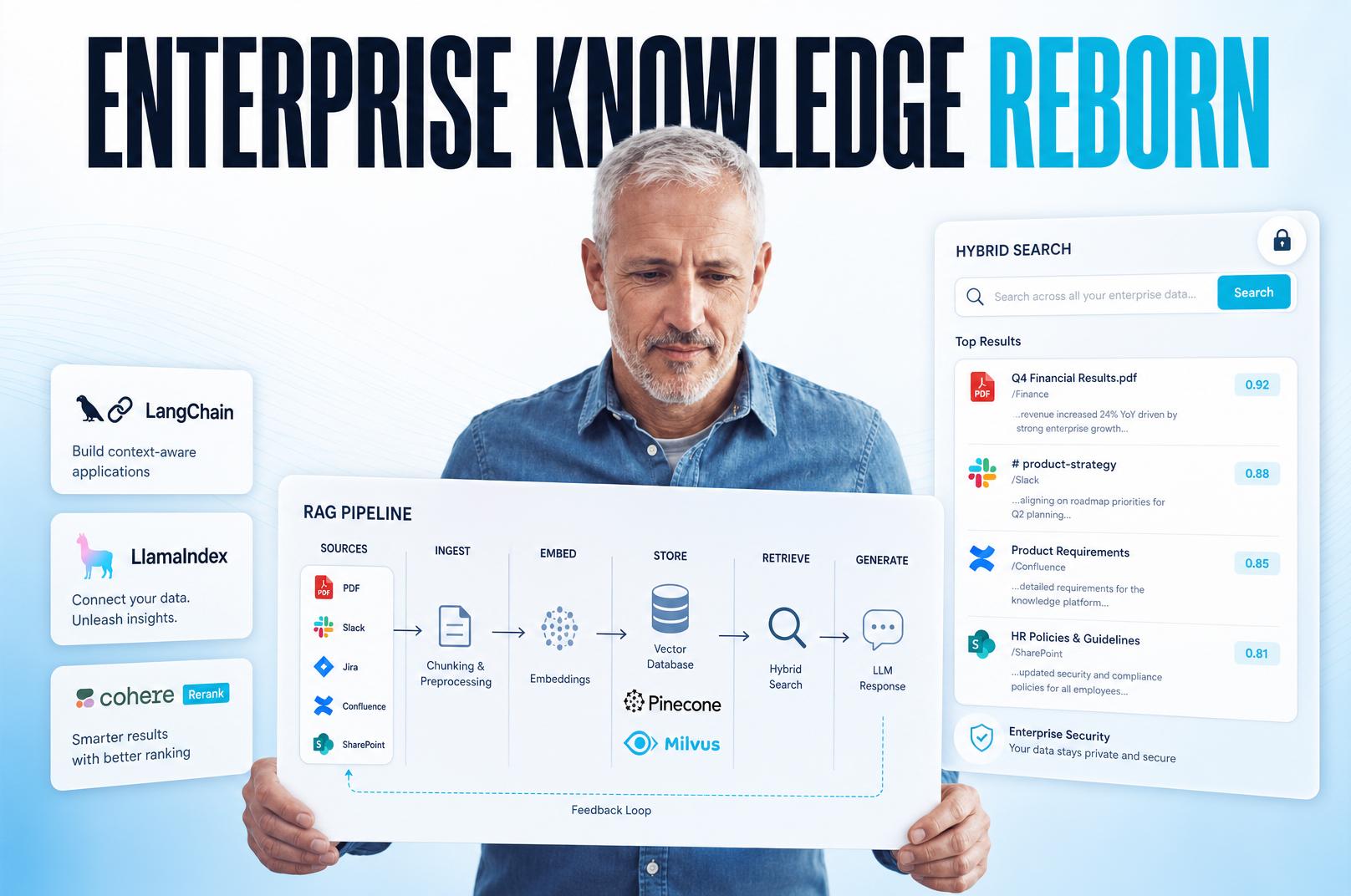
Building a robust AI-first knowledge system requires more than wrapping an API call to GPT-4. It demands a sophisticated pipeline centered on Retrieval-Augmented Generation (RAG). This architecture grounds the LLM in your specific enterprise data, reducing hallucinations and ensuring relevance. At Plavno, we implement this as a distributed system of microservices handling ingestion, embedding, retrieval, and orchestration.
The core data flow begins with an ingestion layer. Connectors pull raw data from sources (Google Drive, SharePoint, Git repositories, SQL databases). This data is then normalized—text is extracted from PDFs, HTML is stripped, and code is parsed—using libraries like Unstructured.io or Tika. The cleaned text is then chunked. This is a critical engineering decision: too small, and you lose context; too large, and you lose precision. We often employ recursive character splitting or semantic chunking to ensure boundaries align with logical thoughts.
Once chunked, the data passes through an embedding model (e.g., OpenAI text-embedding-3-small or open-source alternatives like HuggingFace MTEB leaders) to generate vector representations. These vectors are stored in a specialized Vector Database (Pinecone, Milvus, or pgvector) alongside the original text chunk and metadata (source URL, author, last updated, access control list).
The real engineering challenge in AI Knowledge Management is not the model, but the plumbing. A system that retrieves accurate data in 200 milliseconds is useless if it takes 10 seconds to verify user permissions against five different legacy directories.
When a user queries the system via an internal assistant or enterprise search bar, the orchestration layer—often built with frameworks like LangChain or LlamaIndex—springs into action. The user's query is converted into a vector and a similarity search is performed against the vector database. However, a modern implementation uses "Hybrid Search," combining dense vector retrieval with sparse keyword search (BM25) to capture both semantic meaning and exact matches (like part numbers or acronyms).
The retrieved chunks are then passed through a "Reranker" model (like Cohere Rerank or BERT-based cross-encoders) to filter out noise before the top N results are sent to the LLM. Crucially, this is where security is enforced. The system must intersect the retrieved documents with the user's permissions (stored in Auth0, Okta, or LDAP) to strip out any results the user is not authorized to see. The LLM then synthesizes the final answer, citing sources to maintain verifiability.
- Ingestion & ETL: Python-based workers using Kafka or AWS SQS for message queues to handle high-throughput document processing without blocking the main API.
- Vector Store: Managed vector databases (Pinecone/Weaviate) for horizontal scaling, or pgvector for tighter integration with existing relational data.
- Orchestration: LangChain or LlamaIndex for managing prompt templates, chaining retrieval steps, and handling memory/state.
- API Gateway: Kubernetes-ingress managed gateways (Kong or Ambassador) handling rate limiting, OAuth2 introspection, and request routing.
- Observability: Integration with tools like Arize or LangSmith for tracing the retrieval pipeline, measuring latency, and detecting hallucination drift.
Business impact & measurable ROI
Implementing an AI-first knowledge base is not just a technical upgrade; it is a productivity lever with direct financial implications. The shift from "searching" to "asking" fundamentally changes the speed of operations. For support teams, this means deflecting Tier 1 and Tier 2 tickets by empowering internal assistants to answer complex policy questions instantly. For engineering teams, it drastically reduces the time spent onboarding new developers, who can now query the system for "How is the auth microservice deployed?" rather than waiting for a senior engineer's availability.
Enterprises implementing RAG-based knowledge retrieval see a 30-40% reduction in time-to-resolution for internal support queries and a significant decrease in duplicate work caused by information asymmetry.
The ROI is driven by three primary factors. First is the efficiency gain: if a company of 500 engineers saves 2 hours a week per person on information retrieval, that is 1,000 hours a week redirected toward product development. Second is the preservation of institutional memory; when senior employees leave, their knowledge remains indexed and queryable, preventing the "brain drain" that typically accompanies turnover. Third is risk mitigation; by grounding AI responses in verified documents and enforcing strict ACLs, enterprises avoid the legal and compliance risks associated with public generative AI models.
From a cost perspective, operating a RAG system is predictable. While token generation incurs costs, the heavy lifting is done by vector retrieval, which is computationally cheap compared to fine-tuning models. Caching frequent queries (semantic caching) further reduces API calls to the LLM, optimizing the cost per query to fractions of a cent. This allows for enterprise-grade scalability without the runaway costs associated with naive AI implementations.
Implementation strategy
Deploying an AI Knowledge Management system requires a phased approach that prioritizes data hygiene and governance over model hype. A "big bang" launch often fails due to poor data quality. Instead, we recommend a pilot program focused on a high-impact, bounded domain, such as IT documentation or HR policies.
- Data Audit & Cleanup: Identify the "Golden Datasets"—the most accessed and accurate documents. Archive or tag outdated content to prevent the AI from retrieving deprecated information.
- Infrastructure Setup: Deploy the vector store and ingestion pipelines in a secure cloud environment (AWS/Azure/GCP). Ensure containerization (Docker/Kubernetes) for reproducibility.
- Security Integration: Implement the "AuthZ filter" pattern. Ensure the ingestion pipeline captures ACLs (Access Control Lists) and the retrieval layer enforces them before data hits the LLM.
- Pilot & Feedback Loop: Release the internal assistant to a beta group. Implement a "thumbs up/down" feedback mechanism on every answer to gather reinforcement data for prompt tuning.
- Scaling & Expansion: Once the pilot achieves a containment rate (questions answered without human escalation) above 60%, expand connectors to other data sources like Jira, Salesforce, and code repositories.
Common pitfalls to avoid include neglecting the "cold start" problem (where the system has no data), ignoring metadata hygiene (failing to tag document dates or authors), and relying solely on vector search without keyword fallback. Governance is also critical; you must establish a human-in-the-loop review process to periodically audit the AI's answers for accuracy and tone. By treating the knowledge base as a living product rather than a static project, organizations ensure the system evolves with the business.
Why Plavno’s approach works
At Plavno, we don't just implement chatbots; we engineer intelligent information systems. Our approach is grounded in custom software development principles, ensuring that your AI solution is tailored to your specific data topology and security requirements. We understand that off-the-shelf SaaS solutions often fail to integrate deeply with legacy on-premise systems or complex permission structures.
We specialize in building robust AI agents and internal assistants that utilize advanced RAG architectures. Our team leverages frameworks like LangChain and LlamaIndex not as black boxes, but as modular components that we orchestrate to meet specific latency and throughput requirements. Whether it is integrating with Plavno Nova for automation or building bespoke chatbots, we focus on observability and control.
Furthermore, our expertise in digital transformation allows us to navigate the complexities of enterprise data governance. We implement rigorous security measures, ensuring that your AI consulting and deployment strategies align with compliance standards like SOC2 and GDPR. By choosing Plavno, you are partnering with engineers who prioritize system reliability, scalability, and measurable business value over fleeting trends.
The transition to AI-first knowledge systems is inevitable for enterprises that want to maintain agility. The technology to synthesize enterprise data exists today, but the value lies in the implementation—building pipelines that are secure, fast, and deeply integrated into the daily workflows of engineers and business teams. AI Knowledge Management is the bridge between your data reservoirs and your workforce's potential. By treating this as a serious engineering discipline rather than a marketing gimmick, organizations can unlock productivity gains that were previously impossible. If you are ready to move beyond the search bar and build a system that actually understands your business, the time to act is now.