Why AI Integration Is Becoming More Important Than Model Selection
Discover why enterprise success with AI depends more on robust integration strategies than on model selection. Learn how to connect LLMs to legacy systems efficiently.
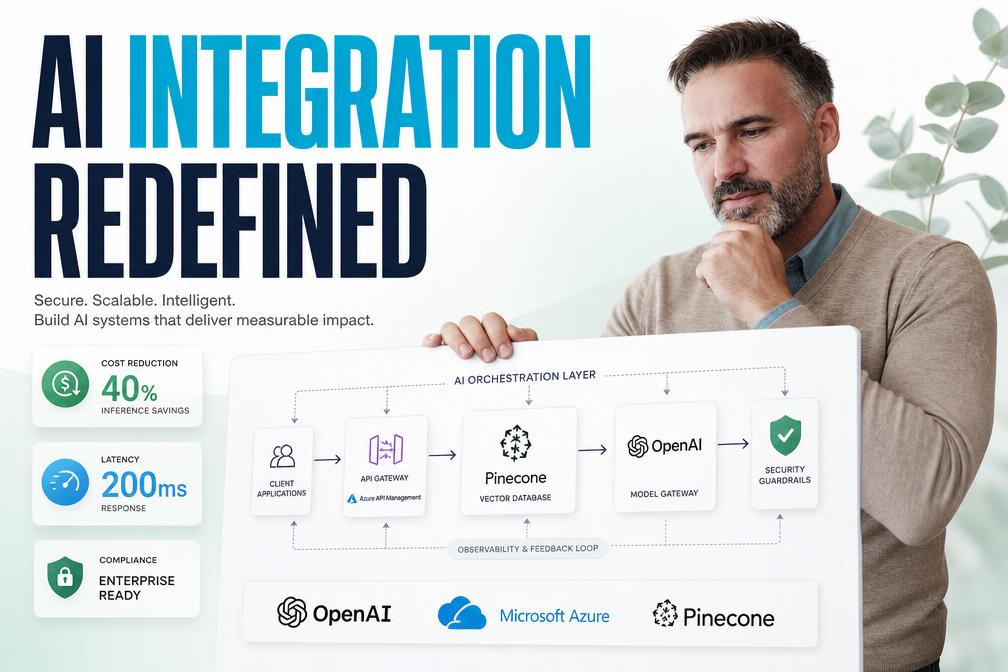
The novelty of large language models (LLMs) is wearing off, replaced by the hard reality of enterprise integration. CTOs and engineering leads are realizing that swapping GPT-4 for Claude 3 or fine-tuning Llama 3 delivers marginal gains compared to the massive overhead of actually connecting these models to legacy business systems. The market is shifting from "model shopping" to "system building." The companies winning today aren't those with the most expensive model subscription; they are the ones with a robust AI Integration Strategy that treats AI as a component within a larger, resilient architecture.
Enterprise AI adoption is hitting a wall. Proof-of-concepts are abundant, but production-grade deployments are rare. The primary bottleneck is no longer model intelligence; it is the inability to reliably embed that intelligence into existing workflows without breaking compliance, security, or latency budgets. Organizations are discovering that a powerful model isolated from customer data or operational tools is essentially useless.
A successful AI Integration Strategy decouples the model from the application logic. We treat the LLM as a stateless service that requires a sophisticated orchestration layer to manage context, memory, and tool execution. The architecture must support hybrid deployment—running sensitive workloads on-prem or in VPCs while utilizing public APIs for general tasks.
In a typical enterprise setup, the flow begins at the API Gateway, which handles authentication (OAuth2/JWT) and rate limiting before the request ever touches an AI component. From there, an orchestration layer—often built with frameworks like LangChain or LlamaIndex—determines the intent of the request. If the user asks for current account balance, the system should not query an LLM; it should route the request to a standard REST API endpoint serving the database of record. If the user asks for a summary of contract risks, the orchestrator triggers a RAG pipeline.
Data pipelines are the circulatory system of this architecture. Raw data from business systems (PDFs, SQL databases, CRM logs) cannot be fed directly into the model. It must be cleaned, chunked, and embedded. For example, when processing legal documents, we use a pipeline that extracts text, removes headers/footers, splits text into 500-token chunks with overlap, and generates embeddings using a model like OpenAI text-embedding-3-small. These vectors are stored in the vector DB with metadata pointers to the original source.
Model orchestration is where the real engineering happens. We implement "tool use" or "function calling," allowing the LLM to interact with external APIs. When a user asks to "schedule a meeting," the LLM outputs a structured JSON object representing a function call. The orchestration layer validates this schema, executes the call via Google Calendar or Outlook API, and returns the result to the LLM to formulate the final natural language response. This requires strict error handling; if the API returns a 429 (Too Many Requests), the system must implement exponential backoff and retry logic to ensure idempotency.
Infrastructure considerations are critical. We generally recommend containerizing the orchestration layer using Docker and deploying on Kubernetes. This allows for horizontal scaling when traffic spikes. For the vector database, choose a solution that supports your required scale; a hosted solution like Pinecone is great for speed, but pgvector might be better for data residency. Caching is non-negotiable. Redis is used to cache frequent query-response pairs to avoid redundant API calls, which directly reduces latency and cost.
Security and governance must be baked in, not bolted on. We implement a "guardrail" layer—using tools like NeMo Guardrails or Llama Guard—that sits between the user and the model. This layer checks input for prompt injection attacks and PII leakage, and checks output for toxic content or policy violations. All interactions must be logged to an immutable audit trail for compliance. Furthermore, we utilize Virtual Private Cloud (VPC) endpoints to ensure that traffic between the enterprise infrastructure and the AI provider does not traverse the public internet.
Implementing a rigorous AI Integration Strategy shifts the conversation from "cool tech demos" to measurable business outcomes. The ROI is driven by efficiency gains, cost optimization, and risk mitigation. By treating AI as an architectural component rather than a standalone product, enterprises can predict and control their spend.
Deploying AI at scale requires a phased approach. Do not attempt a "big bang" overhaul of your entire technology stack. Start with a pilot that solves a specific, high-impact problem, but build it with production-grade architecture from day one. This avoids the "throwaway prototype" trap where the pilot code has to be completely rewritten for enterprise scaling.
Common pitfalls to avoid include neglecting the "human in the loop" for high-stakes decisions, ignoring data privacy by sending sensitive logs to public models for debugging, and underestimating the complexity of prompt engineering. Another frequent failure mode is over-reliance on the model's memory; stateless architectures backed by durable databases (Redis, Postgres) are far more reliable than relying on the context window to maintain conversation history.
At Plavno, we don't just "add AI" to your product; we engineer AI into your business logic. Our approach is grounded in custom software development principles that prioritize scalability, security, and maintainability. We understand that an AI model is only as good as the infrastructure that supports it.
We specialize in building complex AI agents that can execute multi-step workflows, interacting with your existing APIs to perform actual work, not just generate text. Whether it's AI automation for internal operations or customer-facing assistants, we design the architecture to handle the nuances of real-world data. Our expertise in digital transformation ensures that these AI systems integrate seamlessly with your legacy stack, bridging the gap between modern AI capabilities and established enterprise environments.
Furthermore, our AI consulting services help you navigate the rapidly changing landscape of models and tools. We help you choose the right components for your specific needs, avoiding vendor lock-in and ensuring your architecture remains flexible. From web development to backend integration, we provide the full-stack engineering capability required to make AI a tangible driver of value for your business.
The future of enterprise AI isn't about who has the best model; it's about who has the best AI Integration Strategy. It is about the plumbing, the governance, and the architectural patterns that allow intelligence to flow safely and efficiently through your organization. By focusing on integration, workflow, and robust engineering, you turn AI from a novelty into a reliable, high-performance asset.
Contact Us
Plavno experts contact you within 24h
Discuss your project details
We can sign NDA for complete secrecy
Submit a comprehensive project proposal with estimates, timelines, team composition, etc
Plavno has a team of experts ready to start your project. Ask us!

Vitaly Kovalev
Sales Manager
