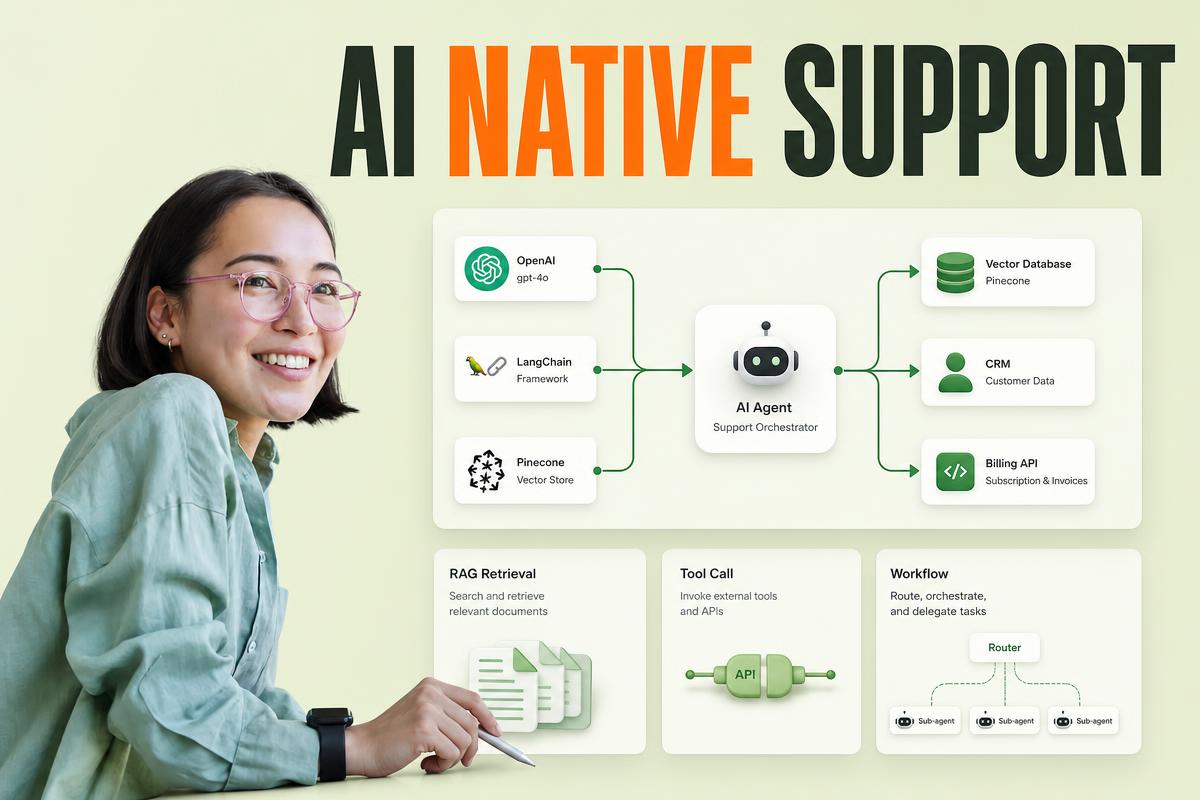
The shift from "AI-assisted" to "AI-native" is not a semantic upgrade; it is a fundamental architectural rethinking of service operations. For years, enterprises have treated AI as a wrapper around legacy ticketing systems—a chatbot bolted onto a rigid, human-centric workflow. That approach fails because it forces a deterministic, linear process onto a probabilistic technology. True AI Customer Support requires redesigning the stack from the ground up, treating the AI agent not as a triage tool but as the primary operator capable of reasoning, retrieving data, and executing actions via APIs. This transition moves support from a cost center burdened by latency to a self-healing operational layer.
Industry challenge & market context
Legacy support operations are hitting a scalability wall. The traditional model—tiered L1/L2 support, rigid ticket routing, and static knowledge bases—cannot keep pace with the complexity of modern software products or the volume of user queries. Organizations are struggling with three specific structural failures that customer support AI must address.
- Fragmented data silos: Customer context is scattered across CRM systems (Salesforce), ticketing platforms (Zendesk), and product databases. Legacy bots cannot query these sources dynamically, leading to generic "I didn't understand that" loops.
- Rigid escalation matrices: Traditional workflows rely on hardcoded rules (e.g., "if billing > $500, escalate to finance"). This lacks nuance. A high-value customer with a minor bug needs a different path than a churn-risk user with a critical outage, but rule-based engines cannot weigh context effectively.
- High operational latency: Human agents spend 30-50% of their time digging for information or switching tabs. This "research tax" destroys First Contact Resolution (FCR) rates and inflates Cost Per Ticket.
- The hallucination risk: Early LLM implementations proved that without guardrails, AI invents policies. The challenge is implementing support automation that is factually grounded and auditable, not merely fluent.
The competitive advantage in the next decade will not belong to those with the best models, but to those who build the most robust orchestration layers that can safely connect those models to their proprietary business logic.
Technical architecture and how AI Customer Support works in practice
Building an AI-native helpdesk requires moving beyond simple prompt engineering. You need a distributed system that handles ingestion, retrieval, reasoning, and execution. At Plavno, we architect these systems using a microservices approach, typically deployed on Kubernetes with a mix of Python (for data/ML) and Node.js (for real-time websockets).
The core of the architecture is the Orchestration Layer. We utilize frameworks like LangChain or LlamaIndex to manage the lifecycle of a request. When a user query hits the system via an API Gateway, it is not immediately sent to the LLM. First, it passes through a Router. This lightweight classifier determines the intent—is this a billing question, a technical bug, or a feature request? Based on this classification, the system selects the appropriate "Agent" or sub-chain.
For knowledge retrieval, we implement Retrieval-Augmented Generation (RAG). We do not rely on the model's pre-training. Instead, we chunk technical documentation, past tickets, and policy PDFs, convert them into embeddings using models like OpenAI text-embedding-3 or HuggingFace embeddings, and store them in a Vector Database (Pinecone, Milvus, or pgvector). When a query comes in, the system performs a semantic search to fetch the top 5-10 relevant chunks. These chunks are injected into the system prompt as context, drastically reducing hallucinations and ensuring the answer is grounded in company data.
However, modern AI Customer Support must do more than answer questions; it must perform actions. This is where Tool Use and Function Calling become critical. The LLM is granted access to a defined set of secure APIs wrapped in tools.
- Identity Verification: Before accessing data, the agent calls an OAuth2 endpoint to verify the user's JWT token.
- CRM Lookup: Using tools defined in OpenAPI specs, the agent queries the CRM to fetch user status, subscription tier, and recent interaction history.
- Business Logic Execution: For a refund request, the agent doesn't just say "I can help." It calls a billing API (Stripe/Adyen) to check transaction status and, if policy allows, triggers a refund webhook.
State management is handled via a fast key-value store like Redis or a durable execution framework like Temporal. This ensures that if a conversation involves multiple steps (e.g., "check my server status, then restart it"), the system maintains context across turns. We also implement Guardrails using frameworks like NeMo Guardrails or custom output parsers to ensure the AI never stray into prohibited topics or emit toxic content.
In practice, the flow looks like this: A user asks, "Why is my API latency high?" The system identifies the user via API key. It retrieves their recent logs from a monitoring service (Datadog/New Relic) via an API integration. It summarizes the logs using a smaller, faster model (like Llama-3-70b or GPT-4o-mini) to identify a rate-limit error. It then cross-references the documentation in the Vector DB to explain the specific limit and offers to increase the quota via a button click that triggers a backend workflow.
Business impact & measurable ROI
Implementing this architecture drives specific, measurable levers that CTOs and CFOs care about. The move to service operations driven by AI shifts the economics of support from linear scaling to logarithmic scaling.
- Deflection Rates: Effective AI-native systems can deflect 60-80% of Tier 1 tickets. Unlike keyword bots that frustrate users, RAG-based agents resolve complex queries by pulling real-time data.
- Reduced MTTR (Mean Time To Resolution): By automating the data gathering phase, AI reduces the "research tax" on human agents. When an escalation occurs, the human agent receives a summarized ticket with all relevant context, logs, and suggested actions, cutting resolution time by 50% or more.
- 24/7 Availability without Latency: Global enterprises operate across time zones. AI agents provide instant responses in the user's native language, eliminating the overnight queue backlog that traditionally overwhelmed support teams in the morning.
- Cost Per Ticket Reduction: While the infra cost for LLMs is non-zero (typically $0.01–$0.05 per interaction depending on the model), it is orders of magnitude lower than the $5–$15 cost of a human minute. The ROI becomes positive almost immediately once the system handles volume.
The real ROI of AI Customer Support isn't just replacing headcount; it is the capture of intent data. Every interaction becomes a structured data point that informs product roadmap, churn prediction, and feature prioritization.
Implementation strategy
Deploying an AI helpdesk is not a "set it and forget it" project. It requires a phased approach that prioritizes data hygiene and incremental value delivery.
- Data Audit & Ingestion: Identify high-value data sources (Confluence, Salesforce, GitHub issues). Clean and standardize this data. Garbage in, garbage out is the law of AI; if your documentation is outdated, the AI will hallucinate.
- The "Golden Dataset": Create a test set of 50-100 real, anonymized historical tickets. Use this to evaluate the performance of your RAG pipeline and prompts before exposing the system to users.
- Pilot with Human-in-the-Loop: Launch the AI as an assistant for your human agents first. It drafts responses, which agents review and send. This trains the model on preferred tone and accuracy while building trust.
- Gradual Autonomy: Move the AI to the front lines for low-risk, high-volume topics (e.g., password resets, "where is my invoice"). Keep high-risk actions (account deletion, large refunds) under human approval workflows.
- Observability & Feedback Loops: Implement tracing (using OpenTelemetry) to monitor latency and token usage. More importantly, capture explicit user feedback (thumbs up/down) to fine-tune the retrieval algorithm and re-rank results.
Common pitfalls include over-reliance on massive context windows (which increases cost and latency without improving accuracy) and neglecting idempotency in API calls. If an AI agent retries a failed "refund" request three times due to a network timeout, you must ensure your backend APIs handle this gracefully without processing the refund three times.
Why Plavno’s approach works
At Plavno, we do not believe in generic, one-size-fits-all chatbots. We build enterprise-grade AI agents that integrate deeply with your existing infrastructure. Our engineering-first approach ensures that your AI Customer Support system is secure, scalable, and actually solves the problems your users face.
We leverage advanced AI automation techniques, including multi-agent frameworks like CrewAI or AutoGen, where specialized agents (e.g., a "Billing Agent" and a "Tech Support Agent") collaborate to solve complex queries. This mimics human teamwork but executes it at machine speed. Whether you need a sophisticated AI assistant for internal ops or a customer-facing AI chatbot, we focus on the "glue"—the API integrations, the vector database architecture, and the governance layers that make the system reliable.
As a leading AI development company, we understand that the value lies in the specifics. We provide comprehensive AI consulting to map your business logic to technical workflows, ensuring that the AI acts as a competent extension of your team, not a black box. Our expertise in custom software development allows us to modify your backend systems if necessary to make them more AI-accessible, exposing the right endpoints and securing the right data.
Redesigning your service operations around AI is a technical challenge that pays dividends in efficiency and customer satisfaction. It requires a partner who speaks both language—business strategy and systems architecture. That partner is Plavno.
The future of support is not a ticket number; it is a resolved issue. The technology is here. The architecture is understood. The only variable is your organization's willingness to implement AI Customer Support correctly. If you are ready to move beyond the hype and build a system that works, let's talk.