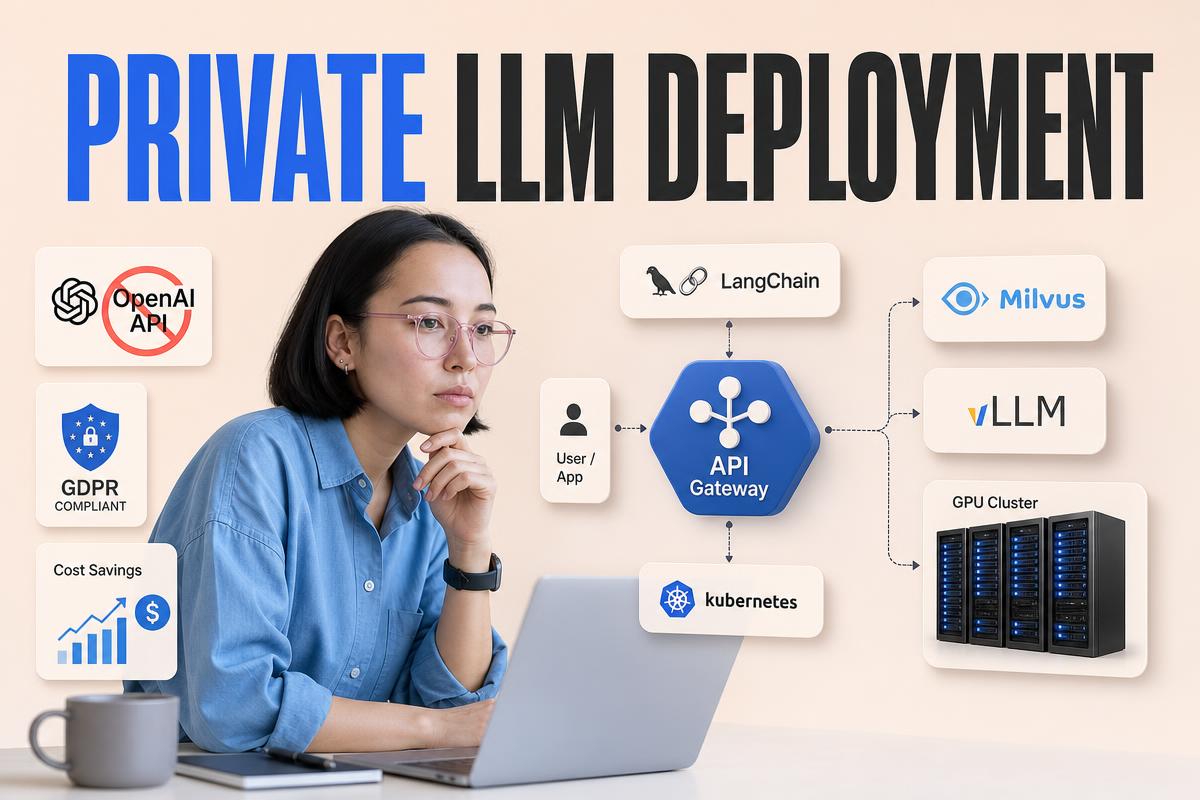
The rush to integrate Large Language Models (LLMs) into enterprise workflows has created a critical bifurcation in technical strategy. On one side, there is the allure of plug-and-play public AI API services like OpenAI or Anthropic, which offer immediate intelligence but demand you surrender your data to a third-party black box. On the other, there is the complex but sovereign path of private LLM deployment, where you own the stack, the weights, and the data. For CTOs and engineering leaders, the decision is no longer just about capability; it is a calculation of data sovereignty, long-term unit economics, and architectural control. As regulatory scrutiny tightens and data privacy becomes a board-level imperative, the "rented intelligence" model is showing cracks for enterprises handling sensitive IP.
Industry challenge & market context
Enterprises are hitting a wall with the "API-first" approach to Generative AI. While prototyping with a public API is fast, moving that prototype into production introduces systemic risks that engineering teams cannot simply patch over. The core issue is the tension between velocity and compliance. When you send proprietary context—customer data, financial records, or source code—to a public inference endpoint, you are effectively exporting your crown jewels. Even with "zero data retention" policies, the network transit and the opaque nature of the model updates create a liability shadow that legal and security teams find unacceptable.
- Data sovereignty and leakage: Sending PII or trade secrets to external models violates GDPR, HIPAA, and internal corporate policies, creating legal exposure that outweighs the utility of the AI.
- Unpredictable cost structures: Public API pricing is token-based and opaque; as usage scales, costs become non-linear and difficult to forecast, especially with long context windows.
- Vendor lock-in and instability: Relying on a single provider’s API means your product roadmap is hostage to their rate limits, model deprecations, and downtime.
- Lack of model customization: Public APIs offer limited fine-tuning capabilities; you cannot easily inject domain-specific knowledge or change the model weights to optimize for your specific jargon.
- Latency and connectivity: Dependence on external networks introduces jitter and latency that is unacceptable for real-time applications like high-frequency trading assistants or instant support bots.
Technical architecture and how private LLM deployment works in practice
Deploying an enterprise LLM privately is not merely about downloading a model weight file and running a Python script. It requires a robust, production-grade architecture that handles inference, vector storage, and orchestration. A typical private LLM deployment shifts the paradigm from "calling a service" to "managing a microservices ecosystem." The architecture usually sits within your VPC (Virtual Private Cloud) or on-premise metal, ensuring that data never crosses a public trust boundary.
The system generally consists of an API Gateway (e.g., Kong or Envoy) that handles authentication and rate limiting, routing requests to an orchestration layer. This orchestration layer, often built with frameworks like LangChain or LlamaIndex, manages the logic of Retrieval-Augmented Generation (RAG). It breaks down the user query, generates embeddings using models like BGE or E5 running locally, and queries a Vector Database (such as Milvus, Weaviate, or pgvector) to retrieve relevant context. This context is then injected into the prompt template and sent to the inference engine.
The inference engine is the heart of the system. Instead of a monolithic script, we use high-performance serving runtimes like vLLM or Text Generation Inference (TGI). These runtimes utilize PagedAttention technology to maximize GPU utilization and manage KV caches efficiently. The models themselves—whether Llama 3, Mistral, or Mixtral—are often quantized (4-bit or 8-bit) using AWQ or GPTQ to reduce VRAM requirements without significant quality loss. This allows you to run powerful 70B parameter models on fewer GPUs, drastically lowering the hardware barrier.
The biggest misconception in enterprise AI is that you need a 400-billion parameter model to be useful. In reality, a well-architected 7B or 8B model, paired with a high-precision RAG pipeline, will outperform a generic GPT-4 class model on domain-specific tasks while costing a fraction of the price to operate.
Infrastructure-wise, this stack is containerized using Docker and orchestrated via Kubernetes. This allows for auto-scaling based on queue depth; if the request queue spikes, Kubernetes spins up additional inference pods. State is managed externally, ensuring that the inference pods are stateless and immutable. For on-premise AI deployments, bare metal clusters with NVIDIA GPUs or specialized accelerators (like AMD ROCm or AWS Inferentia) are provisioned. Storage is handled via high-throughput solutions like NVMe or S3-compatible object storage for loading large model weights quickly.
- API Gateway & Security: Implements OAuth2, mTLS, and request validation to ensure only authorized internal services can access the LLM endpoints.
- Orchestration Layer (LangChain/LlamaIndex): Manages prompt templates, chain routing, and tool use (e.g., connecting to SQL databases or internal APIs via function calling).
- Vector Database: Stores embeddings of your private documents; supports hybrid search (keyword + semantic) and filtering based on metadata (e.g., "document date < 2023").
- Inference Runtime (vLLM/TGI): Optimized servers that handle continuous batching and tensor parallelism for low-latency text generation.
- Observability Stack: Integrates with Prometheus/Grafana for metrics and OpenTelemetry for tracing to monitor token throughput, latency (Time to First Token), and hardware utilization.
In a real-world scenario, consider a legal firm querying a database of contracts. The user asks, "What are the termination clauses in our 2023 vendor contracts?" The system authenticates the user via the API Gateway. The orchestrator converts the query to an embedding, searches the Vector DB restricted to "2023" and "vendor" tags, retrieves the relevant contract chunks, and feeds them into a locally hosted Llama 3 model. The model synthesizes the answer, citing sources, and returns it—all without the data ever leaving the firm's private cloud.
Business impact & measurable ROI
Moving to a secure LLM architecture is a capital expenditure (CapEx) versus operational expenditure (OpEx) decision. While public APIs offer a low barrier to entry, their unit costs scale aggressively with volume. For an enterprise processing millions of tokens daily, the "pay-per-token" model becomes a financial bleed. Private deployment flips this: you invest in hardware upfront, but the marginal cost of inference drops to near zero (essentially the cost of electricity and maintenance).
Quantifying the ROI involves looking at three vectors: direct cost savings, risk mitigation, and performance gains. On the cost side, running a 7B model on a single NVIDIA A10G or A100 instance can cost roughly $1–$3 per hour in cloud compute, capable of processing thousands of tokens per second. Compared to public API rates, this breaks even typically after a few hundred million tokens and becomes exponentially cheaper thereafter. Furthermore, you eliminate the "context window tax"—public APIs charge heavily for large context inputs, whereas in a private deployment, you are only constrained by VRAM, not by a pricing tier.
Private deployment reduces inference latency by 40-60% on average compared to public APIs because you eliminate the network round-trip to the provider and optimize the model specifically for your hardware and use case.
Risk mitigation, while harder to put a dollar figure on, is arguably more valuable. By keeping data in-house, you avoid the potential fines associated with data breaches (which can run into millions of dollars) and the reputational damage of leaking customer data. Additionally, private deployment offers "infinite uptime" potential—you control the SLA. You are not subject to the outages that have plagued major public AI providers. Finally, performance gains in latency and the ability to fine-tune models lead to better user adoption and more efficient automation, directly impacting the bottom line.
- Cost Predictability: Fixed hardware costs allow for accurate budgeting, removing the volatility of token-based pricing models.
- Data Gravity: Processing data where it lives (e.g., within a specific AWS region or on-prem data center) eliminates egress fees and compliance hurdles.
- Customization Depth: You can perform full fine-tuning or LoRA (Low-Rank Adaptation) on the model to deeply internalize your business logic, something impossible with closed public models.
- Vendor Independence: Owning the stack means you can swap underlying models (e.g., switching from Llama 2 to Llama 3) without rewriting your application logic.
Implementation strategy
Transitioning from a public API to a private LLM deployment should be treated as a migration project, not a "big bang" rewrite. The goal is to minimize disruption while building internal competence. We recommend a phased approach starting with a "shadow mode" pilot. In this phase, you route a copy of production traffic to your private instance and compare the outputs (latency, quality, cost) against the public API baseline. This allows you to fine-tune your RAG pipelines and prompt engineering strategies without affecting end-users.
Once parity is achieved, you can begin cutting over specific, low-risk workloads. It is crucial to establish a Center of Excellence (CoE) or a dedicated AI platform team early on. This team should own the infrastructure, the model lifecycle, and the governance policies. They will define the guardrails for what data is allowed into the vector store and how models are updated. Governance is key; you need automated pipelines to re-index your vector databases when source documents change and mechanisms to audit model responses for safety.
- Assessment & Baseline: Audit current AI usage, identify high-volume/high-sensitivity use cases, and establish performance benchmarks using public APIs.
- Infrastructure Setup: Provision GPU-accelerated Kubernetes clusters, deploy the inference runtime (vLLM/TGI), and set up the Vector DB and monitoring stack.
- Pilot RAG Pipeline: Ingest a subset of data, build the retrieval pipeline, and run A/B tests against the public API to validate response quality and latency.
- Model Optimization: Apply quantization and test smaller models (7B/8B) to see if they suffice for your specific tasks, reducing hardware requirements.
- Production Cutover: Migrate low-risk internal tools first (e.g., HR bots, code assistants), then move to customer-facing applications as confidence grows.
Common pitfalls include over-estimating the necessary model size (starting with 70B when 8B would do) and neglecting the data preprocessing pipeline. Garbage in, garbage out is doubly true for RAG; if your document chunking and cleaning strategies are poor, the LLM will hallucinate, regardless of where it is hosted. Another trap is ignoring observability; without tracing, debugging a distributed LLM system is a nightmare. Ensure you have logging for every retrieval step and generation token.
Why Plavno’s approach works
At Plavno, we don't treat AI as a magic wand; we treat it as an engineering discipline. We specialize in building robust AI solutions that integrate seamlessly with your existing enterprise architecture. Our approach to private LLM deployment is grounded in pragmatism. We don't just deploy a model; we build the entire data ecosystem around it. From designing high-throughput ETL pipelines that feed your Vector DB to implementing sophisticated orchestration layers using LangChain or AutoGen, we ensure your AI initiative is scalable and secure.
We understand that every enterprise has unique constraints. Whether you need custom software development to bridge legacy systems with modern AI agents or require strategic AI consulting to define your roadmap, our team of principal engineers and architects delivers concrete results. We have experience deploying secure, on-premise AI solutions for industries ranging from fintech to healthcare, ensuring compliance without sacrificing performance. If you are ready to move beyond the limitations of public APIs and own your AI infrastructure, hire developers from Plavno to build a future-proof, private intelligence layer for your organization.
The choice between public and private AI is ultimately a choice between convenience and autonomy. For prototypes, public APIs win. For enterprises that plan to be here in ten years, private deployment is the only viable path. It offers the control, security, and economics required to turn AI from a novelty into a sustainable competitive advantage. By investing in a private stack today, you are not just saving money on tokens; you are building a proprietary asset that grows in value with every document you process and every query you answer.