The shift from simple autocomplete to autonomous agency is fundamentally rewriting the economics of software engineering. We are no longer just discussing tools that write lines of code; we are deploying systems that understand context, navigate complex codebases, and execute multi-step workflows to resolve architectural bottlenecks. For enterprise engineering leaders, the question has moved beyond "can AI code?" to "how do we integrate AI agents into our SDLC without introducing chaos?" The answer lies in the sophisticated application of models like OpenAI Codex enterprise within a governed, secure architectural framework that turns raw generative power into reliable product velocity.
Industry challenge & market context
Enterprise product development is currently stalled by a collision of increasing complexity and resource scarcity. Engineering teams are burdened not just by feature requests, but by the weight of legacy maintenance, technical debt, and the cognitive load of navigating massive monolithic repositories. Traditional hiring models cannot scale fast enough to meet demand, and existing "low-code" solutions often fail to deliver the customization required at scale.
- Velocity bottlenecks in prototyping phases where business requirements stall waiting for technical feasibility studies.
- Knowledge silos where critical context resides solely in the heads of senior architects, creating single points of failure.
- High operational overhead in maintaining documentation and unit tests, which often deprioritized in favor of feature shipping.
- Security risks associated with shadow AI usage, where engineers paste proprietary code into public interfaces to gain productivity.
- Inconsistent code quality across distributed teams, leading to increased technical debt and refactoring cycles.
The competitive advantage is no longer just having the best model, but having the best orchestration layer that allows that model to safely interact with your proprietary data and infrastructure.
Technical architecture and how OpenAI Codex enterprise works in practice
Implementing AI coding agents effectively requires moving beyond a simple chat interface. We need to treat the LLM as a reasoning engine within a distributed system. When we deploy OpenAI Codex enterprise solutions, we are typically building an agent architecture that involves an orchestration layer, a retrieval system, and a secure execution environment.
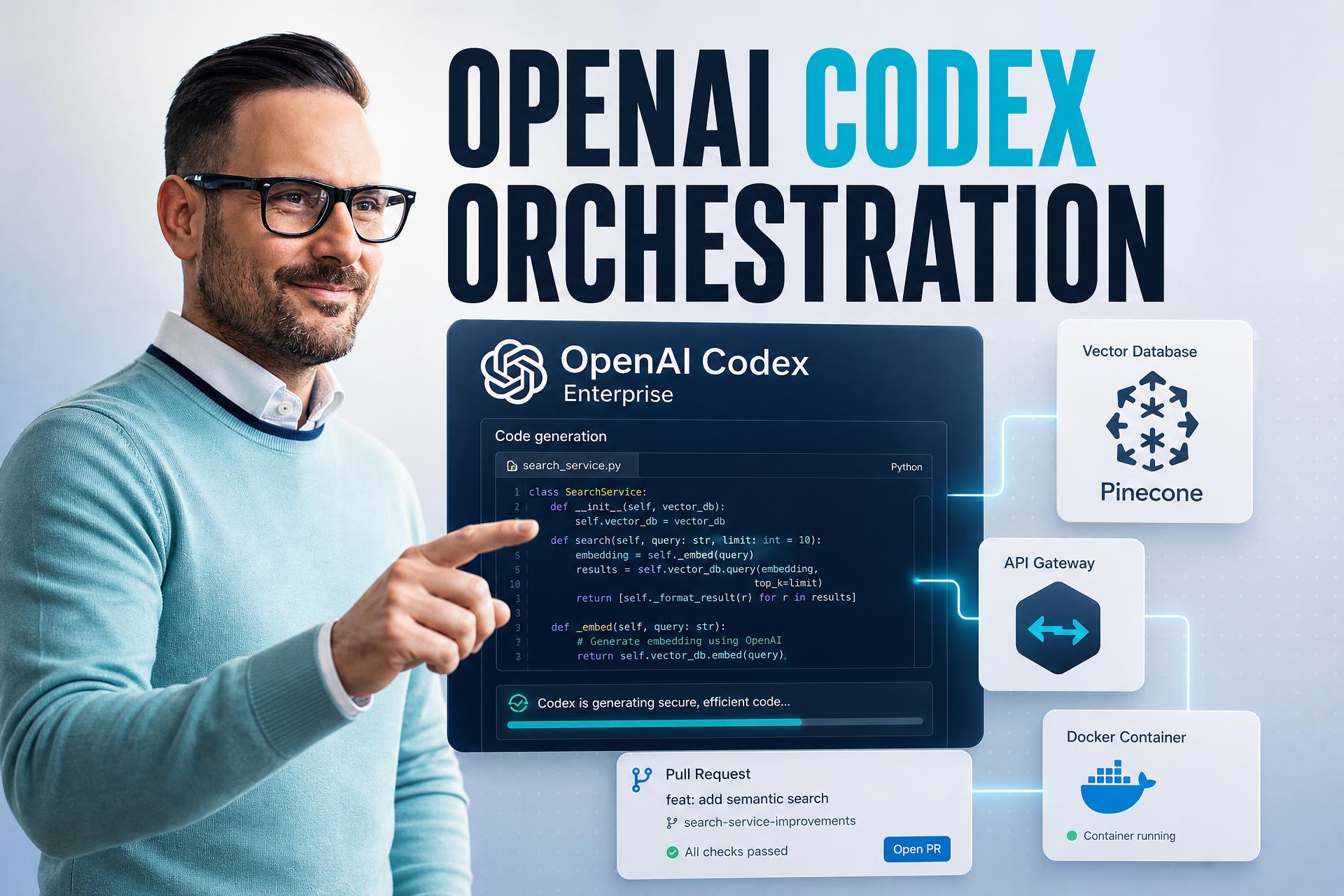
In a robust setup, the flow begins with a developer or product trigger. This input is routed via an API Gateway—often Kong or AWS API Gateway—to an orchestration service. This service, built on frameworks like LangChain or CrewAI, manages the state and logic of the interaction. It does not simply send a prompt to the model; it first determines if context is needed.
This is where Retrieval-Augmented Generation (RAG) becomes critical. The orchestration layer queries a Vector Database (such as Pinecone, Weaviate, or Milvus) containing embeddings of the company's codebase, documentation, and Jira tickets. By performing a semantic search, the system retrieves only the relevant snippets of code or policy documents, keeping the context window within limits while ensuring accuracy.
- Orchestration Layer: Uses Python or Node.js runtimes to manage agent loops, tool selection, and memory (using frameworks like LangChain or AutoGen).
- Vector Store: Stores embeddings of source code and docs, allowing the LLM to "read" private repositories without training on the data.
- Tool Use / Function Calling: The agent can trigger specific actions, such as running a Docker container, executing a test suite, or querying a PostgreSQL database via a secure API.
- Message Queues: Utilizing RabbitMQ or Kafka to handle long-running tasks asynchronously, preventing API timeouts during complex refactoring jobs.
- Observability Stack: Integration with tools like Datadog or LangSmith to trace token usage, latency, and hallucination rates in real-time.
Consider a scenario where a developer asks an agent to "refactor the authentication module in the billing service to support OAuth2." The agent breaks this down. First, it retrieves the current auth code from the vector store. Second, it identifies the necessary OAuth2 libraries. Third, it generates the new code. Crucially, fourth, it uses a "tool" to run the existing unit tests against the new code in a sandboxed environment. If tests fail, it enters a self-correction loop, iterating on the code before presenting a pull request. This transforms the LLM from a text generator into a verified participant in the CI/CD pipeline.
Architecturally, the agent must be stateless where possible but stateful regarding conversation context; we utilize Redis for caching conversation history to maintain context across sessions while strictly enforcing TTL (Time To Live) policies to manage memory costs.
Security in this architecture is non-negotiable. We implement strict role-based access control (RBAC) at the API gateway level. The agents themselves must be scoped to specific permissions; a "documentation agent" should have read-only access to the Wiki, while a "deployment agent" might have restricted write access to a staging environment via Kubernetes Service Accounts. We also employ strict output filtering and guardrails to prevent the leakage of PII or secrets in generated code. By leveraging ChatGPT Enterprise APIs, we ensure that data is not used to train public models, maintaining compliance with GDPR and SOC2 requirements.
Business impact & measurable ROI
The integration of OpenAI Codex enterprise capabilities into product development delivers tangible returns that go far beyond "typing faster." The ROI is realized in three distinct vectors: acceleration of prototyping, reduction of cognitive load on senior staff, and improvement in code quality consistency.
From a prototyping standpoint, product development AI allows teams to validate architectural decisions in hours rather than days. An architect can describe a data model and have the agent generate the corresponding SQL migrations, ORM definitions, and CRUD API endpoints in Node.js or Python instantly. This allows product owners to see a working representation of an idea immediately, reducing the time-to-market for MVPs significantly.
- Reduction in boilerplate overhead: Developers save 30-40% of time previously spent on repetitive setup, configuration, and standard CRUD operations.
- Accelerated onboarding: New hires can query the internal AI agent about codebase conventions and receive contextual answers with code examples, reducing ramp-up time by approximately 50%.
- Debt reduction: Automated agents can be tasked with identifying deprecated libraries or suggesting updates for legacy code blocks, systematically chipping away at technical debt.
- Test coverage expansion: Agents can generate comprehensive unit and integration tests for existing code, often uncovering edge cases that human reviewers missed.
Cost optimization is also a key factor. While token consumption has a price, the cost of a senior engineer's time is significantly higher. By offloading documentation, test generation, and boilerplate coding to AI coding agents, we maximize the value of human capital. Furthermore, by implementing caching strategies and semantic routing, we can minimize API calls. For example, common questions about internal libraries can be served from a cache rather than hitting the LLM every time, reducing latency and operational costs.
Implementation strategy
Deploying these capabilities requires a phased approach that prioritizes governance and quick wins. You cannot simply buy a license and turn it loose; you must cultivate the ecosystem around the model.
- Phase 1: Infrastructure & Security Setup. Establish a secure tenant within ChatGPT Enterprise or configure the Azure OpenAI Service. Set up VPC peering, API key management via HashiCorp Vault, and define the initial RBAC policies.
- Phase 2: Context Injection (RAG). Ingest high-value documentation and architectural decision records (ADRs) into a Vector DB. Do not start with the entire codebase; start with the "readme" and "style guide" layers to establish behavior.
- Phase 3: Pilot Use Cases. Select a single squad to focus on specific workflows, such as automated unit test generation or SQL query optimization. Measure baseline metrics before deployment.
- Phase 4: Agent Orchestration. Introduce multi-agent frameworks (like CrewAI or AutoGen) where specialized agents (e.g., a "Reviewer Agent" and a "Coder Agent") collaborate on a task before human review.
- Phase 5: Full CI/CD Integration. Embed the agents into the pull request workflow, providing automated suggestions and security scans directly within GitHub or GitLab.
Common pitfalls often involve over-trusting the model's output. A critical success factor is maintaining the "Human-in-the-Loop" (HITL) protocol. The AI should propose, but the human must dispose. Another pitfall is neglecting the context window limit. Sending an entire repository to the LLM is inefficient and expensive; effective retrieval strategies are more important than model size for most enterprise tasks.
- Avoid allowing agents to modify production databases directly without strict, multi-person approval workflows.
- Do not neglect prompt engineering; generic prompts yield generic results. Invest time in crafting system prompts that enforce your specific coding standards and security protocols.
- Never ignore latency; synchronous agent calls can block UI. Ensure heavy lifting is done asynchronously via message queues.
Why Plavno’s approach works
At Plavno, we do not treat AI as a novelty add-on. We integrate it as a core component of our custom software development lifecycle. Our engineering-first approach ensures that OpenAI agents are deployed within a robust architectural framework designed for scalability and security. We understand that for enterprise clients, the value lies not in the hype, but in the reliable execution of complex logic.
We specialize in building end-to-end solutions where AI agents handle the heavy lifting of data processing and code generation, while our senior architects oversee the system design and governance. Whether you are looking to build a new MVP at breakneck speed or automate complex workflows within your existing infrastructure, our team leverages AI agents development to deliver measurable results.
Our expertise extends beyond simple integration. We offer comprehensive software development consult to help you map out your AI strategy, identifying the highest-impact areas for AI automation. If your current team lacks the bandwidth to implement these sophisticated architectures, you can hire developers from Plavno who are already trained in the latest AI orchestration patterns and tools.
We build systems that are observant, secure, and capable of evolving. By combining deep domain knowledge with cutting-edge AI development capabilities, we ensure your transition to an AI-augmented SDLC is smooth, profitable, and technically sound.
The future of product development is not human versus machine; it is the human architect directing a fleet of intelligent agents. By adopting OpenAI Codex enterprise technologies today, you secure the technical foundation for tomorrow's velocity. The tools are here, the patterns are established, and the opportunity to outpace the competition is immediate.