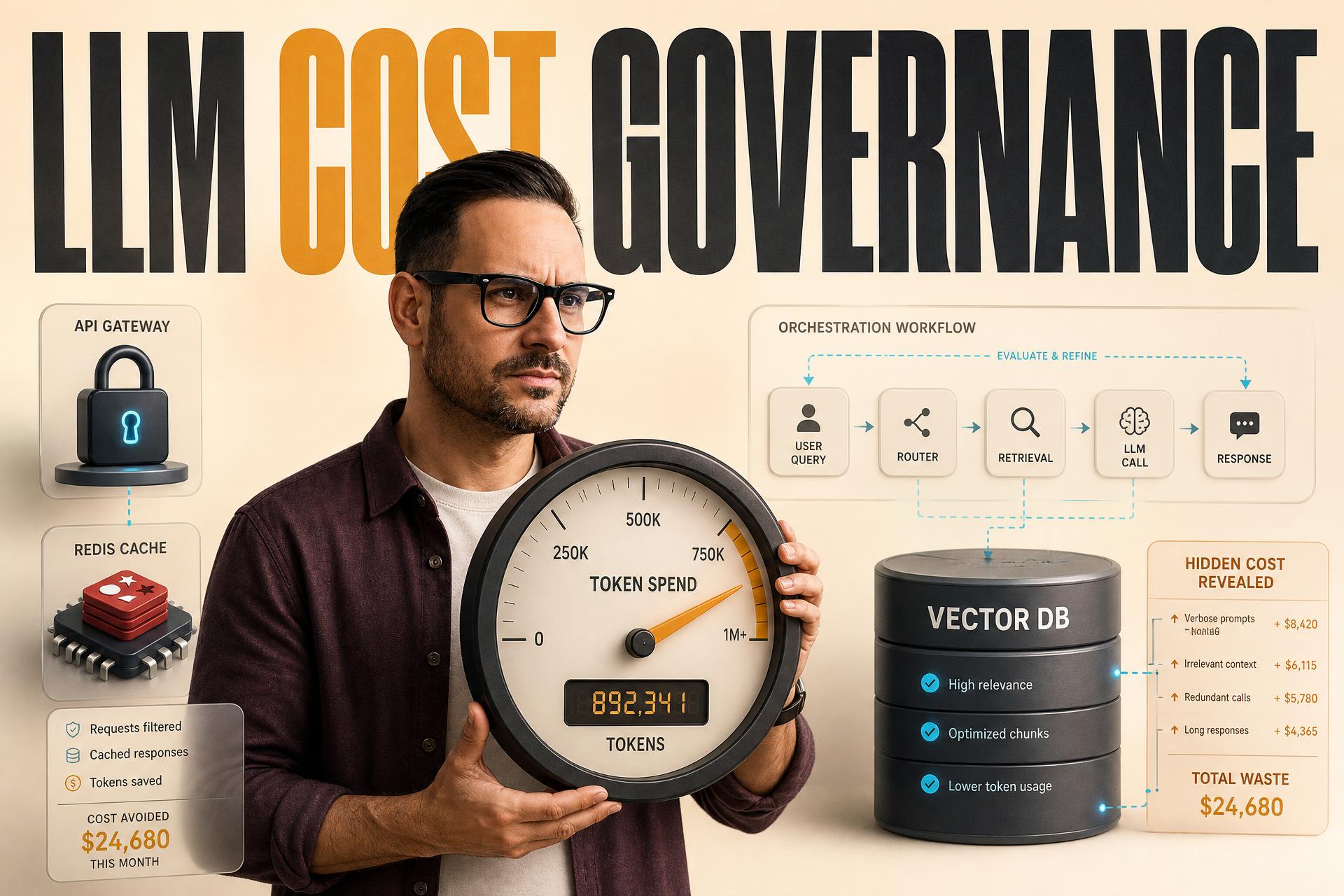
Most companies treat Large Language Models (LLMs) like magic wands—drop in an API key, prompt a model, and wait for revenue. In reality, naive LLM integration is a fast track to burning your cloud budget with zero measurable return. We see enterprises spending thousands of dollars a month on GPT-4o or Claude 3.5 Sonnet for tasks that a 7-billion-parameter parameter model—or even a deterministic script—could handle for a fraction of the cost. The difference between a successful AI deployment and a costly science experiment isn't the model; it is the engineering discipline surrounding it. If you are optimizing for prompts instead of pipelines, you are building a house of cards.
Industry challenge & market context
The rush to adopt generative AI has created a "demo-to-production" gap that is swallowing engineering budgets. CTOs are under pressure to ship AI features, yet the underlying infrastructure for LLM integration is often immature. The market is flooded with tools, but the fundamental challenge remains: LLMs are non-deterministic, stateless, and expensive to run at scale. Without a robust architecture, these traits translate directly into business risk.
- Uncontrolled token spend: Engineering teams often lack visibility into per-user token consumption, leading to runaway API costs that scale linearly with user growth rather than value creation.
- Latency bottlenecks: Synchronous calls to LLMs can add 2 to 10 seconds of latency, killing user experience in real-time applications unless properly architected with asynchronous streams.
- Fragmented tooling: The ecosystem is a mix of open-source libraries (LangChain, LlamaIndex) and proprietary APIs, creating vendor lock-in risks and maintenance overhead.
- Data privacy leakage: Sending sensitive PII or proprietary data to public models without proper sanitization or governance layers poses severe compliance risks.
- Reliability issues: LLMs can hallucinate or return malformed JSON, breaking downstream systems that expect structured data.
Technical architecture and how LLM integration works in practice
Effective LLM integration requires treating the model not as the application, but as a single component within a broader, deterministic system. A robust architecture separates concerns: ingestion, retrieval, orchestration, and generation. We typically move away from direct client-to-model calls, implementing a backend orchestration layer that acts as a gatekeeper. This layer handles authentication, rate limiting, prompt management, and response parsing before the data ever touches the model provider.
In a typical Retrieval-Augmented Generation (RAG) pipeline, the flow begins with data ingestion. Raw documents are chunked, embedded using models like OpenAI text-embedding-3 or HuggingFace transformers, and stored in a vector database such as Pinecone, Milvus, or pgvector. When a user query arrives, the system performs a semantic search to retrieve relevant context. This context is then injected into the prompt sent to the LLM. However, a common mistake is retrieving too much context, which blows up the token count and introduces noise. We implement "re-ranking" steps—using a cheaper, faster model (like BERT) to score retrieved chunks before sending only the top 3 to 5 results to the expensive generative model.
Orchestration is where the cost savings are realized. Instead of hard-coding prompts, we use frameworks like LangChain or LlamaIndex to manage chains and agents. For example, a customer support agent might first classify the intent using a small, fine-tuned model. If the intent is "refund," the system routes to a deterministic Python script that queries the SQL database directly. If the intent is "product advice," it routes to the LLM. This "model routing" prevents using a Ferrari to drive to the mailbox.
- API Gateway & Auth: Use Kong or AWS API Gateway to handle OAuth2 tokens and API keys, ensuring only authenticated services can trigger inference.
- Orchestration Layer: Python (FastAPI) or Node.js services running in Docker containers that manage logic flow, prompt templates, and tool calling.
- Vector Database: Pinecone, Weaviate, or Milvus for storing embeddings, optimized for approximate nearest neighbor (ANN) search to keep latency low.
- Caching Layer: Redis or Memcached to store prompt-response pairs. Exact match caching saves 100% of cost on repeat queries; semantic caching (embedding the query and checking similarity) saves cost on paraphrased repeats.
- Message Queues: RabbitMQ or AWS SQS for decoupling heavy processing tasks, such as bulk document summarization, from the user-facing API.
- Observability Stack: OpenTelemetry for tracing and Prometheus/Grafana for metrics to track token usage, latency, and error rates per model.
The most expensive LLM call is the one that didn't need to happen. If your architecture doesn't aggressively cache and route requests, you are paying a premium for compute you have already performed.
State management is another critical architectural component. LLMs are stateless, but business applications are not. We store conversation history in a database (e.g., DynamoDB or PostgreSQL) and manage the context window programmatically. Instead of sending the entire chat history to the model, we implement a sliding window or summarize previous turns to keep the token count within the model's context limits (e.g., 128k for GPT-4o) without degrading performance. This requires careful prompt engineering to ensure the summary retains the necessary intent and entities for the next turn.
Business impact & measurable ROI
When LLM integration is executed correctly, the business impact shifts from "cool demo" to "operational efficiency." The primary ROI driver is usually the deflection of high-cost human labor. For instance, a Tier 1 support agent might cost a company $1.50 per interaction. An AI agent, if architected with high accuracy and low latency, can reduce that cost to $0.15 per interaction. However, if the AI hallucinates and escalates the ticket, or if it provides a wrong answer that requires a fix later, the ROI evaporates. Therefore, the metric isn't just "cost per query," but "cost per resolution."
Cost optimization directly impacts the bottom line. By implementing semantic caching, we often see cache hit rates of 25-40% in enterprise knowledge bases. This immediately reduces API spend by a corresponding margin. Furthermore, switching from a general-purpose model like GPT-4o to a smaller, domain-specific model (like Llama 3 8B or Mistral 7B) for specific tasks can reduce inference costs by 10x to 20x with minimal loss in accuracy for those specific tasks. This allows businesses to scale AI features to millions of users without linear budget increases.
- Reduced Operational Expenditure (OpEx): Strategic caching and model routing can cut token costs by 30-50% while maintaining latency under 500ms for cached responses.
- Improved Time-to-Value: Standardized orchestration layers allow teams to spin up new AI agents in days rather than months, accelerating feature delivery.
- Risk Mitigation: Implementing guardrails and evaluation frameworks reduces the risk of brand damage from hallucinations, protecting customer trust.
- Scalability: Decoupling the ingestion pipeline from the inference layer allows the system to handle traffic spikes without crashing the model endpoints.
ROI in AI isn't about model capability; it is about system reliability. A 99% accurate model that fails 1% of the time in a banking context is useless, whereas an 85% accurate model with a human-in-the-loop loop is a valuable asset.
Implementation strategy
Successful LLM development requires a phased approach that prioritizes data hygiene and evaluation over model selection. Do not start by fine-tuning a model. Start by understanding your data and defining success. We recommend a "Data-Centric AI" approach where the initial weeks are spent on cleaning datasets, defining evaluation metrics (e.g., BLEU, ROUGE, or custom faithfulness scores), and building a robust testing harness.
The pilot phase should focus on a narrow, high-value use case. Avoid the "do everything" chatbot. Instead, build an agent that does one thing perfectly—like summarizing legal contracts or generating SQL queries. Once the pilot proves value, you scale by refactoring the orchestration layer into reusable components. This is where frameworks like AI agents development come into play, allowing you to compose complex workflows from simple, tested tools.
- Define Metrics: Establish clear KPIs such as "resolution rate," "average handle time," and "cost per 1,000 tokens" before writing a single line of code.
- Data Preparation: Clean and chunk your data. Ensure your vector database is populated with high-quality, deduplicated information to improve retrieval accuracy.
- Build the Evaluation Harness: Use tools like RAGAS or DeepEval to automate testing. Run your pipeline against a "golden dataset" of questions and ideal answers to measure performance.
- Iterate on Prompts: Use prompt management systems (like PromptLayer or LangSmith) to version control your prompts and A/B test different variations.
- Deploy with Guardrails: Implement input/output filtering to prevent prompt injection and block toxic or irrelevant responses before they reach the user.
Common pitfalls during implementation include neglecting the "cold start" problem where the vector database is empty, leading to poor retrieval initially. Another pitfall is over-reliance on the model's internal knowledge rather than grounding it in your data via RAG. Always assume the model knows nothing about your private business logic. Finally, ensure you have a fallback mechanism. If the LLM fails or times out, the system should gracefully degrade to a rule-based response or a human handoff, rather than returning a server error to the user.
Why Plavno’s approach works
At Plavno, we do not treat AI as a buzzword; we treat it as an engineering discipline. Our approach to LLM integration is grounded in building enterprise-grade software that is secure, scalable, and maintainable. We understand that a model is only as good as the infrastructure that supports it. We design systems that leverage the best of modern cloud-native architectures—Kubernetes for orchestration, microservices for modularity, and event-driven pipelines for resilience.
We specialize in navigating the complex landscape of AI consulting, helping you choose the right stack for your specific needs. Whether it is integrating GPT-4 for complex reasoning, Claude 3.5 for nuanced content creation, or deploying open-source models like Llama 3 on-premise for data privacy, we build the bridges between your legacy systems and the AI frontier. Our focus on custom software development ensures that the AI solution fits seamlessly into your existing workflow, rather than forcing you to rebuild your business around the AI.
We prioritize observability and control. Our implementations include comprehensive logging and tracing so you know exactly where your budget is going and how your models are performing. By combining deep technical expertise in machine learning development with pragmatic business acumen, we deliver solutions that actually reduce costs and drive revenue, not just generate hype.
Effective LLM integration is not about buying the biggest model; it is about building the smartest system. By avoiding the mistakes of over-provisioning, neglecting caching, and skipping evaluations, you can harness the power of AI without bankrupting your cloud budget. It requires a shift from "prompt engineering" to "system engineering," where the LLM is a powerful tool within a tightly controlled, highly optimized architecture. If you are ready to move beyond prototypes and build AI that works at scale, the engineering discipline you apply today will define your ROI tomorrow.