Industry challenge & market context
Enterprise AI products today sit on a moving target. OpenAI, Anthropic, and Google release major model upgrades—GPT‑4.5, Claude‑3.5, Gemini‑1.5—every few weeks. Each new release reshapes token limits, pricing, and even fundamental behavior. For a fintech chatbot that processes 5 M requests a month, a sudden increase in per‑token cost or a shift in hallucination rates can break SLAs overnight.
- Legacy pipelines assume static latency; a 30 % slowdown in model inference cascades into queue‑backlogs and missed deadlines.
- Hard‑coded prompts become brittle when system prompts change semantics after an LLM update.
- Compliance teams lose auditability when model responses drift without traceable regression data.
- Cost models based on historic token consumption become obsolete, leading to overruns of up to 40 %.
- Customer‑facing reliability drops, eroding trust and increasing churn.
Technical architecture and how LLM evaluation works in practice
Robust LLM evaluation is not a one‑off test suite; it is a continuously running pipeline that lives beside your production stack.
- API gateway: Envoy or Kong terminates OAuth2, performs rate‑limit enforcement, and forwards calls to the orchestration layer.
- Orchestration layer: A Python FastAPI service (or Node.js NestJS) hosts LangChain and LlamaIndex pipelines. It decides whether to route a request to GPT, Claude, or Gemini based on metadata stored in PostgreSQL.
- Model layer: Each provider is wrapped in a thin adapter exposing a unified
generate(prompt, context) interface. The adapter handles token pagination, detects model‑specific errors, and retries with exponential back‑off. - Data store: Interaction logs are streamed to Kafka, persisted in ClickHouse for analytical queries, and mirrored to S3 for long‑term audit.
- Vector DB: We use Pinecone or Milvus for RAG embeddings; the retrieval step is decoupled via gRPC so that evaluation can inject synthetic documents.
- Cache: Redis stores recent embeddings and request fingerprints to enforce idempotency on retries.
- Observability stack: OpenTelemetry traces travel from the client‑side SDK through the gateway into each model adapter. Prometheus scrapes latency histograms; Grafana dashboards expose per‑model error rates, token‑usage, and cost metrics.
When a user asks, “What’s the projected cash flow for Q4?”, the system executes:
- Client SDK sends a GraphQL query to the API gateway with a JWT.
- Gateway authenticates, normalizes the request, and forwards it to the orchestration service.
- Orchestration selects the latest
gpt‑4.5‑turbo model because it satisfies the max_tokens=4096 constraint. - Prompt is enriched with recent financial documents retrieved from Pinecone (RAG).
- LangChain’s
AgentExecutor runs a tool‑use chain that calls an internal forecasting microservice via HTTP. - Composite response is logged, traced, and cached; a copy is sent to the evaluation runner for regression comparison.
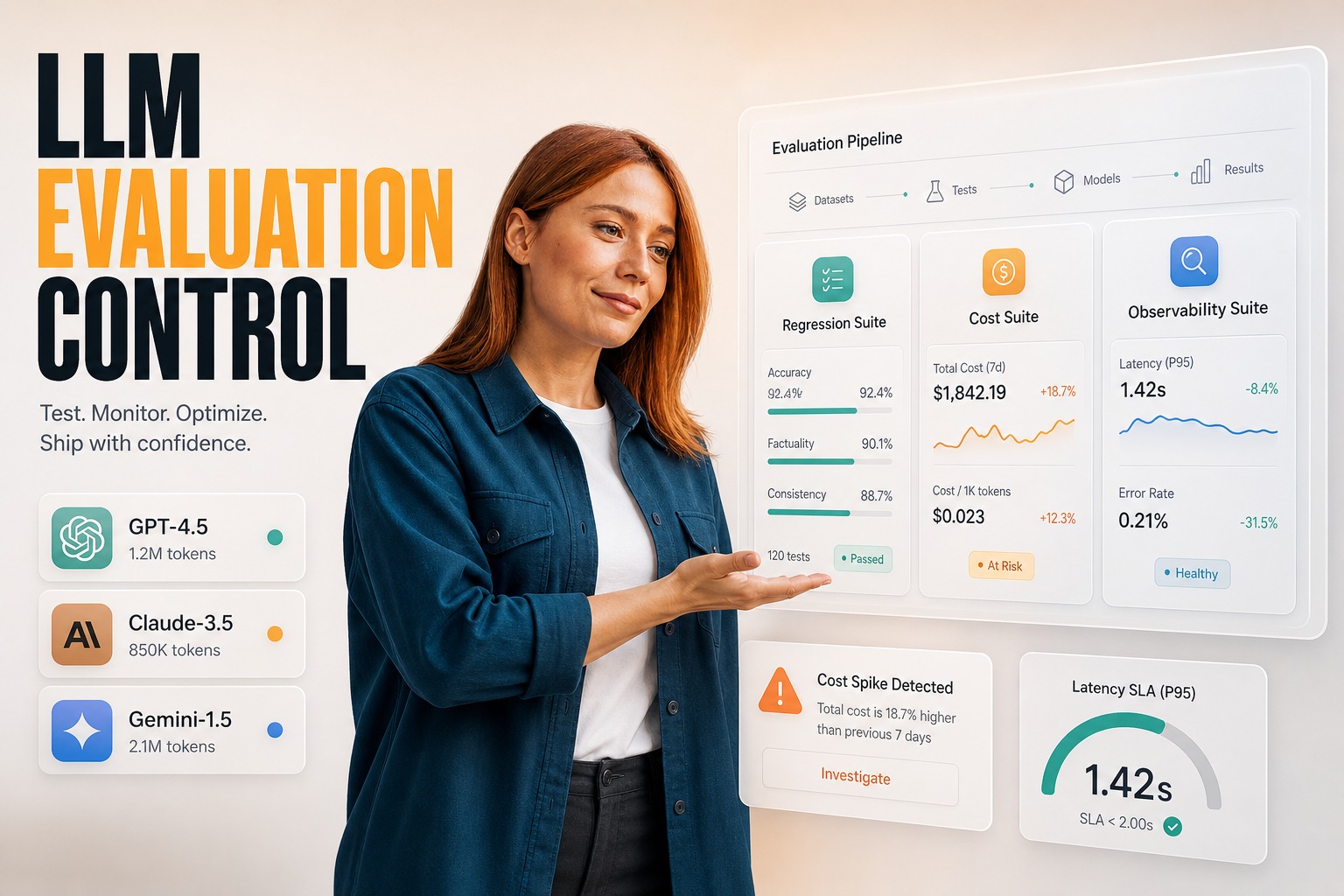
The evaluation runner is a separate Kubernetes CronJob that pulls the last 24 h of logs, reconstructs the exact inference graph, and runs three parallel suites:
- Regression suite: Runs stored prompts against the new model version; compares outputs using BLEU, ROUGE, and a custom hallucination detector.
- Cost suite: Calculates token usage per request, multiplies by the provider’s current price (e.g., $0.03 per 1 K tokens for GPT‑4.5) and flags any variance > 15 %.
- Observability suite: Checks that latency stays below the SLA (e.g., 250 ms 95th percentile) and that circuit breakers fire correctly on downstream timeouts.
Any deviation triggers an alert in PagerDuty and creates a GitHub issue with a reproducible test case, ensuring the development team can roll back or apply a fallback model (e.g., Claude‑3.0) within minutes.
Model upgrades are no longer “nice‑to‑have” features—they are production‑critical events that demand the same rigor as a kernel patch in a data‑center.
Business impact & measurable ROI
When evaluation is baked into CI/CD, enterprises see concrete gains:
- Reduced downtime: Regression alerts cut model‑related incidents from an average of 4 per quarter to <1, saving ~120 hours of engineering time.
- Cost predictability: Automated token‑usage monitoring kept monthly LLM spend within 3 % of forecast, avoiding unexpected bill spikes of $30 K.
- Faster time‑to‑market: With a validated fallback strategy, new features that depend on a model upgrade can be released 2‑3 weeks earlier.
- Compliance confidence: Full audit trails stored in immutable S3 buckets satisfy GDPR and SOC 2 audit queries in under 30 minutes.
- User satisfaction: Latency improvements from early detection of throughput degradation raise Net Promoter Score (NPS) by 0.7 points on average across SaaS customers.
Implementation strategy
Adopting a rigorous LLM evaluation regime can be phased over three sprints:
- Sprint 1 – Baseline instrumentation: Add OpenTelemetry, configure Kafka pipelines, and store raw request/response payloads.
- Sprint 2 – Evaluation harness: Build the CronJob runner, integrate BLEU/ROUGE checks, and set up cost calculators using provider pricing APIs.
- Sprint 3 – Automation & governance: Wire alerts to PagerDuty, codify rollback policies in GitOps (ArgoCD), and document the evaluation SLA.
Team composition:
- Product owner (defines critical prompts and cost targets)
- ML engineer (maintains adapters and evaluation metrics)
- Site reliability engineer (observability, circuit breakers)
- Security analyst (ensures audit logs are tamper‑proof)
Common pitfalls to avoid:
- Testing only on synthetic prompts – real‑world traffic patterns expose edge‑case token spikes.
- Hard‑coding provider URLs – use a configuration service (Consul or AWS Parameter Store) to allow seamless provider swaps.
- Neglecting rate‑limit back‑off – uncontrolled bursts can trigger provider throttling, inflating costs.
- Skipping cost suite – token‑price changes happen quarterly; static thresholds become meaningless quickly.
A well‑engineered evaluation pipeline is the safety net that lets you exploit every new LLM capability without sacrificing SLA guarantees.
Why Plavno’s approach works
Plavno builds AI systems on an engineering‑first foundation. Our teams combine deep domain expertise with proven enterprise patterns:
- We deploy cloud‑software‑development pipelines on Kubernetes with Istio service mesh, guaranteeing zero‑downtime model rollouts.
- Our AI agents development practice uses LangChain, CrewAI, and AutoGen to orchestrate multi‑model workflows, making fallback routing trivial.
- Observability is baked in via OpenTelemetry and our proprietary Plavno Nova dashboard, delivering per‑model latency, cost, and hallucination metrics in real time.
- Compliance is handled through immutable S3 audit logs, fine‑grained OAuth2 scopes, and region‑aware deployments that respect data residency requirements.
- Our AI consulting arm assists enterprises in defining evaluation SLAs, building custom regression datasets, and instituting governance that scales with model churn.
Whether you need a fintech chatbot (fintech‑solutions), a medical voice assistant (medical‑voice‑assistant), or an enterprise knowledge base powered by Gemini, our modular architecture lets you plug in the latest model without rewriting the entire stack.
Conclusion
In the post‑GPT era, LLM evaluation is the linchpin that separates experimental pilots from production‑grade AI products. By institutionalizing regression tests, cost monitoring, and automated fallbacks, enterprises protect revenue, maintain compliance, and unlock the competitive edge of each new model release. Partner with Plavno to embed a robust evaluation pipeline that scales with your ambition—reach out today and let our engineers design a reliable, observable AI stack that keeps your business moving forward.