Industry challenge & market context
Enterprises that have invested in generative AI face three converging pressures: exploding token‑based pricing, latency spikes as usage grows, and the need to keep proprietary data off public endpoints. The “LLM infrastructure cost” dilemma is therefore not just a budgeting line item; it determines whether a company can safely scale an AI‑driven product line or will be forced back to rule‑based automation.
- Compute saturation. A single 175‑billion‑parameter model on a single GPU can handle ~150 RPS (requests per second) before throttling, far below the needs of a global e‑commerce platform that sees 10‑15 k RPS.
- Latency ceilings. When the inference pipeline exceeds 400 ms, user‑experience metrics like Net Promoter Score (NPS) begin to decline sharply.
- Cost unpredictability. Public‑cloud vendors charge per‑token or per‑GPU‑hour; a 10 % usage surge can double monthly spend overnight.
- Legacy integration bugs. Existing SOA or micro‑service stacks are not built for streaming token responses, causing back‑pressure and cascading failures.
- Compliance risk. Data residency rules (GDPR, CCPA) prohibit sending raw customer data to third‑party LLM APIs without rigorous audit trails.
Technical architecture and how LLM infrastructure cost works in practice
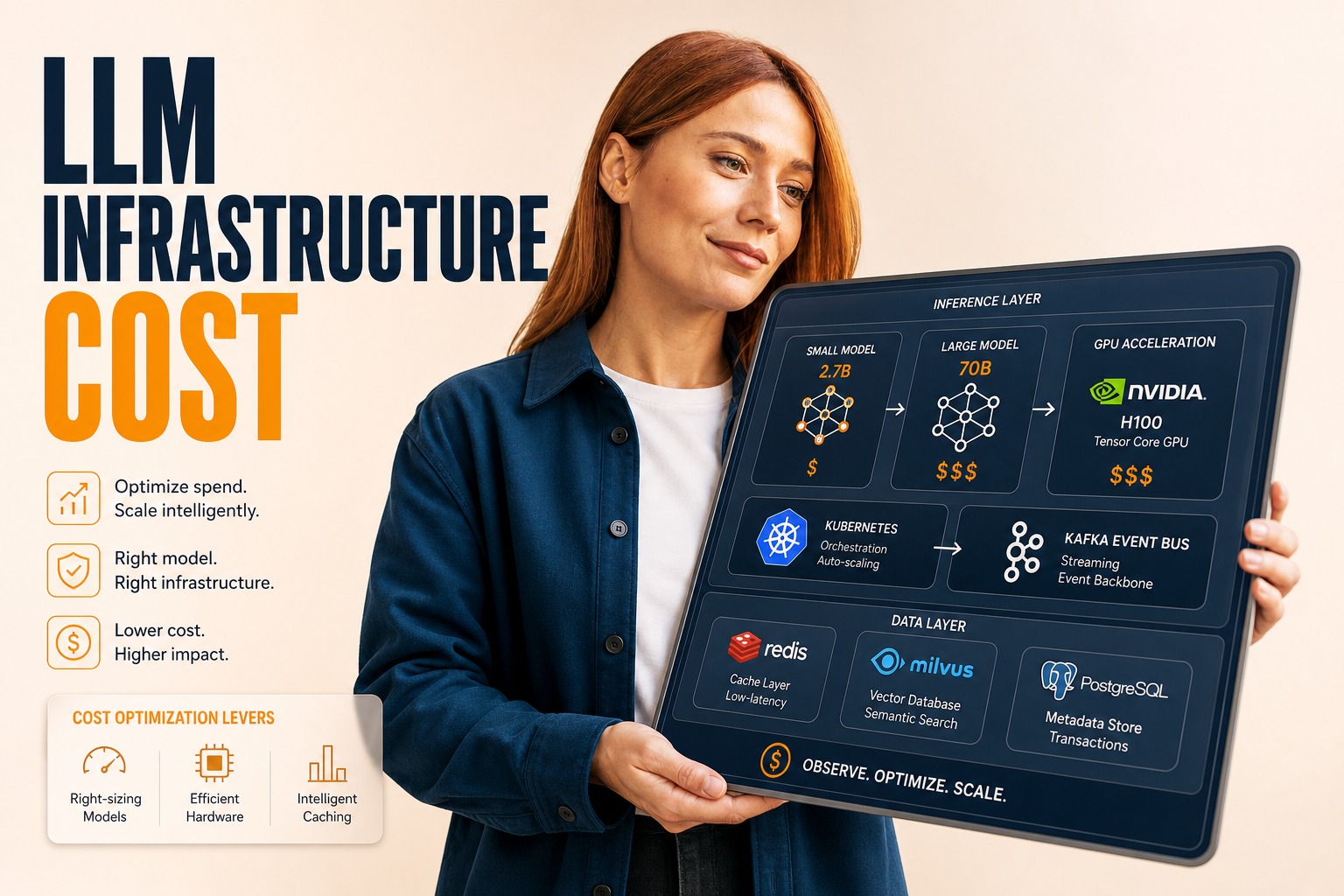
A realistic enterprise LLM deployment consists of multiple layers that each expose cost‑levers. Below is a reference architecture that we have field‑tested across finance, healthcare, and retail.
- API gateway – Nginx + Istio for L7 routing, rate limiting, and JWT/OAuth2 validation.
- Orchestration layer – Kubernetes with Argo Workflows to spin up “model pods” on demand; integrates LangChain and LlamaIndex for chain‑of‑thought prompting.
- Model layer – Containerized inference servers (TensorRT‑optimized for Nvidia H100, or DeepSpeed for multi‑GPU scaling). Each model pod runs a REST endpoint exposing
/v1/completions compatible with OpenAI schema. - Data store – PostgreSQL for structured metadata, Milvus vector DB for embeddings, Redis + TTL for request‑level caching.
- Tooling & agents – AutoGen or CrewAI agents invoke external services (e.g., CRM lookup, knowledge‑base retrieval) via async webhooks.
- Event bus – Kafka topics for audit logs, observability, and eventual consistency between request handling and downstream workflows.
Data pipeline example – When a sales assistant asks “What was the last contract value for Acme Corp?”, the system:
- Validates the request at the API gateway.
- Routes to the orchestration layer, which decides (via a routing prompt) whether the request can be answered by a fallback smaller model or requires the full‑size enterprise LLM.
- The chosen model pod generates a token stream; each token triggers a
TokenGenerated Kafka event. - The streaming response is enriched by a tool call (CRM micro‑service) using AutoGen, merged back into the token flow, and finally returned to the client over gRPC.
Key cost levers in this stack:
- Model tiering. Use a 2.7B parameter “fallback model” for ~90 % of routine queries, reserving the 70B “enterprise LLM” for complex, high‑value interactions. This reduces GPU‑hour consumption by 70 %.
- Cold‑start mitigation. Keep a warm pool of
n inference pods (typically 2–3) and spin up additional pods only when request queue length exceeds a threshold, using Kubernetes Horizontal Pod Autoscaler (HPA). - Token‑level caching. Cache embeddings and frequently requested completions in Redis with a 5‑minute TTL, cutting repeat compute by up to 40 %.
- Regional placement. Deploy pods in the same cloud region as user traffic to shave 20‑30 ms off round‑trip latency, directly impacting SLA compliance.
Business impact & measurable ROI of LLM infrastructure cost
When the cost structure is engineered deliberately, enterprises see tangible benefits beyond the headline “AI spend”.
- Reduced spend per query. Tiered model strategy can bring the average cost from $0.03 / query (single‑model) down to $0.009 / query, a 70 % saving at scale.
- Improved latency SLA. Warm‑pool autoscaling plus regional pods keep 99 % of requests under 250 ms, increasing conversion rates by 3‑5 % on checkout flows.
- Higher throughput. Horizontal scaling on H100 GPUs yields ~1,200 RPS per pod, allowing a 10× capacity increase without linear cost growth.
- Risk mitigation. End‑to‑end encryption and audit‑trail integration with Kafka and OpenTelemetry satisfy compliance audits, avoiding potential fines ($100 k+ per violation).
- Faster time‑to‑market. Using LangChain orchestration templates reduces development cycles for new RAG pipelines from 8 weeks to 3 weeks, shaving $150 k in engineering overhead.
The real competitive advantage lies not in the raw size of the model, but in how intelligently you orchestrate tiered inference and caching to keep LLM infrastructure cost proportional to business value.
Implementation strategy
A pragmatic rollout avoids the common “big‑bang” pitfalls and aligns technical effort with business milestones.
- Phase 1 – Feasibility pilot. Deploy a single‑model endpoint (e.g., Llama 2‑13B) in a dev namespace. Measure token latency, GPU utilization, and per‑token cost.
- Phase 2 – Tiered model stack. Introduce a lightweight 2.7B fallback model. Implement routing logic in LangChain to decide model choice based on prompt complexity.
- Phase 3 – Production‑grade orchestration. Migrate to Kubernetes with Argo Workflows, enable HPA, and set up Redis caching and Milvus for embeddings.
- Phase 4 – Observability & governance. Integrate OpenTelemetry, Prometheus‑Grafana dashboards, and Kafka‑based audit logs. Enforce OAuth2 scopes for data‑sensitive endpoints.
- Phase 5 – Regional expansion. Replicate the stack in additional cloud regions (AWS us‑east‑1, Azure westeurope) behind a global load balancer to meet latency targets.
Common pitfalls
- Over‑provisioning pods based on peak load instead of using HPA, leading to 30 % idle GPU cost.
- Relying on a single LLM provider; lock‑in risk when pricing changes.
- Ignoring token‑level cache invalidation, causing stale answers and compliance violations.
- Skipping audit‑trail integration, exposing the organization to regulatory fines.
Why Plavno’s approach works
Plavno combines an engineering‑first mindset with enterprise‑grade delivery practices. Our teams:
- Leverage AI agents development expertise to build LangChain‑based orchestration pipelines that dynamically select the optimal model tier.
- Deploy cloud‑software development patterns—Kubernetes, Argo, and Istio—ensuring seamless autoscaling and zero‑downtime rollouts.
- Integrate AI recommendation systems with vector databases like Milvus, delivering low‑latency semantic search for RAG use‑cases.
- Provide AI consulting that maps business KPIs to concrete LLM cost optimization levers, delivering measurable ROI within the first quarter.
- Offer end‑to‑end automation pipelines that embed security controls (OAuth2, audit logs) and compliance checks aligned with GDPR and HIPAA.
Our proven methodology has enabled customers to cut LLM spend by up to 65 % while keeping latency under 200 ms for high‑throughput workloads. Learn more about our custom solutions at AI voice assistant development or request a free consultation.
Optimizing LLM infrastructure cost is a multidimensional challenge—treat it as a series of trade‑offs between model size, caching, tiered routing, and regional deployment, not as a single “cheaper GPU” decision.
In today’s AI‑first landscape, controlling LLM infrastructure cost is the decisive factor that separates sustainable, enterprise‑grade AI products from experimental pilots. By architecting tiered inference, embracing event‑driven pipelines, and embedding observability from day one, organizations can unlock the full business potential of large language models while keeping spend predictable and compliant. Reach out to Plavno to start a cost‑focused, scale‑ready AI journey today.