The legal industry is drowning in unstructured data, yet the billable hour model forces firms to process it faster than ever. Traditional keyword search is no longer sufficient when dealing with terabytes of case law, contracts, and regulatory filings. The shift from simple retrieval to semantic reasoning is not just an efficiency play; it is a survival mechanism for modern legal departments and firms. We are moving beyond static document management to dynamic legal AI agents that can read, reason, and act on data with near-human accuracy but machine-level speed.
Industry challenge & market context
The current state of legaltech AI adoption is characterized by high demand but fragmented implementation. Enterprises are struggling to move from pilot projects to production-grade systems because the complexity of legal language—nuanced, context-dependent, and high-stakes—breaks generic AI models. Legacy approaches rely heavily on manual review or brittle rule-based systems that fail when contract language deviates even slightly from the template.
- Enterprise bottlenecks include the sheer volume of document automation required in M&A due diligence, where thousands of leases and agreements must be analyzed in days, not weeks.
- Legacy approaches fail because they treat text as flat strings rather than semantic entities, missing dependencies between clauses (e.g., a termination clause that references a force majeure section 50 pages prior).
- Main risks involve hallucination in case law AI, where a model might invent a precedent, and data privacy leaks, where sensitive client data is inadvertently sent to public model endpoints.
- The talent gap is widening; law firms need engineers who understand both transformer architectures and the Rules of Civil Procedure, a rare combination that necessitates specialized engineering partners.
The shift from keyword search to semantic reasoning is not an upgrade; it is a paradigm shift that renders static legal playbooks obsolete. You cannot solve a dynamic problem with static regex.
Technical architecture and how legal AI agents works in practice
Building a robust legal AI agents ecosystem requires a move away from monolithic applications toward a composable, event-driven architecture. At Plavno, we design systems where distinct agents specialize in specific tasks—contract review, case research, or filing—orchestrated by a central controller. This allows for parallel processing and granular auditing, which is critical in regulated environments.
System Components and Roles
The architecture typically begins with an Ingestion Layer. We use tools like Unstructured.io or PyPDF2 wrapped in Docker containers to parse PDFs and Word docs, converting them into markdown or plain text while preserving table structures. This is crucial because financial tables in contracts often contain the most critical data. From there, data flows into an Embedding Pipeline. We utilize models like OpenAI’s text-embedding-3-large or open-source alternatives like SentenceTransformers running on GPU instances to vectorize text chunks. These vectors are stored in Vector DBs such as Pinecone, Weaviate, or Milvus, often deployed within a VPC to ensure data residency.
Model Orchestration and Agent Workflow
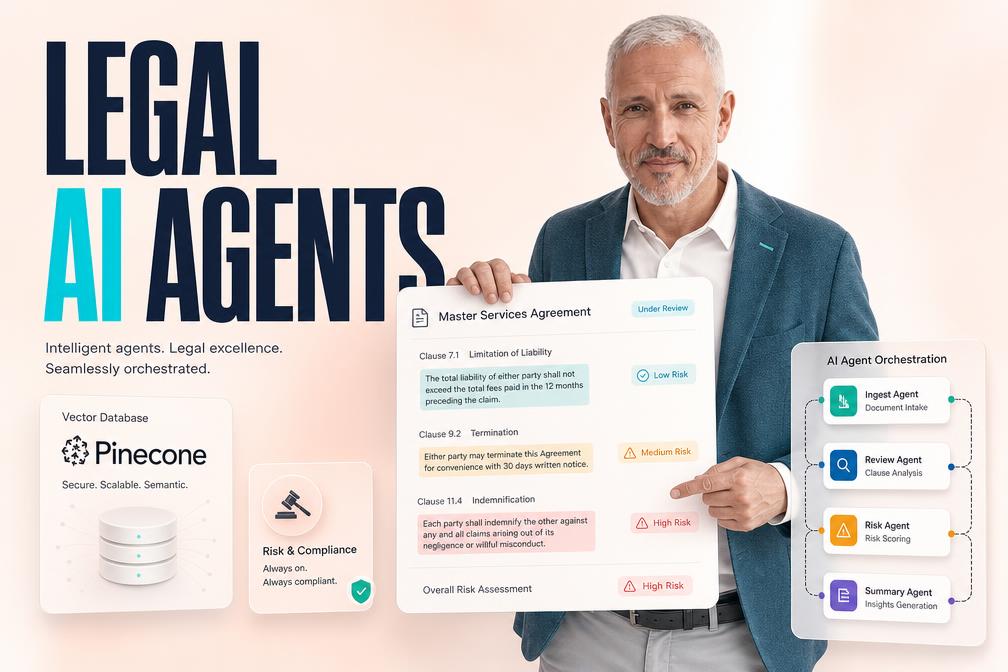
The brain of the system is the Orchestration Layer, often built with LangChain or LlamaIndex. For complex multi-step reasoning, we employ frameworks like CrewAI or Microsoft AutoGen. In a typical contract review AI workflow, a "Manager Agent" receives a document and delegates tasks to specialized sub-agents. A "Risk Agent" queries the vector database for clauses matching a defined risk playbook (e.g., "unlimited liability caps"). A "Compliance Agent" checks clauses against GDPR or CCPA embeddings. These agents operate asynchronously, communicating via a message queue like RabbitMQ or Kafka to ensure the system can scale under heavy load without blocking the main thread.
APIs, Integrations, and State Management
Exposing these capabilities requires a robust API Gateway, often implemented with Kong or AWS API Gateway, handling authentication via OAuth2 or JWTs. We prefer GraphQL for frontend integrations because legal dashboards often require fetching nested relationships (e.g., a contract, its clauses, and the specific case law cited within those clauses) in a single request. State management is handled by a combination of Redis for caching frequent queries to reduce latency (targeting <500ms for known answers) and PostgreSQL for persistent records of all agent actions to maintain an immutable audit trail.
Infrastructure and Deployment
We deploy these workloads on Kubernetes (EKS/GKE) to handle the variable compute requirements of LLM inference versus vector search. The infrastructure is designed as hybrid: sensitive embedding and vector storage might reside on-prem or in a private cloud subnet, while heavy inference tasks might burst to serverless GPU instances (like AWS Lambda or Fargate) to control costs. We implement circuit breakers to prevent cascading failures if an external LLM provider (e.g., Azure OpenAI) hits rate limits, ensuring the internal application remains responsive.
In legal AI, accuracy is non-negotiable. A 99% accuracy rate in contract review means 1% catastrophic failure, which is why we implement strict guardrails and human-in-the-loop verification protocols using RAG and deterministic rule-checking.
Business impact & measurable ROI
Implementing legal AI agents drives value by converting legal spend from a cost center into a predictable, scalable operational metric. The ROI is not just in speed, but in the quality of risk mitigation. By automating the first pass of document review, firms can reclaim 60-80% of junior associate time, redirecting that talent toward higher-value strategic work.
- Operational gains include reducing contract review cycles from an average of 4 hours to 15 minutes for standard NDAs and MSAs, allowing legal teams to clear backlogs instantly.
- Cost levers are achieved through intelligent routing; simple queries are handled by smaller, faster models (e.g., Llama-3-8B) to minimize token costs, while complex case law AI queries are routed to larger models (e.g., GPT-4) only when necessary.
- Risk reduction is quantifiable: automated clause deviation analysis catches non-compliant terms in 100% of reviewed documents, compared to the ~85% catch rate of manual review due to human fatigue.
- Time-to-value accelerates when document automation pipelines are integrated directly into CRM systems like Salesforce, allowing sales teams to generate self-executing contracts without legal intervention for low-risk deals.
Implementation strategy
Deploying legal AI agents requires a disciplined approach that prioritizes data hygiene and incremental value delivery. We advise against a "big bang" overhaul; instead, focus on high-volume, low-complexity workflows first to build trust in the system.
- Start with a data audit: identify the top 20 document types consuming 80% of review time and clean the training data, ensuring OCR accuracy and consistent metadata tagging.
- Develop a pilot focused on a single use case, such as contract review AI for NDAs, using a Retrieval-Augmented Generation (RAG) pipeline grounded in your specific playbook.
- Implement a "Human-in-the-Loop" interface where lawyers can approve or reject agent suggestions, using this feedback to fine-tune the embedding models and prompt strategies.
- Integrate observability tools like Weights & Biases or Arize to trace hallucinations and monitor token usage and latency across the agent fleet.
- Scale gradually by adding new agents (e.g., a Case Research Agent) to the existing orchestration framework, reusing the authentication and vector storage infrastructure.
Common Pitfalls
A frequent failure mode is relying solely on the LLM's internal knowledge without grounding it in specific documents (RAG), leading to hallucinations in case law AI. Another pitfall is ignoring context window limits; dumping a 200-page PDF into a prompt without chunking and summarization strategies leads to truncated data and missed clauses. Finally, neglecting idempotency in API design can cause duplicate processing of documents if retries occur, leading to billing errors and data corruption.
Why Plavno’s approach works
At Plavno, we do not treat AI as a magic black box. We approach legaltech AI as an engineering challenge requiring rigorous architecture, security-first design, and deep domain integration. Our team builds enterprise-grade systems that are maintainable, scalable, and compliant with the strictest data governance standards. We specialize in transforming vague legal requirements into concrete technical specifications, ensuring that the legal AI agents we build actually solve the problems they are deployed for.
Whether you need to automate complex AI automation workflows, develop custom AI agents tailored to your firm's playbook, or integrate advanced legaltech and eDiscovery solutions, we provide the technical depth to execute. Our experience extends to specialized interfaces like legal voice AI assistants, enabling lawyers to interact with their data hands-free. We also offer strategic AI consulting to help you navigate the rapidly evolving landscape of legal technology.
The future of legal work is autonomous, precise, and data-driven. By leveraging legal AI agents, enterprises can achieve a level of operational efficiency and risk management that was previously impossible. The technology is ready; the question is whether your infrastructure is prepared to harness it.