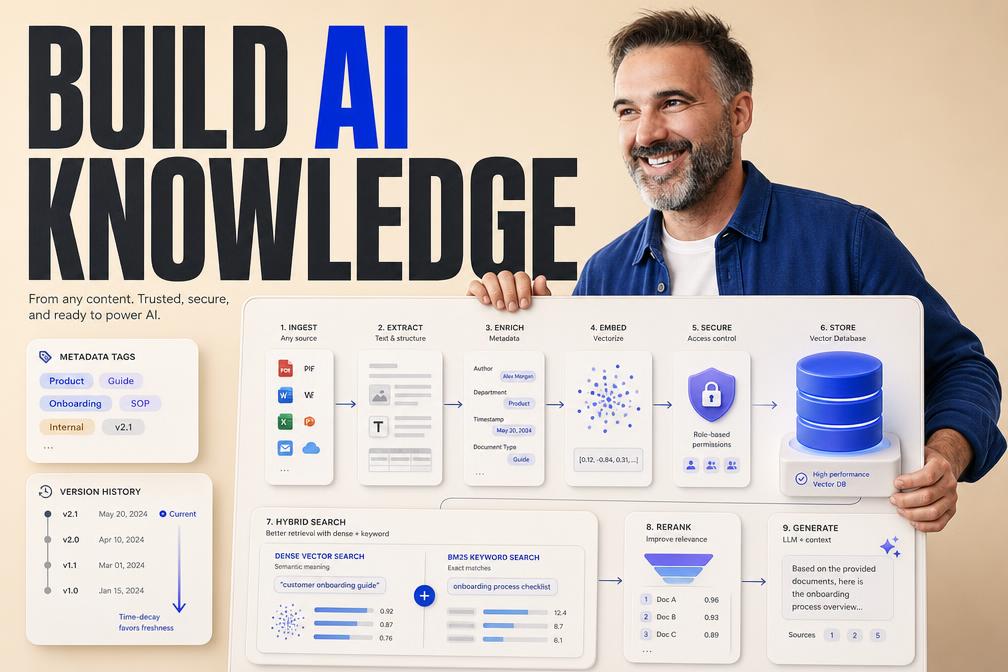
Your enterprise likely has terabytes of valuable documentation trapped in Confluence, SharePoint, legacy file systems, and thousands of Slack threads. The problem isn't storing information; it is that when a human or an AI tries to retrieve it, the system fails. Traditional keyword search returns 500 irrelevant links, and generic LLMs hallucinate confidently because they lack access to your private context. To fix this, you cannot simply "plug in" GPT-4. You must engineer a robust AI knowledge base that treats data as a supply chain problem—ingesting, cleaning, vectorizing, and securing information with the same rigor you apply to financial transactions.
Industry challenge & market context
Most organizations attempt to solve internal search by dumping documents into a vector database and hoping for the best. This approach fails at scale because enterprise data is messy, access-controlled, and constantly evolving. Without a sophisticated pipeline, your retrieval-augmented generation (RAG) system will leak sensitive data or provide stale answers.
- Data silos and fragmentation: Critical knowledge lives in unstructured PDFs, ticketing systems like Jira, and code repositories, often lacking a unified schema or API for ingestion.
- Permission complexity: A junior engineer should not see executive compensation plans, yet naive vector stores often strip ACLs (Access Control Lists) during the embedding process, creating severe security vulnerabilities.
- Stale information: In dynamic sectors like fintech or SaaS, a document from three months ago can be dangerously misleading, yet most basic RAG systems lack robust versioning or time-decay mechanisms.
- Context window limitations: Even the most advanced models have token limits; retrieving 50 documents to answer a simple query results in high latency and cost, often truncating the most relevant information.
- Hybrid search failure: Pure semantic search often misses exact product names or specific acronyms, while pure lexical search fails to understand intent, requiring a sophisticated hybrid approach.
Technical architecture and how AI knowledge base works in practice
Building an enterprise-grade AI knowledge base requires a distributed systems approach, not just a script. You need an architecture that handles asynchronous ingestion, ensures data consistency, and enforces security at the vector level. When a user queries the system, the flow must traverse ingestion, retrieval, orchestration, and generation layers with low latency.
System Components and Data Flow
The ingestion pipeline is the foundation. It typically runs on Kubernetes, orchestrated via a workflow engine like Apache Airflow or Temporal. Connectors pull data from sources (Google Drive, Salesforce, PostgreSQL). The data is normalized—text is extracted from PDFs using libraries like PyPDF2 or Unstructured, and HTML is stripped. Crucially, before text is chunked, the system must capture metadata: author, department, last_updated timestamp, and the source URL. This metadata is stored alongside the vector embeddings in a database like PostgreSQL or MongoDB, while the embeddings themselves go into a vector store such as Pinecone, Weaviate, or Milvus.
Model Orchestration and Retrieval Logic
For the retrieval layer, we avoid simple "top-k" searches. Instead, we implement a hybrid search strategy combining dense vector retrieval (semantic similarity) with sparse retrieval (BM25 keyword matching). This ensures that if a user searches for a specific error code "ERR-404-X", the system finds it even if the semantic embedding is vague. The results are then passed through a reranking model (like Cohere Rerank or BGE-Reranker) to sort the top 5-10 chunks by relevance before they are sent to the LLM.
Security and Governance
Security is enforced via "Pre-Filtering." When a user initiates a search via a REST or GraphQL API, their JWT (JSON Web Token) is decoded to extract their group memberships (e.g., "Engineering", "HR"). The query to the vector database includes a metadata filter: where group in ['Engineering']. This ensures the AI only retrieves documents the user is authorized to see. We also implement audit trails, logging every query and the retrieved context to satisfy compliance requirements like SOC2 or GDPR.
Metadata is the difference between a toy chatbot and an enterprise-grade system. If you don't tag your chunks with permissions, source truth, and timestamps, you are building a security liability, not a productivity tool.
Infrastructure and Deployment
- API Gateway: Kong or AWS API Gateway to handle rate limiting, auth (OAuth2/OIDC), and request routing.
- Orchestration Layer: LangChain or LlamaIndex running in Python/Node.js containers to manage prompt templates, context injection, and tool calling.
- Vector Database: Managed services like Pinecone or self-hosted Qdrant on AWS EKS for high-throughput similarity search.
- Caching Layer: Redis or Memcached to store frequent query-response pairs, reducing latency to under 200ms and cutting LLM API costs by 30-50%.
- Observability: OpenTelemetry and Prometheus to track token usage, retrieval latency, and index freshness, integrated with Grafana dashboards.
Business impact & measurable ROI
Implementing a robust RAG system is not just a technical upgrade; it is a direct lever for operational efficiency. The ROI manifests in reduced support load, faster employee onboarding, and better decision-making. However, the gains depend on the quality of the retrieval. A well-tuned system shifts the organization from "searching for answers" to "generating insights."
- Reduced Resolution Time: Internal support tickets often take hours to resolve as engineers hunt for specs. An AI knowledge base can surface the exact configuration parameter in seconds, reducing Mean Time To Resolution (MTTR) by up to 60%.
- Developer Velocity: New hires spend weeks learning the codebase and tribal knowledge. By integrating the AI with GitHub and Wikis, developers get instant, context-aware answers about architecture patterns, reducing onboarding time from months to weeks.
- Cost Optimization: By using smaller, domain-specific models (like Llama-3-8B or Mistral-7B) for retrieval and routing, and reserving expensive models (GPT-4o) only for complex synthesis, enterprises can lower query costs significantly while maintaining accuracy.
- Risk Mitigation: Automated internal knowledge automation ensures that compliance documents and safety protocols are easily accessible and verifiable, reducing the risk of human error in critical operations.
RAG is not a prompt engineering trick; it is a distributed systems problem. The value comes not from the model, but from the reliability of the pipeline feeding it.
Implementation strategy
Deploying an AI knowledge base requires a phased approach. Do not attempt to index the entire enterprise on day one. Start with a high-impact, bounded domain to refine the architecture and ingestion patterns.
- Phase 1: Data Audit and Selection: Identify a specific domain (e.g., IT Documentation or Sales Playbooks). Assess data quality: clean up duplicates, standardize formats, and ensure existing permissions are documented.
- Phase 2: Infrastructure Setup: Provision the vector database and orchestration layer. Start with a managed vector DB to reduce operational overhead. Implement the basic connectors for the selected data sources.
- Phase 3: The MVP Pilot: Build a simple chat interface (using Streamlit or React) for a pilot group of 20-50 users. Focus on retrieval accuracy. Use "relevance feedback" mechanisms (thumbs up/down) to gather data on where the pipeline fails.
- Phase 4: Optimization and Scaling: Analyze the logs. Are chunks too small? Is the reranker aggressive enough? Introduce hybrid search if semantic search is missing keywords. Once precision is above 85%, expand to other departments and integrate with existing tools like Slack or Microsoft Teams.
Common Pitfalls
Many teams fail because they ignore the "last mile" of data engineering. One common error is "chunking" documents arbitrarily (e.g., every 500 tokens) which breaks semantic context. Instead, use recursive character text splitters or semantic chunking that respects paragraph and header boundaries. Another pitfall is ignoring freshness; if your ingestion pipeline runs once a week, the AI will lie about current status. Implement event-driven ingestion using webhooks (e.g., trigger a re-index when a Confluence page is updated) to ensure eventual consistency.
Why Plavno’s approach works
At Plavno, we do not treat AI as a magic black box. We treat it as an engineering discipline that requires rigorous architecture, security-first design, and scalable infrastructure. We understand that an enterprise knowledge base is only as good as the data pipeline that supports it. Our team builds custom solutions that integrate seamlessly with your existing stack, whether you are on AWS, Azure, or on-premise Kubernetes clusters.
We specialize in moving beyond prototypes to production-ready systems. This means implementing proper circuit breakers to handle LLM API rate limits, designing idempotent ingestion pipelines to handle failures gracefully, and ensuring that your AI search capabilities are auditable and secure. Whether you need AI consulting to map your strategy or custom software development to build the entire RAG infrastructure, we focus on delivering measurable business value.
Our experience spans AI chatbot development and complex AI agents that can execute tasks, not just answer questions. We ensure that your knowledge graph is not static but evolves with your business. If you are ready to transform your static documents into an intelligent, interactive asset, explore our case studies or contact us to build a system that actually works.
Building a functional AI knowledge base is a significant undertaking, but with the right architecture and a disciplined implementation strategy, it becomes the most valuable tool in your enterprise stack. Stop letting your data sit idle—start engineering the infrastructure that turns it into actionable intelligence.