Industry challenge & market context
Enterprises that have invested heavily in ERP, CRM, and a patchwork of internal tools face three simultaneous pressures:
- Data silos. Each system exposes a different API contract (REST, GraphQL, SOAP) and stores data in incompatible schemas, making real‑time insight costly.
- Operational friction. Business users must navigate multiple UIs or wait for batch‑jobs; latency spikes above 300 ms become a productivity killer.
- Compliance risk. Legacy integrations often rely on hard‑coded API keys, no audit trail, and violate GDPR or SOC‑2 requirements.
Traditional point‑to‑point scripts or RPA bots can stitch systems together, but they suffer from:
- High maintenance overhead when any upstream API changes.
- Limited scalability – most run on a single VM and cannot handle >1 000 req/s without throttling.
- Absence of contextual awareness – they cannot reason about “why” a request is made, only “what”.
Technical architecture and how AI agent integration works in practice
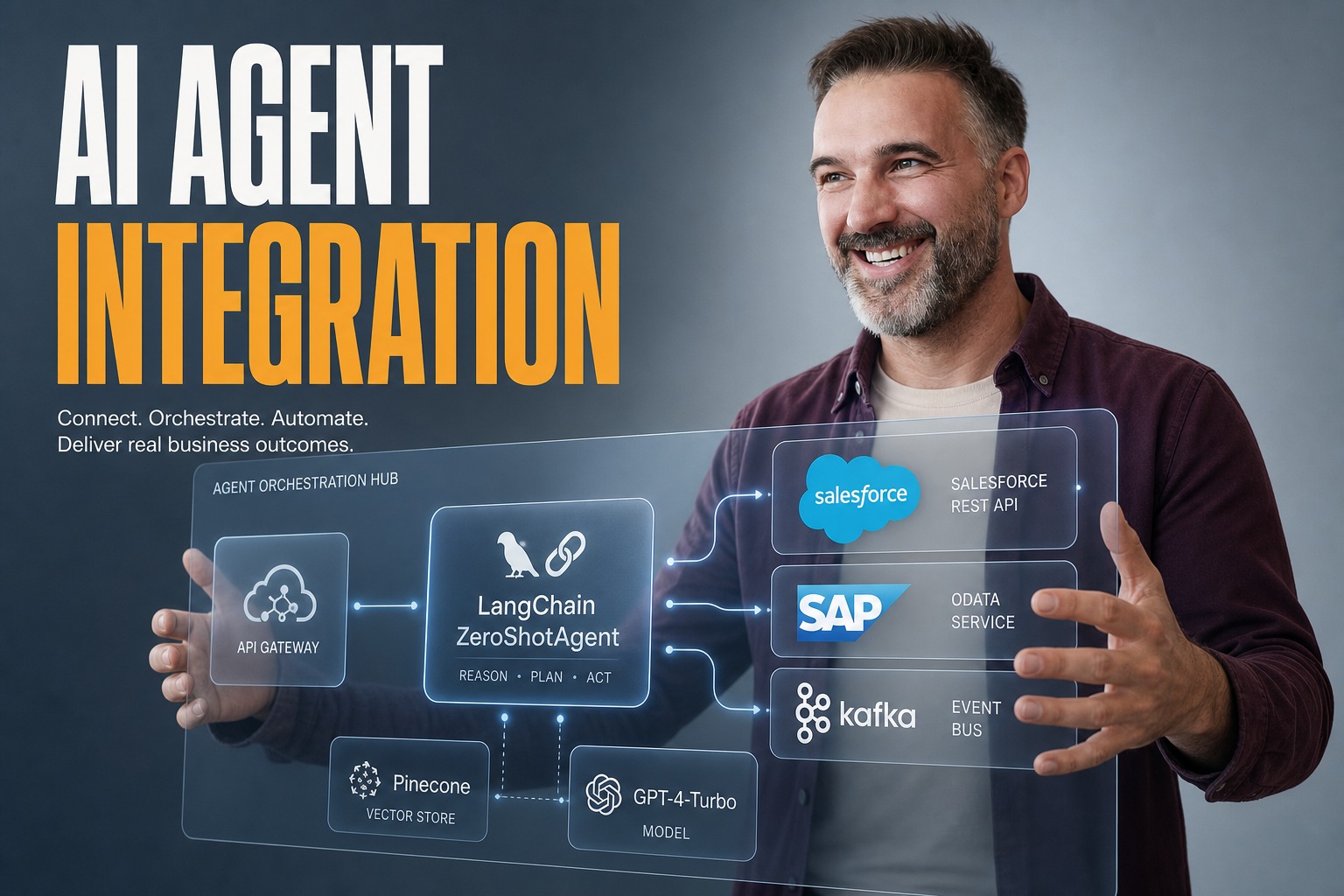
Modern AI agents treat every external system as a tool in a composable toolbox. The typical stack looks like this:
- API gateway / edge layer – Amazon API Gateway or Kong, handling OAuth2, rate‑limiting, and TLS termination.
- Orchestration layer – a micro‑service written in Python (FastAPI) or Node (NestJS) that runs the LangChain or CrewAI runtime.
- Model layer – hosted LLMs (e.g., GPT‑4‑Turbo) behind OpenAI’s service or self‑hosted Mistral on Kubernetes, exposed via gRPC.
- Vector store – Pinecone, Milvus, or local Qdrant for embeddings used in Retrieval‑Augmented Generation (RAG).
- State store – Redis for short‑lived session context, PostgreSQL for durable task logs.
- Message bus – Apache Kafka or Google Pub/Sub for event‑driven communication between agents and downstream services.
Data pipeline example: A sales rep queries the AI assistant: “What’s the status of Opportunity #12345?” The flow is:
- The request hits the API gateway, where the user’s JWT is validated.
- The orchestration service extracts intent via LangChain’s
ZeroShotAgent and decides the “CRM lookup” tool is needed. - Using the
Tool abstraction, the agent calls the Salesforce REST endpoint (API integration AI) through a typed client. The call is wrapped in a circuit‑breaker (Hystrix) and retried up to three times. - Result JSON is transformed into a small embedding, stored in the Redis context, and merged with the LLM’s prompt.
- The LLM synthesizes a natural‑language answer and streams it back via the gateway, typically within 120‑150 ms.
When an action must mutate state – e.g., “Create a new purchase order in SAP” – the agent follows an event‑driven path:
- Orchestration publishes a
PurchaseOrderRequested event to Kafka. - ERP micro‑service consumes the event, validates business rules, writes to the SAP OData service (ERP automation), and publishes
PurchaseOrderCreated. - The agent subscribes to the confirmation event, updates the session store, and notifies the user.
Key integration patterns that keep the system robust:
- Synchronous REST/GraphQL calls for low‑latency lookups (sub‑200 ms).
- Asynchronous webhooks or event streams for long‑running transactions.
- Idempotent operations – every tool wrapper includes a deterministic request ID to protect against retries.
- Observability stack – OpenTelemetry tracing, Prometheus metrics, and Loki logs provide end‑to‑end visibility.
Security and governance are baked in:
- OAuth2 with scope‑limited tokens for each downstream system (CRM integration AI, ERP automation).
- Audit tables in PostgreSQL capture every agent‑initiated request, user ID, and response hash.
- Data residency policies enforce that EU‑origin data never leaves a Europe‑zone Kubernetes cluster.
Business impact & measurable ROI
The tangible upside of a well‑engineered AI agent integration platform can be quantified:
- Support cost reduction. A 30 % drop in tickets for CRM queries translates to $350 k annual savings for a 10 k‑employee firm.
- Process acceleration. Order‑to‑cash cycle time falls from 3 days to under 12 hours, a 75 % improvement driven by automated ERP actions.
- Scalable throughput. Deploying the orchestration service on a 4‑node GKE cluster handles 1 200 req/s with 99.9 % SLA, compared to 200 req/s on a legacy RPA VM.
- Compliance confidence. Centralized audit logs and OAuth scopes reduce audit preparation effort by 40 %.
Implementation strategy
Enterprise teams can move from prototype to production in four stages:
- Discover & prototype. Identify 2–3 high‑impact use cases (e.g., “Invoice status lookup” and “Lead creation”). Build a LangChain PoC that calls the existing REST endpoints.
- Architect & harden. Design the full integration layer: choose API gateway, vector DB, and event bus. Implement circuit‑breakers, idempotency keys, and OpenTelemetry.
- Scale & secure. Containerize services, deploy to Kubernetes with autoscaling, enable JWT/OAuth flow for each downstream system, and configure WAF rules.
- Govern & iterate. Establish a Center of Excellence, define SLAs for latency (<200 ms) and error budget (<0.5 %). Continuously train the LLM with domain‑specific data.
Common pitfalls
- Hard‑coding API URLs – leads to breakage when the source system version changes.
- Neglecting token limits – sending full document dumps to the LLM exceeds context windows; use embeddings and chunking instead.
- Skipping idempotency – retries can duplicate orders in ERP.
- Under‑estimating latency budgets – network hops between cloud regions add 50‑100 ms per call.
Why Plavno’s approach works
Plavno builds AI agent integration platforms that start with the same engineering rigor described above, then adds three differentiators:
- Enterprise‑grade scaffolding. Our services (AI agents development, AI automation) ship with pre‑configured API gateways, vector stores, and OpenTelemetry pipelines, reducing time‑to‑value by 40 %.
- Domain‑specific model tuning. We fine‑tune LLMs on your CRM/ERP data (e.g., Salesforce schemas, SAP transaction codes) to keep token usage under 8 k per request while retaining 95 % answer accuracy.
- Full‑stack governance. Our compliance package (cybersecurity, software development consult) provides audit‑ready logging, role‑based access, and data‑residency controls out of the box.
Clients across finance, healthcare, and logistics have leveraged this stack to replace legacy RPA fleets with AI‑driven agents that process >2 k events/s while staying under a $0.12 per hour cost envelope on GCP.
Most enterprises underestimate the hidden cost of “just connecting APIs.” Without a unified orchestration layer, every new use case multiplies operational debt exponentially.
AI agent integration delivers ROI only when the integration layer enforces idempotency, observability, and security at the tool‑call level.
Ready to turn siloed systems into a conversational, context‑aware workflow? Contact our AI solutions team or explore our voice AI assistant portfolio to see a live demo of AI agent integration in action.
In conclusion, AI agent integration is the bridge that turns static APIs, CRMs, and ERPs into an interactive knowledge layer. By adopting a composable architecture, enterprises cut costs, accelerate processes, and stay compliant—all while giving users natural language access to the data they need. The next step is to map your high‑value use cases to the patterns described here and let Plavno’s engineering‑first practice accelerate your journey.