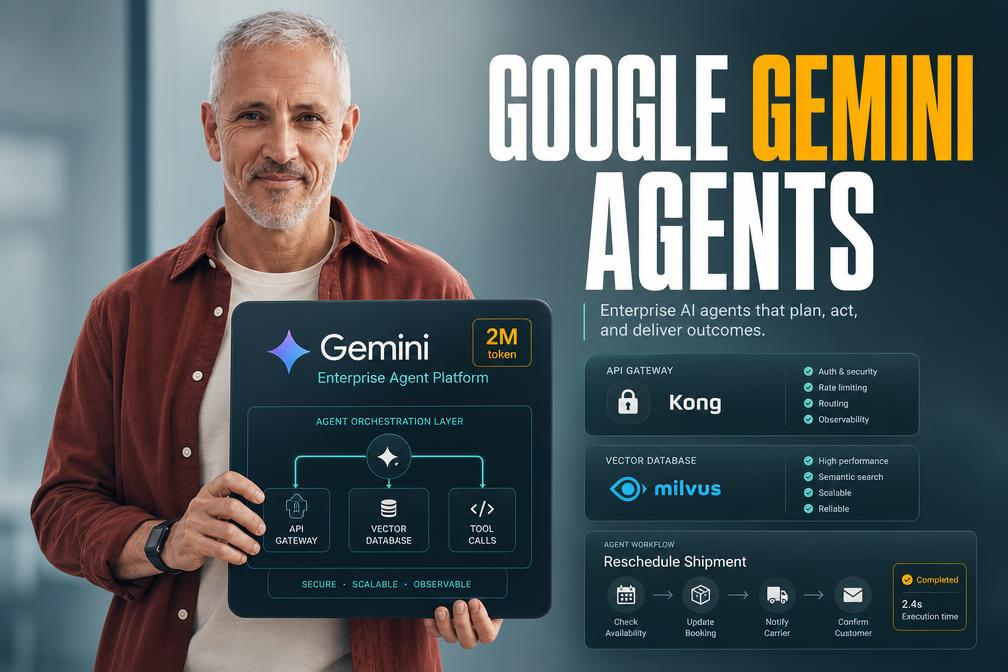
The shift from generative AI as a novelty to agentic AI as an operational backbone is happening faster than most CTOs anticipate. We are moving past the era of simple chatbots that retrieve information into a phase where autonomous agents execute complex workflows. The Gemini Enterprise Agent Platform represents Google’s bet on this infrastructure, but the technology itself is only half the battle. For enterprises, the challenge is not just accessing a multimodal model with a 2 million token context window; it is building the secure, stateful, and integrated plumbing required to let that model interact with proprietary business systems without hallucinating or exposing sensitive data. If your infrastructure relies on brittle APIs and siloed data lakes, simply plugging in an agent platform will create chaos, not automation.
Industry challenge & market context
Enterprises are under immense pressure to operationalize AI, yet the gap between a proof-of-concept and a production-grade agent system is massive. Most organizations struggle because they treat AI agents like traditional software—stateless and deterministic—when they are fundamentally probabilistic and stateful. The legacy approach of simple RAG (Retrieval-Augmented Generation) over static documents is no longer sufficient. Business leaders want agents that can book flights, update CRMs, and negotiate supply contracts, but they are hitting hard walls.
- Integration friction: Legacy ERP and CRM systems often lack modern API standards (REST/GraphQL), making it difficult for agents to "call tools" reliably without custom middleware.
- Security and governance: Allowing an LLM to execute SQL queries or write to a database introduces significant risks regarding data residency, PII exposure, and privilege escalation.
- State management: Unlike standard microservices, agents need memory—both short-term (conversation context) and long-term (user preferences)—which existing stateless serverless architectures often fail to handle efficiently.
- Observability: Debugging a multi-agent workflow where one agent fails to parse a JSON output, causing a downstream circuit breaker to trip, requires deep tracing that standard APM tools don't provide out of the box.
- Cost unpredictability: Agentic loops that involve self-correction and tool use can consume massive amounts of tokens, leading to unpredictable OpEx spikes compared to fixed-cost SaaS subscriptions.
Technical architecture and how Gemini Enterprise Agent Platform works in practice
To leverage the Gemini Enterprise Agent Platform effectively, you must view it as an orchestration layer sitting on top of your existing infrastructure. It is not a magic box; it is a sophisticated router that reasons, plans, and executes. A robust implementation typically involves a multi-tier architecture where the LLM is the brain, but the nervous system is composed of enterprise-grade middleware.
In a typical deployment, the architecture begins with an API Gateway. This is the entry point where authentication happens—usually via OAuth2 or JWTs—ensuring that the agent knows who is asking. From there, the request hits the Orchestration Layer. This is where frameworks like LangChain or LangGraph (often running in Python or Node.js) manage the state of the interaction. The orchestrator decides if the request requires a tool call or just a retrieval step. If tools are needed, the orchestrator invokes specific functions defined in your codebase, such as "get_inventory_status" or "create_invoice," which then communicate with your downstream services via REST or gRPC.
Data handling is critical. The Gemini Enterprise Agent Platform excels when fed high-quality, contextual data. This requires a robust RAG pipeline. Unstructured data (PDFs, emails) is chunked, embedded using models like text-embedding-004, and stored in a Vector Database (e.g., Milvus, Pinecone, or pgvector). When a query comes in, the system performs a semantic search to retrieve relevant chunks, passing them as context to the Gemini model. However, for structured data, you cannot rely solely on vector search. You need a "Text-to-SQL" or API routing layer where the model generates safe, parameterized queries to fetch live data from your transactional databases.
The real bottleneck in agentic AI isn't model intelligence; it is the reliability of the tool layer. If your APIs are inconsistent or your data is dirty, the agent will fail, regardless of how smart the LLM is.
Consider a practical scenario: A supply chain manager asks, "Reschedule the shipment for Order #5005 due to the weather delay and notify the carrier." Here is how the stack processes this. First, the Intent Classifier identifies this as a multi-step action. The Agent Planner breaks this down: 1) Fetch order details, 2) Check carrier API for available slots, 3) Update the ERP, 4) Send email notification. The agent calls the "get_order" tool, which queries the database. It then calls the "check_slots" tool, which hits the carrier's GraphQL endpoint. Once it receives the data, it reasons about the best slot, calls "update_shipment" via an internal REST API, and finally triggers a "send_notification" webhook. All of this happens within a single conversation thread, managed by the orchestrator to maintain context.
Infrastructure-wise, we generally recommend deploying these components on Kubernetes. This allows you to scale the orchestrator pods independently of the vector database or the API gateways. You need a message queue (like RabbitMQ or Kafka) to handle asynchronous tasks—imagine an agent that needs to wait 24 hours for a vendor to reply before proceeding. You cannot keep an HTTP request open that long. The agent must persist its state to a database (like Redis or PostgreSQL), sleep, and wake up when a webhook event triggers the next step.
- API Gateway & Auth: Kong or Apigee for handling OAuth2, rate limiting, and initial request validation.
- Orchestration Runtime: Python (FastAPI) or Node.js containers running LangChain/LangGraph, deployed on Kubernetes with auto-scaling.
- Model Layer: Vertex AI endpoints accessing Gemini 1.5 Pro or Flash, configured with specific system prompts and safety filters.
- Memory & State: Redis for short-term session caching and PostgreSQL for long-term conversation history and agent state persistence.
- Knowledge Base: Vector database (e.g., Weaviate) for storing embeddings of documentation and policies, coupled with ETL pipelines for data ingestion.
- Tool Layer: Wrapper services around legacy systems (SAP, Salesforce) that expose clean, idempotent REST/GraphQL APIs for the agent to consume.
- Observability: OpenTelemetry integration for tracing the decision path of the agent, logging token usage, and capturing tool execution errors.
Business impact & measurable ROI
Adopting an enterprise AI platform based on agentic principles drives value by reducing the "time-to-action." Traditional automation requires a human to read data, make a decision, and input it elsewhere. Agentic AI collapses this loop. The ROI is not just in cost savings but in the velocity of business operations.
For example, in customer support, a standard chatbot might handle a FAQ. An agent powered by the Gemini Enterprise Agent Platform can actually process a return. It verifies the order against the purchase policy (RAG), checks the inventory database to ensure the item is returnable, initiates a refund in the payment gateway, and generates a shipping label. This deflects a Level 1 ticket entirely. We typically see a 40-60% reduction in ticket volume for workflows that are fully agent-enabled.
Agentic systems require a fundamental shift from stateless HTTP requests to long-lived, stateful sessions. Your infrastructure budget must account for high-performance memory stores, not just GPU compute.
From a cost perspective, the move to AI business automation shifts spending from variable headcount to fixed infrastructure costs. While token usage is a new line item, it is often dwarfed by the efficiency gains. A complex legal contract review that takes a human associate 4 hours might cost $15 in API calls and take 5 minutes. The scalability is linear; you can process 10,000 contracts overnight without hiring 100 lawyers. However, to realize this, the business must invest in robust AI automation pipelines that minimize latency and ensure idempotency, so agents don't accidentally double-process tasks.
Implementation strategy
Deploying Google Gemini agents effectively requires a phased approach. Do not boil the ocean. Start with high-velocity, low-risk domains where the cost of failure is low but the value of automation is high.
- Assessment and Discovery: Audit your current API landscape. Identify which endpoints are RESTful, which are legacy SOAP, and where data silos exist. You cannot automate what you cannot access programmatically.
- The Pilot Project: Select a single workflow, such as "Employee Onboarding" or "IT Support Triage." Build a dedicated agent with a narrow set of tools. Use this to tune your prompts, test your retrieval accuracy, and measure latency.
- Infrastructure Hardening: Before scaling, implement guardrails. This includes rate limiting at the gateway to prevent cost spikes, strict role-based access control (RBAC) for tool usage, and audit logging for every agent action.
- Integration Expansion: Gradually connect more data sources. Integrate the agent with your event bus (Kafka) so it can react to business events in real-time, such as a "payment_failed" event triggering a collections agent.
- Governance and Feedback Loops: Implement a "human-in-the-loop" review mechanism for high-stakes actions. Use the feedback data to fine-tune your models and improve your vector embeddings.
Common pitfalls to avoid include neglecting the "cold start" problem where your vector database is empty, leading to poor retrieval, and ignoring the context window limits. If you dump 500 pages of PDF text into the prompt, you will hit latency and token limits. Effective engineering requires summarization chains and hierarchical retrieval strategies to ensure only relevant context is passed to the model.
Why Plavno’s approach works
At Plavno, we don't just wrap APIs; we engineer systems. We understand that the Gemini Enterprise Agent Platform is a powerful engine, but it needs a chassis, wheels, and a transmission to drive business value. Our approach is grounded in custom software development principles. We build the middleware that translates your business logic into functions the agent can understand.
We specialize in designing architectures that are cloud-native and resilient. Whether you need a cloud software development strategy to deploy on Google Cloud Platform (GCP) or a hybrid setup, we ensure your data pipelines are secure and your observability is deep. We focus heavily on the "Tool Layer"—writing the Python and Node.js services that interact with your legacy systems, ensuring they are idempotent, fast, and secure.
Furthermore, our expertise in AI agents development means we understand the nuances of prompt engineering and flow control. We know how to chain agents effectively—using a "researcher" agent to gather data and a "writer" agent to compile the report, supervised by a "manager" agent. This multi-agent orchestration is where the real power of agentic AI lies, and it requires sophisticated engineering that goes beyond simple prompt configuration.
If you are looking to navigate this transition, our AI consulting services can help you map out the roadmap. Or, if you need to augment your team immediately, you can hire developers from Plavno who are already versed in these technologies. We build the infrastructure that turns AI hype into operational reality.
The Gemini Enterprise Agent Platform offers a glimpse into the future of software—interfaces that are intent-based rather than command-based. But to get there, enterprises need to lay a solid technical foundation. It is time to stop treating AI as a side project and start architecting for it as a core utility. By focusing on robust integration, state management, and security, you can transform your business processes from static workflows into dynamic, intelligent operations.