From RPA to AI Agents: The Evolution of Business Automation
Discover the paradigm shift from rigid RPA scripts to autonomous AI agents. Learn how intelligent automation is redefining business efficiency and decision-making.
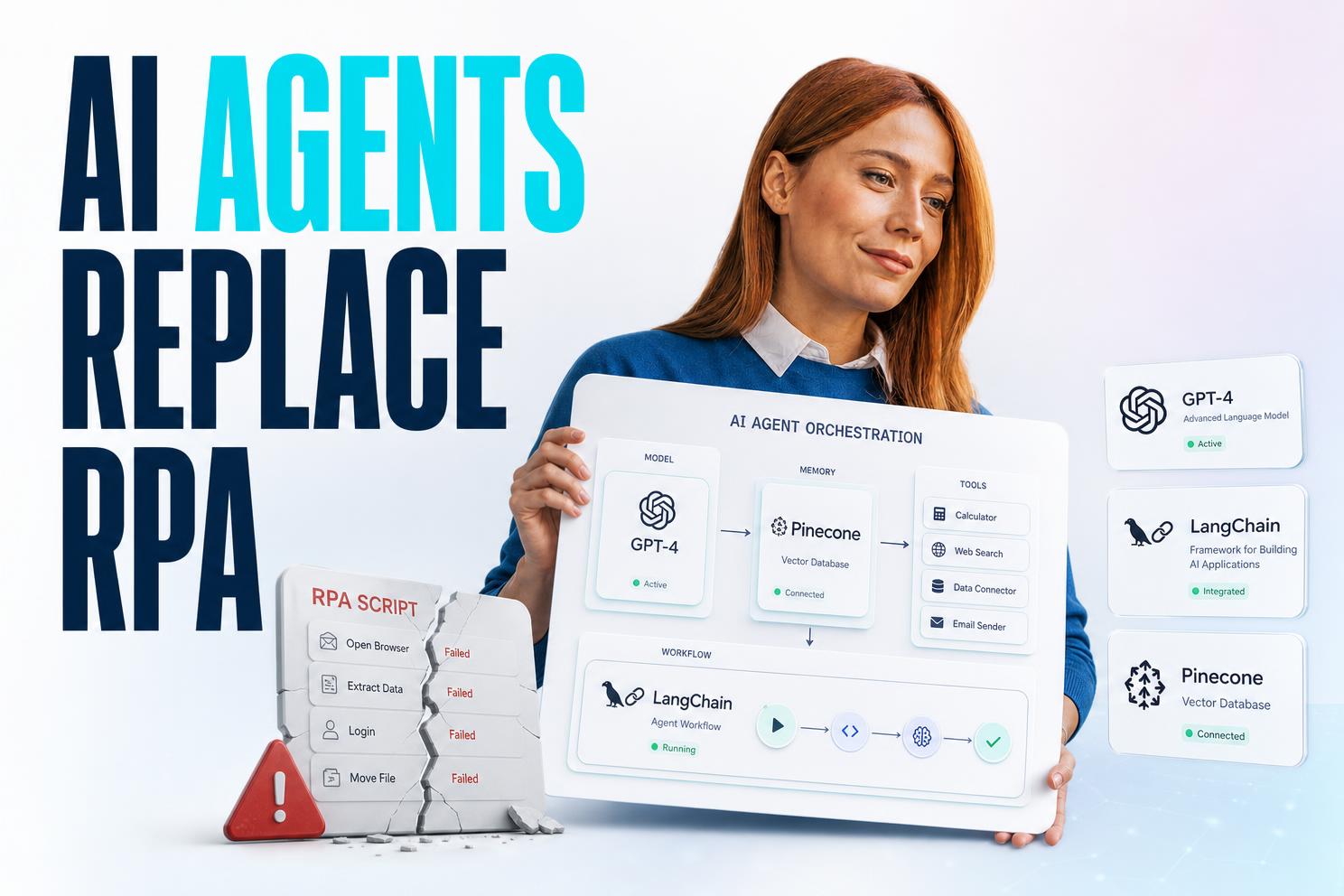
Robotic Process Automation (RPA) promised a future of hands-free operations, but for many enterprises, it delivered a fragile ecosystem of scripts that break the moment a UI changes or a dataset shifts. The industry is now witnessing a paradigm shift from rigid, rule-based bots to autonomous, reasoning-driven AI agents. This transition is not merely an upgrade; it is a fundamental architectural overhaul. We are moving from "do exactly what I said" to "figure out the best way to achieve this goal," leveraging Large Language Models (LLMs) and advanced orchestration frameworks. This evolution represents the core of modern AI Business Automation, where systems adapt to context rather than forcing humans to adapt to the system.
Enterprise automation has hit a complexity wall. Traditional RPA platforms excelled at repetitive, high-volume tasks with structured data, but they struggle significantly with ambiguity. The "bot maintenance" tax has become unsustainable for CTOs. When a vendor changes an API or a pixel shifts on a screen, the bot fails, requiring manual intervention. Furthermore, RPA cannot handle unstructured data—emails, PDFs, or natural language queries—which constitutes the vast majority of business information.
The market demands intelligent automation that can reason, make decisions, and self-correct. Organizations are looking for RPA replacement strategies that do not just swap one tool for another, but reimagine the workflow entirely. The risks of maintaining the status quo are high: technical debt accumulation, operational latency, and the inability to scale digital transformation initiatives.
Modern AI Business Automation relies on a sophisticated architecture that moves beyond simple scripting. It involves an orchestration layer that manages state, memory, and tool execution. Unlike RPA, which follows a linear path, an AI agent operates in a loop of observation, reasoning, and action. We typically utilize frameworks like LangChain, AutoGen, or CrewAI to build these multi-agent systems. The architecture is generally event-driven and asynchronous to handle the variable latency of LLM inference.
In a typical deployment, the system consists of several distinct layers. The entry point is an API Gateway (often Kong or AWS API Gateway) that handles authentication via OAuth2 or JWT. Requests are routed to an orchestration service running in Node.js or Python. This service manages the agent's lifecycle. The "brain" of the operation is the LLM (e.g., GPT-4, Claude 3, or Llama 3 hosted on AWS Bedrock/Azure), accessed via a model router to optimize for cost and speed. For domain-specific knowledge, we implement Retrieval-Augmented Generation (RAG), indexing data into vector databases like Pinecone, Milvus, or Weaviate.
Consider a practical scenario: an autonomous procurement agent. When a new purchase request comes in via a webhook, the agent does not just copy data to a database. It retrieves the vendor's history from a vector store, checks current stock levels via a REST API, analyzes the contract terms (unstructured PDF), and negotiates the price within pre-set bounds. It uses tools—function-calling interfaces that connect to internal APIs—to execute these steps. If an API rate limit is hit, the agent employs a circuit breaker pattern and retries with exponential backoff.
Data pipelines in this architecture are critical. We do not rely on screen scraping. Instead, we use robust workflow automation patterns. Data is ingested via event streams (Kafka or RabbitMQ), normalized, and passed to the agent. The agent processes the data, perhaps using a sub-agent for specific tasks like sentiment analysis or data extraction, and then pushes the result to a CRM or ERP via idempotent API calls. This ensures that if the agent crashes or retries, the system remains consistent.
The financial justification for moving to autonomous processes goes beyond simple labor arbitrage. While RPA typically targets a 20–30% efficiency gain by automating repetitive clicks, AI agents can unlock 50–80% efficiency by automating the cognitive work surrounding those tasks. The ROI is driven by the reduction in exception handling. In RPA, exceptions are frequent and require human intervention. With AI agents, the system can often resolve the exception itself by reading documentation or inferring context.
Cost levers also shift. While LLM inference is more expensive per transaction than a simple script, the total cost of ownership drops because maintenance plummets. You are no longer paying developers to fix broken selectors. Furthermore, the speed of execution improves. An agent can parallelize tasks—checking three different databases simultaneously—whereas an RPA bot must do so sequentially.
For example, in a financial reconciliation process, RPA might match exact amounts but fail on partial payments. An AI agent can read the remittance advice email, understand the deduction logic (e.g., "early payment discount"), and reconcile the invoice automatically. This turns a manual exception into a standard automated process, directly impacting the bottom line.
Migrating to an agent-based architecture requires a disciplined approach. It is not a "rip and replace" operation but a gradual augmentation of existing capabilities. We recommend a phased roadmap that prioritizes high-impact, low-risk domains. Start with "human-in-the-loop" systems where the agent drafts a response or action, and a human approves it. This builds trust and provides training data (RLHF) to fine-tune the system.
Successful implementation relies on a cross-functional team. You need ML engineers to handle the models and RAG pipelines, backend engineers to build the robust tooling and APIs, and product owners to define the guardrails. Governance is crucial from day one. You must establish policies for data privacy (PII redaction), audit trails (logging every decision the agent makes), and cost management (setting token limits and caching strategies).
Common pitfalls include over-reliance on the model's internal knowledge without RAG (leading to hallucinations), ignoring latency (users will not wait 20 seconds for a reply without streaming), and neglecting security (allowing agents broad API access without sandboxing). Avoid these by treating agents as code—they require testing, code review, and secure deployment pipelines.
At Plavno, we do not treat AI as a magic black box. We treat it as an engineering discipline. Our approach to AI agents development is grounded in enterprise-grade architecture. We understand that for a CTO, reliability and security are paramount. That is why we build solutions on top of robust infrastructures like Kubernetes and utilize secure patterns such as service-to-service authentication and encrypted vector stores.
We specialize in custom software development that integrates seamlessly with your legacy systems. We do not force you to abandon your current ERP or CRM; instead, we build an intelligent layer on top of it. Our team has deep expertise in AI consulting, helping you navigate the complex landscape of model selection, prompt engineering, and cost optimization.
Whether you are looking to automate complex digital transformation workflows or need specific AI automation for your fintech or healthcare operations, we bring the technical rigor required to deliver production-ready systems. We focus on observability and governance, ensuring that your autonomous processes are auditable, compliant, and aligned with business goals. By choosing Plavno, you are partnering with engineers who speak both LLM and enterprise architecture fluently.
The transition from RPA to AI agents is inevitable. The question is not if you will make the shift, but how quickly and securely you can do it. With the right architecture and a partner who understands the nuances of both fintech solutions and general enterprise automation, you can turn this evolution into a significant competitive advantage.
Modern AI Business Automation is here, and it is redefining what is possible in operational efficiency. It is time to move beyond the brittle scripts of the past and embrace intelligent, resilient, and autonomous systems.
Contact Us
Plavno experts contact you within 24h
Discuss your project details
We can sign NDA for complete secrecy
Submit a comprehensive project proposal with estimates, timelines, team composition, etc
Plavno has a team of experts ready to start your project. Ask us!

Vitaly Kovalev
Sales Manager
