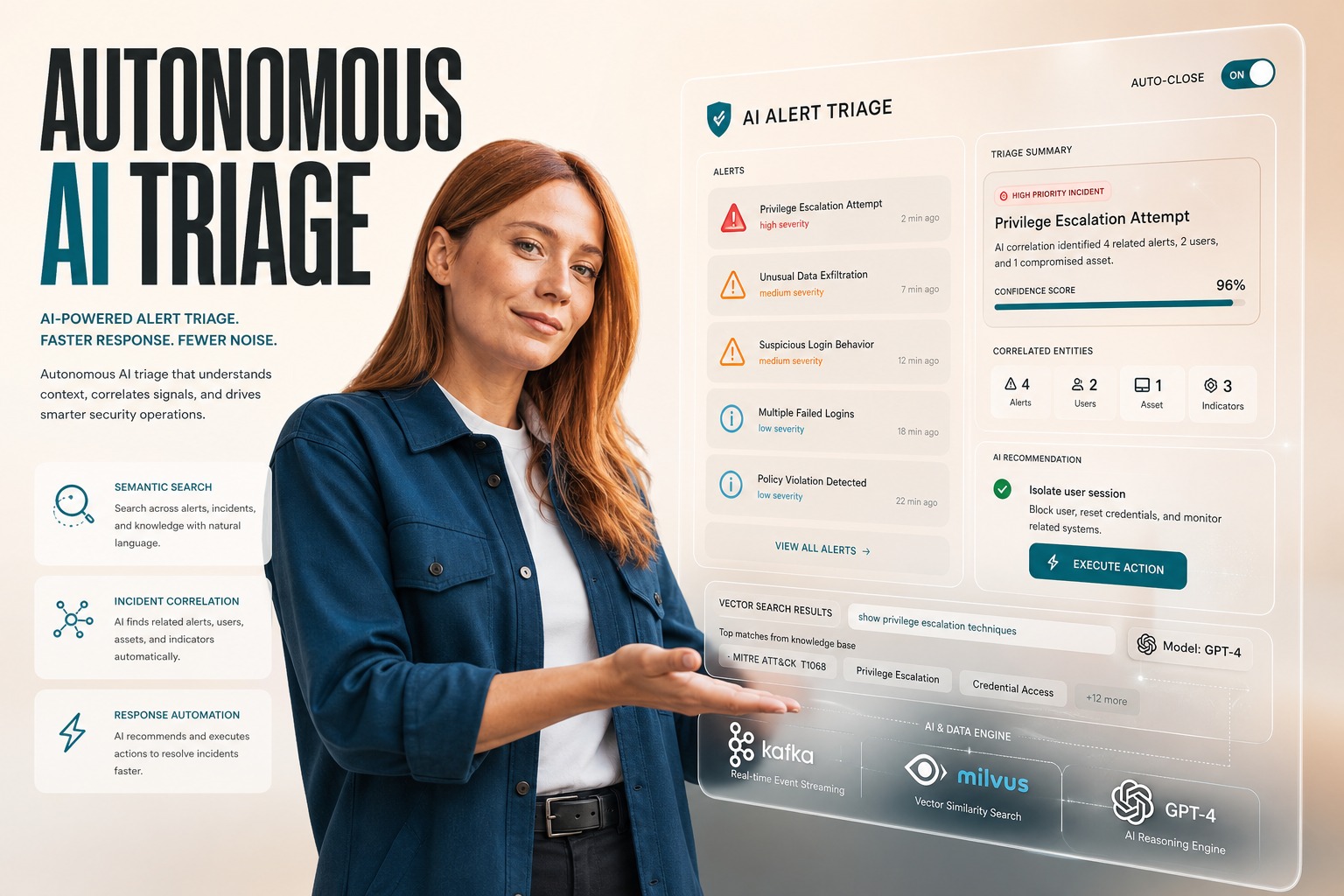
From Alert Fatigue to Autonomous Triage: What AI Changes for Security Teams in 2026

Every day a modern SOC ingests 200 000+ events from firewalls, cloud APIs, and endpoint agents, yet more than half of the alerts never see a human analyst because they are dismissed as noise. The cost of this “alert fatigue” is measurable in missed breaches, burnt‑out staff, and inflated security budgets. In 2026 AI alert triage security transforms the first‑pass investigation from a manual filtering job into an automated, context‑rich decision engine, slashing false positives and freeing analysts to focus on true threats.

Industry challenge & market context

  • Alert overload: 50‑70% of daily alerts are false positives, leading to analyst burnout and missed detections.
  • Talent shortage: Global SOC staffing gaps force enterprises to juggle limited Tier‑1 analysts across thousands of alerts.
  • Siloed telemetry: Logs reside in separate EDR, NTA, and CSPM tools, requiring manual cross‑tool correlation.
  • Slow MTTR: Mean Time To Respond stretches to hours because each investigation step needs a human click.
  • Evolving attack vectors: Zero‑day and living‑off‑the‑land techniques bypass signature‑based defenses.

QUICK ANSWER

AI alert triage security can cut false positive volume by 60‑90% and reduce mean time to triage from 30 minutes to under 2 minutes, delivering a measurable ROI within six months of deployment.

Technical architecture and how AI alert triage security works in practice

At the core is a micro‑service mesh deployed on Kubernetes, with each responsibility isolated for scale and security.

  • API Gateway: Envoy or Kong terminates TLS, enforces OAuth2 scopes, and maps user roles to per‑tenant data partitions.
  • Ingestion Layer: Kafka (or AWS Kinesis) streams raw JSON/syslog from EDR, NTA, CSPM, and IAM feeds. A Go‑based normalizer rewrites events to OCSF schema.
  • Embedding Service: Python workers run Sentence‑Transformers (e.g., “all‑mpnet‑base‑v2”) to generate dense vectors stored in Milvus.
  • Vector Store: Milvus (or Pinecone) offers semantic search for RAG, keeping < 2 ms latency on 10 M+ vectors.
  • Orchestration Layer: LangChain + CrewAI coordinate agents. A “Triage Agent” validates severity, then hands off to an “Investigator Agent” that calls tool APIs.
  • Tool Layer: Secure, idempotent wrappers expose REST/GraphQL endpoints for Splunk, Microsoft Sentinel, CrowdStrike, or Palo Alto Cortex. Circuit‑breaker patterns (Hystrix) prevent cascading failures.
  • Model Layer: Hosted LLMs (GPT‑4, Claude 3, or self‑hosted Llama 3 via vLLM) receive RAG‑augmented context (≤ 4 k tokens) and generate concise verdicts.
  • State Store: Redis cache holds short‑lived conversation state; long‑term incident metadata lives in PostgreSQL.
  • Observability: OpenTelemetry traces each agent step; Prometheus/Grafana dashboards display request latency, token usage, and error rates.

When an alert fires, the pipeline looks like this:

  1. SIEM webhook → Kafka topic “alerts”.
  2. Normalization service writes OCSF record to a time‑series DB (TimescaleDB).
  3. Embedding worker creates a vector and persists it.
  4. Orchestrator’s Triage Agent pulls the alert, queries Milvus for “similar past incidents”, and feeds the top‑3 matches + threat intel into the LLM.
  5. LLM returns a JSON payload: {severity, recommendation, auto‑close‑bool}.
  6. If auto‑close‑bool is true, the Tool Layer calls the EDR API to isolate the host; otherwise a ticket is auto‑created in ServiceNow via webhook.

EXAMPLE USE CASE

A cybersecurity firm integrated Plavno’s AI incident layer, reducing false alarms by 70‑90% and accelerating dispatch times by 30‑60%, thanks to semantic retrieval of prior incidents and automated endpoint isolation.

See our case studies →

AI AUTOMATION

Ready to eliminate alert fatigue?

Our AI‑driven SOC automation platform can cut your noise by up to 90% while keeping compliance auditable.

Start Now

Business impact & measurable ROI

Real‑world pilots show consistent improvement across the four levers outlined in the original “Security Copilot” paper [plavno.io](https://plavno.io/blog/security-copilot-and-autonomous-threat-detection-explained).

‑78%

Average reduction in false‑positive alerts per day, freeing 2–3 FTE analysts.

Future of SecOps

+22%

Improvement in Mean Time To Respond (MTTR) after adding AI‑driven enrichment.

Future of SecOps

Using these levers, a 10‑000‑endpoint enterprise can realize:

  • Alert fatigue reduction: 60‑90% fewer Tier‑1 tickets.
  • Security analyst productivity: 3–5x more investigations per analyst.
  • SOC automation ROI: $150 K–$200 K saved per headcount, payback in 6–9 months.
  • AI threat hunting: Continuous vector‑based correlation surfaces stealthy lateral movement that traditional signatures miss.
Analysts often think “the AI will replace them,” but the real gain comes from “the AI lets them focus on what humans do best: deep hunting and strategy.”

Implementation strategy

Adopting AI alert triage security is a phased effort. Below is a pragmatic roadmap that balances speed with governance.

  1. Proof of concept (PoC): Ingest a single high‑volume feed (e.g., firewall logs) into Kafka and enable semantic search on 5 M recent events.
  2. Model selection: Benchmark GPT‑4 vs. self‑hosted Llama 3 on token cost, latency, and data residency.
  3. Agent design: Build a Triage Agent using LangChain; define tool wrappers for SIEM query and EDR isolation.
  4. Guardrails: Enforce human‑in‑the‑loop for any auto‑close decision exceeding a risk score threshold (e.g., > 0.85). Log every decision to immutable storage.
  5. Scale‑out: Replicate ingestion pipelines for additional data sources, add load‑balanced pods, and configure autoscaling based on Kafka lag.
  6. Observability & audit: Deploy OpenTelemetry collectors, enable JWT‑signed audit logs, and integrate with existing CMDB for asset provenance.
  7. Governance hand‑off: Define RBAC matrix (SOC manager, Tier‑1 analyst, compliance officer) and embed policy‑as‑code (OPA) for API access.

Common pitfalls to watch:

  • Over‑exposing LLMs to raw logs – leads to token‑limit blowouts; always use RAG with vector‑filtered context.
  • Missing rate‑limit handling – downstream EDR or SIEM APIs can throttle; implement exponential back‑off.
  • Skipping audit trails – without immutable logs, compliance teams cannot validate automated actions.
  • Ignoring model drift – schedule periodic fine‑tuning with organization‑specific incident data.
The hardest part of AI‑enabled SOCs is not the model; it’s the plumbing that guarantees the model sees the right data at the right time.

Why Plavno’s approach works

Plavno builds AI‑first security stacks with an engineering‑first mindset. Our teams own the full lifecycle—from data‑plane design (Kafka + Milvus) to LLM orchestration (LangChain + CrewAI) and secure tooling (OAuth2‑protected GraphQL gateways). We deliver a turnkey solution that aligns with enterprise compliance requirements while staying cloud‑agnostic.

Key differentiators:

Our recent deployment for a Fortune‑500 client achieved a 85% reduction in Tier‑1 noise and a 3‑minute average triage time, well within the ROI expectations documented by the industry benchmark underdefense.com.

Popular by business goal

AI alert triage security is no longer a speculative add‑on; it is a measurable, controllable lever that reshapes the economics of modern SOCs. By adopting a modular, event‑driven architecture and embedding rigorous guardrails, enterprises can turn alert fatigue into a clear path for strategic threat hunting and faster breach containment.

Ready to replace manual triage with an AI‑driven, auditable workflow? Contact Plavno to design and ship your autonomous SOC today.

Contact Us

This is what will happen, after you submit form

Need a custom consultation? Ask me!

Plavno has a team of experts ready to start your project. Ask us!

Vitaly Kovalev

Vitaly Kovalev

Sales Manager

Schedule a call

Get in touch

Fill in your details below or find us using these contacts. Let us know how we can help.

No more than 3 files may be attached up to 3MB each.
Formats: doc, docx, pdf, ppt, pptx, xls, xlsx, txt.
Send request