Enterprise AI ROI: What Companies Measure in 2026
In 2026, the enterprise AI conversation has shifted from deployment to ROI. Discover how companies measure value through rigorous AI metrics, cost efficiency, and business outcomes.
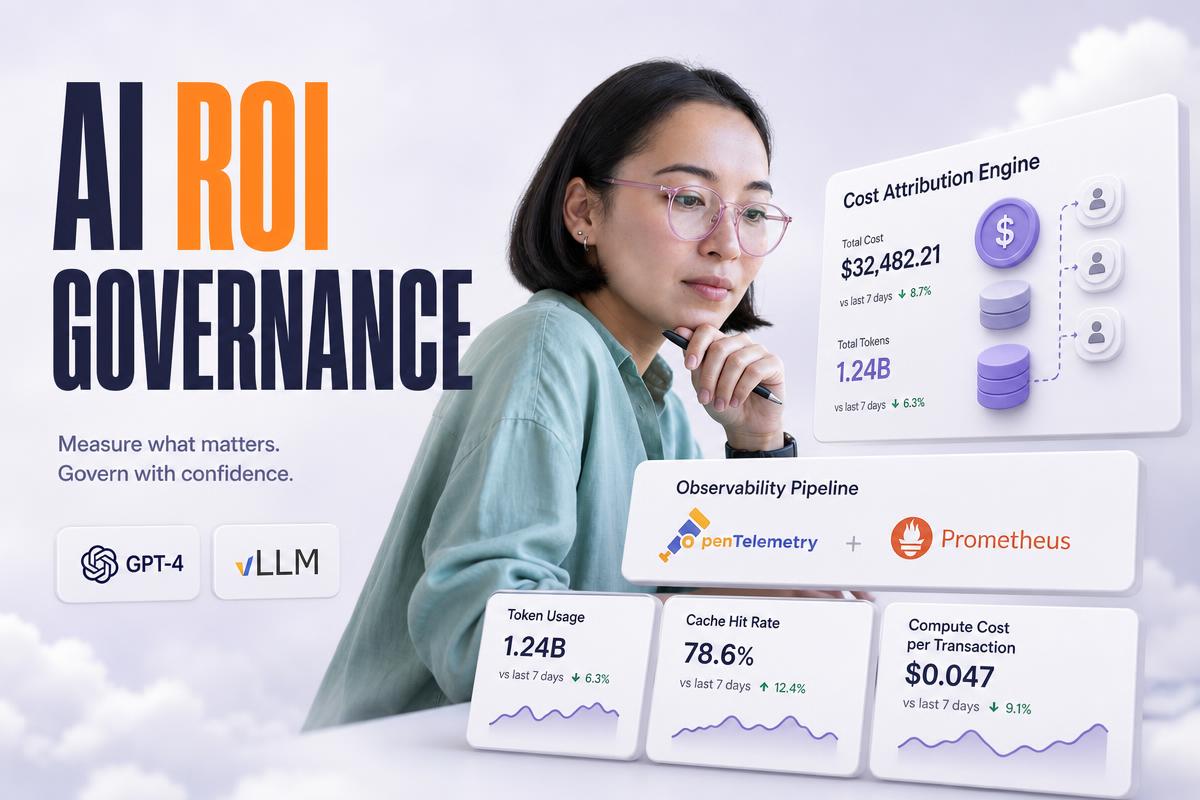
In 2026, the enterprise AI conversation has shifted from "Can we deploy it?" to "Is it actually paying the rent?" The initial hype cycle of Large Language Models (LLMs) has given way to a brutal period of cost-benefit analysis. CFOs are scrutinizing cloud bills inflated by GPU hours and high-volume API calls, while CTOs are demanding evidence that these experimental agents are delivering tangible engineering velocity or business outcomes. The organizations winning today aren't necessarily those with the biggest models, but those with the most rigorous frameworks for measuring value. We have moved beyond vanity metrics like "number of chats" to hard-nosed AI ROI Metrics that tie inference costs directly to P&L impact.
The current landscape is defined by a disconnect between capability and measurability. Engineering teams are spinning up sophisticated agents using frameworks like LangChain and AutoGen, yet they often lack the plumbing to track the efficiency of these systems. The result is a "black box" problem where value is assumed rather than proven. Enterprises face significant bottlenecks when trying to scale AI pilots because they cannot justify the operational expense (OpEx) against vague productivity promises.
To measure AI ROI Metrics effectively, you cannot rely on spreadsheets. You need an architectural layer dedicated to observability and governance. At Plavno, we design systems where telemetry is a first-class citizen, woven directly into the inference pipeline. This involves a shift from simple request/response logging to a comprehensive tracing architecture that captures the entire lifecycle of an AI interaction.
A robust architecture typically consists of an API Gateway (using Kong or AWS API Gateway) that routes requests to an orchestration layer. This layer, often built with Python or Node.js runtimes, utilizes frameworks like LangChain or LlamaIndex to manage complex workflows involving RAG (Retrieval-Augmented Generation) and tool use. Below this, we have the model layer—accessing hosted models like GPT-4 or open-source models via vLLM—and the data layer, comprising Vector DBs (Pinecone, Milvus) and operational stores.
When measuring ROI, we inject telemetry agents into this orchestration layer. Every interaction is traced using OpenTelemetry, capturing metadata that goes far beyond simple latency. We track token counts per prompt, cache hit rates (crucial for cost reduction), and the specific tools or APIs called by the agents. For example, in a customer support automation scenario, when a user asks a question, the system retrieves relevant documents via vector search, generates an answer, and logs the "confidence score" of the retrieval. If the system had to fallback to a human agent, that negative outcome is tagged with specific error codes (e.g., "low_retrieval_score" or "safety_filter_trigger").
In practice, this architecture allows us to generate dashboards that show not just "system health," but "business health." We can visualize the cost per resolved ticket, the average time saved per developer using an AI coding assistant, or the revenue lift attributed to AI-driven product recommendations. By correlating technical signals (like retrieval latency) with business outcomes (like conversion rates), we create a closed loop where engineering improvements directly translate to measurable financial gains.
Translating technical telemetry into financial outcomes requires defining specific AI KPIs that resonate with both the C-suite and engineering leads. The goal is to move beyond generic "productivity metrics" and focus on levers that directly impact the bottom line. In 2026, leading organizations are categorizing ROI into three distinct buckets: Cost Efficiency, Revenue Generation, and Risk Mitigation.
Cost Efficiency is often the easiest to measure. By implementing automation ROI tracking, companies can quantify the savings from deflecting Tier 1 support tickets or automating document processing. For instance, a legal tech firm might use an agent to summarize contracts. If the manual process took 4 hours at $200/hour, and the AI process takes 5 minutes at $0.50 in compute costs, the ROI is tangible. However, we must also account for the "review cost"—the time a human spends verifying the AI's work. The net saving is (Manual Cost) - (Compute Cost + Review Cost). High-performing systems aim for a review cost that is less than 10% of the manual cost.
Revenue impact is harder to attribute but potentially more lucrative. Business outcomes here include increased conversion rates from personalized marketing campaigns generated by AI, or upsell opportunities identified by recommendation engines. For example, an e-commerce platform using AI recommendation systems can track the incremental revenue generated specifically from AI-suggested items versus baseline sales. This requires A/B testing frameworks where AI features are rolled out to specific user cohorts, providing a control group to isolate the AI's financial contribution.
Risk mitigation, while less visible on the income statement, protects the enterprise from catastrophic losses. This includes measuring the effectiveness of AI in detecting fraud, security anomalies, or compliance violations. A successful AI security system might prevent millions in losses by flagging suspicious transactions in milliseconds—a clear ROI achieved through cost avoidance.
Deploying a measurement framework is as complex as deploying the AI itself. It requires a phased approach that aligns data infrastructure with business goals. A common pitfall is attempting to measure everything at once, leading to data overload. Instead, we recommend a "Golden Metric" approach: identifying the single most critical proxy for value in a given domain and instrumenting the system to capture it flawlessly before expanding scope.
Common pitfalls during implementation include ignoring the "cold start" problem where new models lack context, failing to account for the cost of maintaining the vector database (indexing can be expensive), and neglecting the human factor. If the UI/UX of the AI tool is poor, adoption metrics will drop, skewing ROI calculations negatively regardless of the model's technical capability. Furthermore, security must be baked in from day one; using cybersecurity and penetration testing services ensures that your AI metrics pipeline itself cannot be compromised to report false data.
At Plavno, we don't just build AI wrappers; we build enterprise-grade systems engineered for measurable value. Our AI development company approach prioritizes architecture that is observable, scalable, and secure from the ground up. We understand that for a CTO, the success of an AI automation project isn't just about cool demos—it's about system stability and predictable costs. For founders, it's about ROI and time-to-market.
We leverage a modern stack including Kubernetes for orchestration, Docker for containerization, and event-driven patterns to ensure your AI systems are resilient and responsive. Whether we are building AI chatbots, AI assistants, or complex AI agents, we embed the telemetry layers required to calculate AI ROI Metrics from day one. Our expertise in custom software development allows us to integrate these AI solutions seamlessly into your existing legacy systems, ensuring that data flows where it needs to go without friction.
Our engagement models are flexible, designed to meet you where you are. Whether you need to hire a developer to augment your internal team or require a full-scale outsourcing partnership for a major digital transformation, we bring the principal-level engineering oversight required to make AI projects succeed. We focus on digital transformation that is practical, delivering MVP development rapidly to prove value, and then scaling to robust, production-grade cloud software development.
We also specialize in navigating the complexities of AI consulting, helping you define the right AI KPIs before a single line of code is written. From fintech solutions to healthcare AI, our cross-industry experience ensures that the metrics we target are aligned with your specific regulatory and business environment. By choosing Plavno, you are choosing a partner who speaks the language of both the boardroom and the server room, ensuring your AI investment delivers concrete, verifiable returns.
The era of guessing AI value is over. By implementing rigorous AI ROI Metrics, leveraging robust architectural patterns, and partnering with a team that understands the intersection of business and engineering, enterprises can unlock the true potential of AI. It is time to move from experimentation to optimization, ensuring that every token processed contributes directly to your strategic objectives.
Contact Us
Plavno experts contact you within 24h
Discuss your project details
We can sign NDA for complete secrecy
Submit a comprehensive project proposal with estimates, timelines, team composition, etc
Plavno has a team of experts ready to start your project. Ask us!

Vitaly Kovalev
Sales Manager
