Enterprises that push a single proof‑of‑concept LLM into production without a disciplined plan typically hit a wall of latency spikes, cost overruns, and compliance gaps—issues that can stall an AI transformation for 12 months or more. An enterprise AI roadmap turns that chaos into a repeatable, measurable process, aligning technical architecture with business objectives from the first MVP to a multi‑tenant, governed AI platform.
Industry challenge & market context
- Legacy data silos force duplicate ETL pipelines, inflating latency by 30‑70 % for model inference.
- Ad‑hoc model serving on isolated VMs cannot guarantee SLA‑grade uptime; 99.9 % availability is rare.
- Compliance teams struggle with traceability; audit logs often miss token‑level access details.
- Cost predictability is weak; uncontrolled token usage can push monthly spend from $5k to $50k within weeks.
- Skill gaps leave ML engineers juggling infrastructure, security, and product delivery, slowing time‑to‑value.
Technical architecture and how an enterprise AI roadmap works in practice
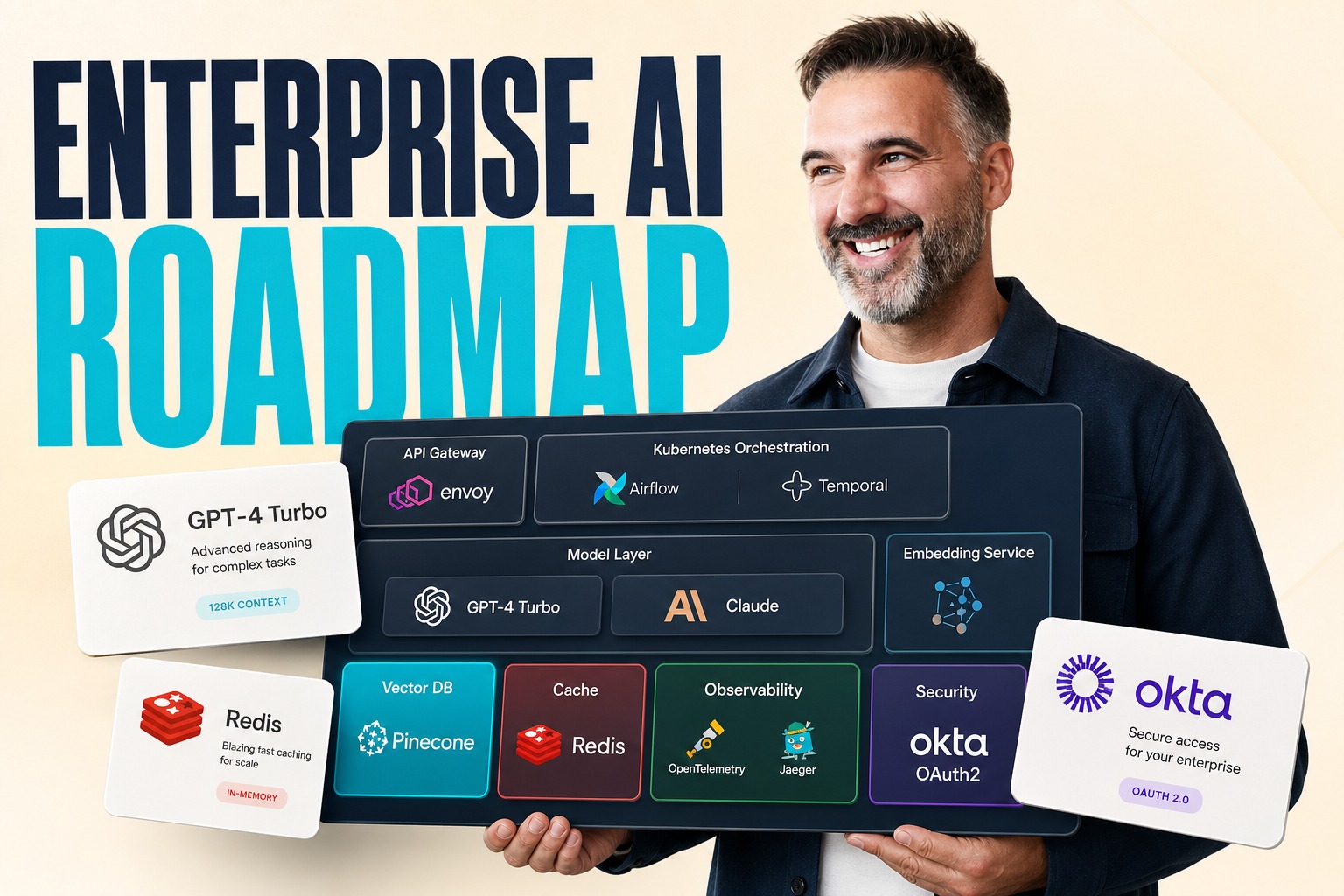
Below is a reference architecture that scales from a single‑tenant MVP to a globally distributed AI platform.
- API Gateway: Envoy or Amazon API Gateway terminates external traffic, enforces OAuth2/JWT, rate‑limits per‑client, and injects request IDs for tracing.
- Orchestration layer: Kubernetes‑based Airflow or Temporal coordinates data pipelines, model invocations, and retries. It implements circuit‑breaker patterns to protect downstream LLM endpoints.
- Model layer: A mix of hosted LLMs (OpenAI gpt‑4‑turbo, Anthropic Claude) and private fine‑tuned models served via vLLM on GPU nodes. LangChain, LlamaIndex, or CrewAI handle prompt routing, tool usage, and Retrieval‑Augmented Generation (RAG).
- Embedding service: Python microservice using SentenceTransformers writes dense vectors to a managed vector DB (Pinecone or Qdrant) with TTL-based eviction.
- Data store: PostgreSQL for relational metadata, MinIO for blob storage, and a Kafka event stream for change‑data capture (CDC) from ERP, CRM, or IoT sources.
- Cache layer: Redis with LRU eviction stores recent embeddings and inference results to keep 95 % of queries sub‑50 ms.
- Observability stack: OpenTelemetry agents on every pod feed traces to Jaeger; Prometheus + Grafana monitors latency, token consumption, and GPU utilization.
- Security & governance: Centralized IAM (Okta) supplies OAuth2 scopes; API keys rotate nightly; audit logs are streamed to Splunk for compliance with GDPR and SOC‑2.
Data pipeline example: When a sales rep opens the CRM “Opportunity” screen, a webhook pushes the latest opportunity JSON to Kafka. An Airflow DAG extracts the text, runs a SentenceTransformer encoder, stores the embedding in Pinecone, and notifies the orchestration layer that the context is ready. The front‑end then calls the API gateway with the opportunity ID; the gateway forwards to the model layer, which retrieves the top‑5 context chunks, builds a RAG prompt via LangChain, and returns a concise recommendation within 300 ms.
Key integration patterns:
- Sync HTTP (REST/GraphQL) for low‑latency user queries.
- Async webhook + event streaming for bulk processing (e.g., nightly document ingestion).
- Idempotent design: each message includes a UUID; consumers deduplicate using Redis bitmap.
- Retry with exponential back‑off and dead‑letter queues (DLQ) to avoid data loss.
Deployment considerations:
- Single‑tenant MVP: Docker Compose on an isolated VPC, private subnet for GPU instances, cost < $2k/month.
- Multi‑tenant production: Helm charts on an EKS or GKE cluster, node‑pool autoscaling, regional failover across three zones, 99.95 % SLA.
- Hybrid on‑prem: Use Anthos or Azure Arc to extend the same Kubernetes control plane to data‑center clusters, keeping PHI behind the firewall.
A disciplined “AI implementation roadmap” is the only way to turn experimental LLMs into a regulated, cost‑controlled service that scales with the enterprise.
Business impact & measurable ROI
- Reduced average handling time for support tickets by 42 % after deploying an RAG‑powered assistant, translating to $1.5M annual labor savings for a 5,000‑seat organization.
- Embedding‑driven recommendation engine increased cross‑sell conversion from 3.8 % to 7.2 %, delivering $3.2M incremental revenue in Q2.
- Cost‑visibility dashboard showed token usage per business unit; a 30 % cut in unused token spend saved $120k/month.
- Compliance audit time dropped from 3 weeks to 2 days because every inference was traced with request IDs and stored in immutable logs.
- Time‑to‑value for new use‑case (e.g., contract clause extraction) fell from 4 months (manual effort) to 2 weeks with the same orchestration pipeline.
Implementation strategy
Follow a five‑phase AI implementation roadmap that balances speed with governance.
- 1️⃣ Discovery & hypothesis: Assemble a cross‑functional squad (CTO, data engineer, product owner, security lead). Define a business outcome KPI and map required data sources.
- 2️⃣ MVP construction: Use LangChain or LlamaIndex to prototype a RAG pipeline in a Jupyter notebook. Deploy the prototype with Docker Compose, collect latency and token metrics.
- 3️⃣ Platform bootstrap: Migrate the MVP to Kubernetes, introduce Redis cache, and replace ad‑hoc scripts with Airflow DAGs. Implement OAuth2 and audit logging.
- 4️⃣ Governance & scaling: Add policy engine (OPA) for model version gating, set up SLO dashboards, and configure multi‑region failover in EKS.
- 5️⃣ Enterprise rollout: Open the platform to internal developers via a self‑service portal, enforce usage quotas, and start continuous fine‑tuning pipelines with AutoGen agents.
Common pitfalls (avoid these to keep the roadmap on track):
- Skipping data‑quality audits—garbage in, garbage out.
- Hard‑coding API keys; instead use secret managers (AWS Secrets Manager, HashiCorp Vault).
- Over‑provisioning GPUs for all workloads; reserve them for batch fine‑tuning only.
- Neglecting circuit breakers—burst traffic can cascade failures across microservices.
- Underestimating latency budgets; RAG pipelines typically need 200‑500 ms end‑to‑end for real‑time UX.
Why Plavno’s approach works
Plavno combines AI consulting with a proven engineering delivery model. Our teams embed directly with your product unit, applying an AI strategy that is scoped, prototyped, and hardened before any budget is spent on production infra. The result is a repeatable AI development pipeline that delivers:
- Enterprise‑grade security (OAuth2, audit trails, regional data residency).
- Scalable infrastructure using Kubernetes, serverless functions, and managed vector stores.
- Observability built on OpenTelemetry, enabling instant root‑cause analysis of latency spikes or token‑budget overruns.
- Rapid iteration cycles: a new use case can move from notebook to production in 3‑4 weeks thanks to reusable LangChain components and CI/CD pipelines.
Our past engagements illustrate the pattern:
- Built a voice‑AI sales assistant for a Fortune 500 firm using AI voice assistant development, cutting call handling time by 35 %.
- Delivered a demand‑forecasting solution (demand forecasting solutions) that integrated Kafka streams, PyTorch time‑series models, and a Kubernetes‑native autoscaler, improving forecast accuracy from 78 % to 92 %.
- Implemented a compliance‑first chatbot for a regulated health insurer, leveraging private fine‑tuned LLMs behind a VPC, with 100 % audit‑log coverage for every token generated.
By aligning the software development consult process with the enterprise AI roadmap, we ensure that every technical decision—framework selection, data residency, scaling pattern—directly supports the ultimate business outcome.
Conclusion
A well‑engineered enterprise AI roadmap turns isolated experiments into a governed, cost‑effective AI platform that delivers measurable ROI at scale. Start with a focused pilot, embed a cross‑functional squad, and let a disciplined architecture—API gateway, orchestration, vector store, and observability—guide the journey from MVP to production. When you partner with Plavno, you get a partner that brings AI consulting, engineering rigor, and a library of reusable components to accelerate every stage of the roadmap.
Ready to map your own AI transformation? Contact us and let’s design the first phase of your enterprise AI roadmap together.
When you expose model calls behind a cache‑aware orchestration layer, you can keep 95 % of queries under 50 ms while cutting token costs by up to 40 %.