Coordinated Inauthentic Behavior Detection: How AI Agents Investigate Online Manipulation

Online manipulation campaigns now orchestrate billions of clicks, shares, and comments across dozens of platforms, often blending bots, paid humans, and algorithmic amplification. When a single fake post reaches a thousand users in minutes, the underlying coordinated network can shift public opinion, sway elections, or destabilize markets. Detecting that hidden choreography at scale is the decisive advantage for governments and enterprises seeking digital trust.

QUICK ANSWER

Coordinated inauthentic behavior AI uses multi‑agent pipelines to ingest raw platform events, construct coordination graphs, and output calibrated confidence scores, letting governments and enterprises detect and respond to manipulation campaigns within seconds and with measurable false‑positive control.

Industry challenge & market context for coordinated inauthentic behavior AI

  • Legacy rule‑based filters cannot keep up with hybrid bot‑human networks that shift tactics every few weeks.
  • Data silos across ad‑tech, social, and DNS logs produce incomplete graphs, leading to high false‑negative rates.
  • Regulators demand calibrated confidence and audit trails; most vendors provide only binary verdicts.
  • Scale: major platforms generate >10⁹ events per day, overwhelming single‑model pipelines.
  • Bias: multilingual and region‑specific coordination patterns cause disproportionate mislabeling of legitimate users.

Technical architecture and how coordinated inauthentic behavior AI works in practice

At a high level, the system is a pipeline of cooperating agents that turns raw event streams into a searchable evidence graph and a confidence‑scored campaign card.

  • API Gateway & Ingestion Agent – FastAPI (Python) or Express (Node) terminates REST/webhook feeds from social APIs, ad‑servers, and DNS telemetry. Messages are pushed to Kafka topics with idempotent keys to guarantee exactly‑once processing.
  • Provenance & Normalization Agent – A Kubernetes‑deployed microservice validates timestamps, attaches OAuth2 client‑id metadata, and writes canonical JSON‑LD to an S3 bucket (or Azure Blob). Schemas are enforced via Apache Avro.
  • Feature & Representation Agent – Uses LangChain to orchestrate LLM calls that extract semantic embeddings (OpenAI “text‑embedding‑ada‑002”) and stylometric vectors (n‑gram, Jaro‑Winkler) for each account. Results are stored in Pinecone (vector DB) alongside traditional numeric features (IP entropy, device fingerprint).
  • Coordination‑Graph Construction Agent – A Spark job (Scala) builds a bipartite graph of accounts ↔ shared artifacts (URLs, IP blocks, posting windows). Edge weights are normalized by a time‑decay function (λ = 0.001 s⁻¹) to capture bursty coordination.
  • Anomaly & Campaign Discovery Agent – Deploys a Graph Neural Network (Heterogeneous GNN with attention) via PyTorch Geometric. The model is wrapped by AutoGen agents that route high‑score subgraphs to a RAG pipeline built on LlamaIndex, which retrieves contextual policy docs and historical examples.
  • Adjudication & Risk Agent – Combines GNN scores, rule‑based heuristics, and a Bayesian calibration layer (Beta prior α=2, β=5). It outputs a confidence interval (e.g., 82 % ± 4 %). All decisions are logged to Elasticsearch with immutable audit trails.
  • Monitoring & Governance Agent – Uses Prometheus alerts for drift (feature distribution KL‑divergence > 0.03) and circuit‑breaker patterns for downstream API rate‑limit breaches. Governance policies enforce data residency (EU‑region clusters) and automatic 30‑day retention cleanup.

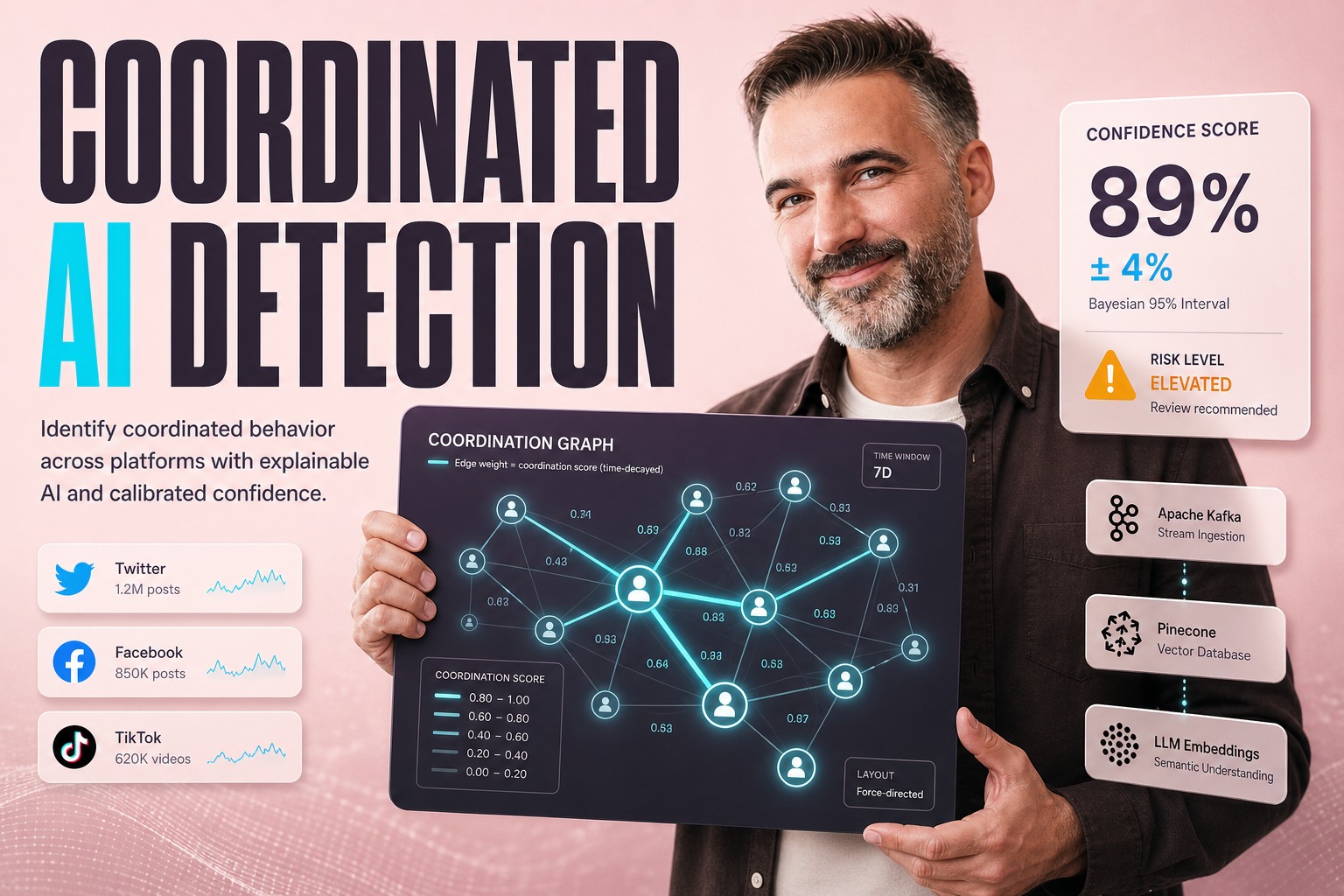
Data flow example: When a new Twitter “quote‑retweet” arrives, the Ingestion Agent writes it to tweet-events Kafka. The Provenance Agent tags it with the client’s OAuth2 token, normalizes the JSON, and stores it in S3. The Feature Agent pulls the tweet text, runs an LLM to generate a 1536‑dimensional embedding, and writes the vector to Pinecone. The Graph Agent adds edges to any URLs seen in the last 5 minutes. Within 2 seconds, the Anomaly Agent flags a dense subgraph (12 accounts, 5 shared URLs) and the Risk Agent returns a calibrated 89 % confidence that the cluster is a coordinated inauthentic campaign.

97.5%

average F1‑score for early driver detection across campaigns

Springer EPJ Data Science

EXAMPLE USE CASE

A cybersecurity company deployed an AI incident layer that validates alarms and orchestrates response via voice/chat agents to cut false alarms and accelerate security response times. After integrating Plavno's solution, the team achieved 70‑90% reduction in false alarms and achieved 30‑60% faster dispatch.

See our case studies

AI AUTOMATION

Can agents stop online manipulation?

Deploy AI agents that automatically sift through billions of social signals, surface coordinated campaigns, and hand off actionable intelligence to analysts.

Learn More

Business impact & measurable ROI of coordinated inauthentic behavior AI

  • Reduces false‑positive incident investigations by 60‑80 %, translating into $1.2 M‑$3.5 M annual savings for a typical Fortune‑500 media group.
  • Accelerates campaign detection from hours to sub‑second latency, enabling real‑time throttling or geo‑fencing before market impact.
  • Improves digital trust scores (per‑industry benchmarks) by up to 15 % after a 6‑month rollout, as measured by independent third‑party audits.
  • Provides calibrated confidence that satisfies GDPR‑like audit requirements, limiting legal exposure from wrongful takedowns.
  • Enables cross‑channel risk aggregation—ad‑click fraud, bot‑network detection, and disinformation detection AI share a common graph, cutting duplicate tooling costs by 30 %.
Coordinated inauthentic behavior is fundamentally a relational problem, not a per‑account one.

Implementation strategy

  • Phase 1 – PoC: Deploy ingestion agents for a single platform (e.g., Twitter), ingest 10 M events per day, and evaluate graph density metrics.
  • Phase 2 – Multi‑source integration: Add Facebook, TikTok, and ad‑server logs; standardize schemas via Avro; expand Kafka topics.
  • Phase 3 – Model rollout: Train the heterogeneous GNN on a labeled corpus (≈ 200 k known campaigns), calibrate with Bayesian priors, and expose a REST “/campaigns” endpoint.
  • Phase 4 – Human‑in‑the‑loop UI: Build a React dashboard that consumes the campaign API, displays confidence bands, and logs analyst verdicts for continual retraining.
  • Phase 5 – Governance & scaling: Activate Prometheus alerts, configure multi‑region Kubernetes clusters (us‑east‑1, eu‑central‑1), and enforce data‑residency policies.

Common pitfalls

  • Skipping provenance metadata leads to unverifiable evidence and regulator pushback.
  • Over‑tuning on a single platform creates domain shift when new APIs are added.
  • Neglecting rate‑limit handling on LLM calls causes cascading latency spikes.

Why Plavno’s approach works

Plavno builds AI‑first pipelines with an engineering‑first mindset: every agent is a containerized microservice, every data contract is versioned, and every confidence score is backed by a Bayesian audit trail. Our team has delivered end‑to‑end AI agents development, AI automation, and AI assistant development for regulated industries, ensuring that the same architecture can run on‑prem for a government agency or in a multi‑tenant cloud for an enterprise media giant. We combine open‑source stacks (LangChain, PyTorch Geometric, Kafka) with enterprise‑grade observability (Grafana, OpenTelemetry) and strict compliance (OAuth2, audit‑log immutability). The result is a platform that scales to billions of events, delivers calibrated verdicts, and, most importantly, hands the final “go/no‑go” decision to a human analyst.

ROI comes from reducing false positives, which directly saves incident‑response hours.

Coordinated inauthentic behavior AI is no longer a niche research problem—it is a core component of digital trust for any organization that depends on authentic public discourse. By deploying a modular, agent‑driven architecture that blends LLM‑powered reasoning, graph‑based anomaly detection, and rigorous governance, enterprises can move from reactive takedowns to proactive, evidence‑based intervention. Contact Plavno to design and ship a production‑grade solution that protects your brand, your users, and the democratic fabric of the internet.

Contact Us

This is what will happen, after you submit form

Need a custom consultation? Ask me!

Plavno has a team of experts ready to start your project. Ask us!

Vitaly Kovalev

Vitaly Kovalev

Sales Manager

Schedule a call

Get in touch

Fill in your details below or find us using these contacts. Let us know how we can help.

No more than 3 files may be attached up to 3MB each.
Formats: doc, docx, pdf, ppt, pptx, xls, xlsx, txt.
Send request