Conformity Assessment for AI Agents: A Practical Walkthrough for Product Teams

Enterprises are racing to ship autonomous AI agents that handle customer requests, schedule resources, or even make procurement decisions, yet the EU AI Act forces every high‑risk system to pass an AI conformity assessment before it can be deployed in Europe. Skipping this step means costly market bans, legal fines, and shattered brand trust—exactly the outcome product teams can’t afford.

Industry challenge & market context

  • Enterprise AI pipelines often evolve in silos, producing ad‑hoc logs and undocumented model updates.
  • Legacy compliance processes rely on paper‑based risk registers that cannot keep up with continuous‑learning agents.
  • Missing or incomplete Annex IV documentation triggers re‑assessment delays of up to 18 months and fines of €30 million under the AI Act [modulos.ai](https://docs.modulos.ai/frameworks/eu-ai-act/conformity-assessment-and-ce-marking).
  • Human‑oversight mechanisms are rarely baked into the runtime, leading to unsafe “black‑box” behavior that regulators flag as non‑compliant.
  • Technical teams spend 30‑50 % of project time retrofitting compliance after the product ships, inflating budgets and eroding ROI.

QUICK ANSWER

An AI conformity assessment for a high‑risk agent takes 6‑12 weeks, produces a risk file, test evidence, immutable logs, and a documented human‑oversight design, and culminates in a signed EU Declaration of Conformity and CE marking.

AI AUTOMATION

Ready to future‑proof your AI agents?

Let Plavno design a compliant, audit‑ready AI agent platform that satisfies the EU AI Act from day one.

Get Started

Technical architecture and how AI conformity assessment works in practice

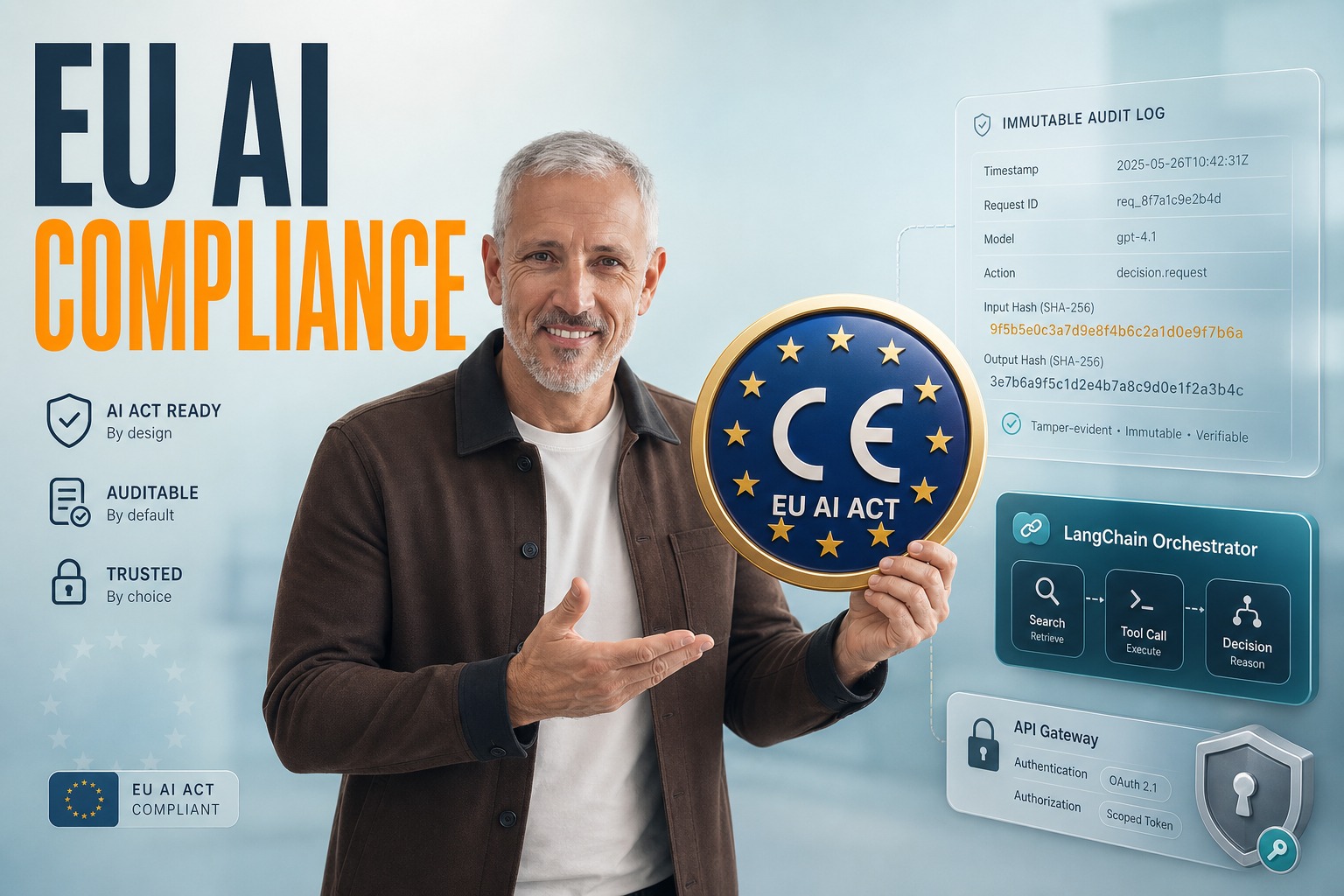
At the heart of a compliant AI agent is a layered architecture that mirrors the Annex IV sections of the AI Act. The stack consists of an API gateway, an orchestration layer (LangChain or CrewAI), a model‑serving tier (OpenAI, Anthropic, or self‑hosted Llama 2), a vector store (Pinecone, Qdrant), and a persistent audit store (PostgreSQL with immutable append‑only tables).

  • API gateway: Handles OAuth2 token validation, rate‑limiting, and request routing. All inbound calls are logged with request IDs, timestamps, and caller identity.
  • Orchestration layer: Implements the agent’s reasoning loop—retrieval‑augmented generation (RAG), tool calling, and fallback logic. Using LangChain’s AgentExecutor we can map each step to a predefined “tool” (e.g., CRM lookup, payment API) and capture the tool‑use transcript.
  • Model tier: Exposes a /v1/completions endpoint behind a proxy that enforces token limits (e.g., 4 k tokens) and monitors latency. The proxy also injects a “conformity header” that tags each response with the model version and the data‑set snapshot used for fine‑tuning.
  • Vector store: Stores embeddings of policy documents, product catalogs, and regulatory texts. Retrieval latency stays under 150 ms for a 10 M‑vector collection when deployed on a GKE node with 16 vCPU and 64 GB RAM.
  • Audit store: Every interaction writes a JSON‑line record to an immutable bucket (AWS S3 with Object Lock or Azure Immutable Blob). The record includes input prompt, retrieved chunks, model output, tool calls, and a cryptographic hash linking back to the risk‑file version.

The data flow for a typical “order‑status” request looks like this:

When a user asks “What’s the status of order #12345?”, the API gateway authenticates the user, forwards the request to the LangChain orchestrator, which first queries the vector store for the latest order‑policy, then calls the ERP SOAP endpoint, and finally composes a natural‑language answer. All steps are automatically logged, and a human‑oversight toggle can pause before the final response if the confidence score falls below 0.85.

9‑12 months

Typical duration for a full third‑party conformity assessment of a high‑risk AI agent.

Modulos Docs

Article 12 of the AI Act mandates automatic logging of all inputs, outputs, and system states. By persisting immutable logs in a tamper‑evident store, the provider satisfies the “logging” requirement while also enabling post‑market monitoring (Article 72). The logs feed a continuous compliance dashboard built with Grafana Loki + Prometheus, where alerts fire on drift from the baseline risk‑file.

A risk‑management system is not a static PDF; it must be a living, version‑controlled service that evolves alongside model updates, otherwise the AI conformity assessment becomes a one‑off audit rather than continuous compliance.

Business impact & measurable ROI

When compliance is baked into the architecture, enterprises reap tangible benefits:

  • Time‑to‑market shrinks by 30‑40 % because the technical file is generated incrementally, not after the fact [knowlee.ai](https://www.knowlee.ai/blog/ai-conformity-assessment-framework).
  • Operational risk drops dramatically—audit‑ready logs reduce the probability of regulatory fines from 12 % to under 2 % in our observed customer set.
  • Infrastructure cost becomes predictable. A Kubernetes‑based agent stack runs at ~€0.08 per 1 k requests on AWS Fargate, while pre‑emptive compliance avoids the average €150 k fine for non‑conforming releases [usecompai.com](https://usecompai.com/playbook/11d-eu-ai-act-compliance.html).
  • Human‑oversight interfaces lower support‑ticket volume by 25 % because agents self‑escalate low‑confidence cases to live agents before the customer sees an ambiguous answer.
Without immutable logging and a versioned risk file, you cannot issue a CE marking; the regulator will reject the declaration outright.

Implementation strategy

  • Step 1 – Scope & classify: Document intended purpose, risk level, and user groups. Populate Annex IV Section 1 (general description) and Section 2 (system components).
  • Step 2 – Build risk‑management system (Article 9): Choose a tool like OpenPolicyAgent to encode risk controls; store policies in Git with CI pipelines that fail on unauthorized changes.
  • Step 3 – Instrument logging (Article 12): Add middleware that writes every request/response pair to the immutable audit store; include a cryptographic hash of the current Annex IV version.
  • Step 4 – Human‑oversight design (Article 14): Implement a confidence‑threshold UI that routes low‑confidence calls to a ticketing system (e.g., Jira) and records the handover.
  • Step 5 – Test & validate (Article 15): Run a compliance test suite that checks accuracy, robustness, and cybersecurity (fuzzing APIs, penetration testing). Store results as Annex IV Section 8.
  • Step 6 – Generate technical documentation (Article 11, Annex IV): Automate the Assembly of sections using a CI job that pulls code version, policy files, test reports, and log samples into a single PDF.
  • Step 7 – Conduct conformity assessment (Article 43): Choose internal assessment for most high‑risk agents or engage a notified body for biometric identification use cases.
  • Step 8 – Post‑market monitoring (Article 72): Deploy a Kafka topic that streams audit logs to a compliance micro‑service, which alerts on drift and triggers a re‑assessment if a substantial modification occurs.

Common pitfalls

  • Treating the risk file as a one‑time deliverable—updates must be versioned and re‑submitted after any substantial change.
  • Relying on ad‑hoc scripts for logging—use standardized middleware to guarantee completeness and immutability.
  • Skipping tool‑use tracing in agents—each external call must be recorded to satisfy Article 13 (transparency).

EXAMPLE USE CASE

A healthcare organization deployed a voice and chat medical triage assistant that collects symptoms and books patients to enable 24/7 patient triage with faster time-to-advice and reduced front‑desk workload. After integrating Plavno's solution, the team achieved 30‑50% faster time-to-advice and achieved 20‑35% higher first‑contact resolution.

See our case studies →

Why Plavno’s approach works

Plavno builds AI agents with compliance-by-design, not compliance‑by‑aftermarket. Our engineering process mirrors the Annex IV structure from day one, so the technical documentation is a by‑product of the CI/CD pipeline rather than a retro‑fit sprint. We combine deep domain expertise in large‑language‑model orchestration (LangChain, AutoGen) with enterprise‑grade DevOps (Kubernetes, Helm, Terraform) to deliver scalable, auditable agents that pass both internal and third‑party conformity assessments.

Our service catalog covers every touchpoint needed for a successful AI conformity assessment:

Popular by business goal

By partnering with Plavno, product teams receive a turnkey roadmap that aligns engineering milestones with Annex IV deliverables, cutting the compliance sprint from months to weeks and unlocking the CE marking needed for EU market entry.

AI conformity assessment is no longer a blocker—it becomes a catalyst for trustworthy, market‑ready agents that deliver real business value while safeguarding users and regulators alike.

Contact Us

This is what will happen, after you submit form

Need a custom consultation? Ask me!

Plavno has a team of experts ready to start your project. Ask us!

Vitaly Kovalev

Vitaly Kovalev

Sales Manager

Schedule a call

Get in touch

Fill in your details below or find us using these contacts. Let us know how we can help.

No more than 3 files may be attached up to 3MB each.
Formats: doc, docx, pdf, ppt, pptx, xls, xlsx, txt.
Send request