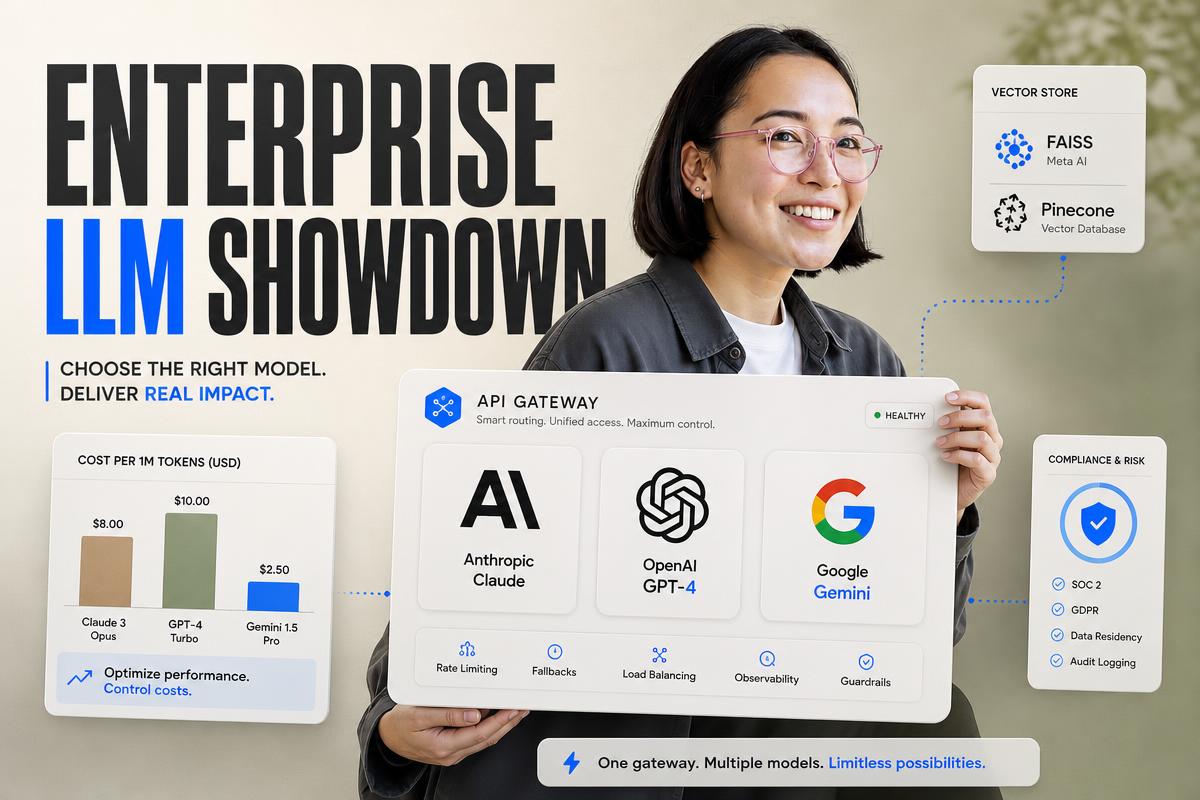
Enterprises that have finally moved beyond “pilot‑only” chatbots are now staring at a new decision point: which large language model (LLM) should power the next generation of AI‑driven workflows? The answer isn’t “the biggest name wins.” Instead, the choice hinges on concrete factors—privacy guarantees, latency budgets, cost curves, and the ability to embed the model in existing orchestration stacks. In the next few minutes we’ll break down the three dominant contenders—Claude, GPT, and Gemini—through the lens of enterprise LLM adoption, so you can pick the model that aligns with your product roadmap and compliance posture.
Industry challenge & market context
- Legacy rule‑engine pipelines cannot keep up with the combinatorial explosion of natural‑language intents, leading to brittle user experiences.
- Data residency regulations (GDPR, CCPA, HIPAA) force many firms to keep raw text on‑premise, yet most public LLM APIs assume cloud‑only processing.
- Cost volatility: per‑token pricing ranges from $0.0001 to $0.03, making unpredictable spend a real blocker for large‑scale deployments.
- Model drift and hallucinations increase operational risk when LLMs are used for compliance‑critical documents.
- Integration fatigue: teams must stitch together REST, GraphQL, and event‑driven back‑ends while preserving idempotency and observability.
Technical architecture and how Claude vs GPT vs Gemini works in practice
At a high level, every enterprise LLM service consists of the same set of components, but the implementation details differ enough to affect latency, security, and developer velocity.
Core components
- API Gateway – terminates TLS, enforces OAuth2 scopes, and routes requests to the orchestration layer.
- Orchestration Layer – typically a Python FastAPI or Node.js Express service that decides which model to invoke, assembles context, and handles retries with exponential back‑off.
- Model Layer – the actual Claude, GPT, or Gemini endpoint, accessed via a vendor‑specific SDK or a generic HTTP client.
- Vector Store – a Faiss, Milvus, or Pinecone instance that holds embeddings for Retrieval‑Augmented Generation (RAG).
- Message Queue – Kafka or Google Pub/Sub for async pipelines (e.g., “run background compliance check”).
- Cache – Redis for short‑lived token‑level results to keep latency under 150 ms for hot queries.
Data pipeline example
- Customer support ticket arrives via webhook → API Gateway validates the JWT.
- Orchestration service extracts the ticket text, creates a 768‑dimensional embedding with Plavno’s embedding service, and stores it in the vector DB.
- RAG query pulls the top‑3 relevant knowledge‑base articles, concatenates them with the ticket, and forwards the prompt to the selected LLM.
- Model response is streamed back, logged to Elastic, and the final answer is posted to the ticketing system via GraphQL mutation.
Model‑specific integration quirks
- Claude integration: Anthropic’s Claude offers a “system‑prompt” that can be set once per session, reducing token overhead for multi‑turn conversations. Claude’s API returns a
finish_reason field that is useful for circuit‑breaker logic. - GPT integration: OpenAI’s GPT‑4 provides function calling, which lets the orchestration layer hand off structured JSON to downstream services (e.g., AI automation pipelines). Rate limits are per‑minute per API key, so a token bucket algorithm is mandatory for high‑throughput bots.
- Gemini integration: Google’s Gemini adds multimodal support; you can attach images to the prompt via multipart/form‑data. The model also exposes a “safety settings” payload that can be toggled per request to meet compliance.
Deployment patterns
- Single‑tenant Docker containers on Kubernetes (EKS, GKE, AKS) for strict data isolation.
- Serverless functions (AWS Lambda, Cloud Run) for bursty workloads, with cold‑start latency under 200 ms when using provisioned concurrency.
- Hybrid on‑prem + cloud: keep the vector store and cache in a private VPC, while routing model calls to the vendor’s public endpoint over a dedicated VPN.
Integration patterns
- Sync REST calls for low‑latency UI features (average response 350 ms for GPT‑4, 280 ms for Claude, 300 ms for Gemini on a 2 GHz CPU).
- Async event‑driven pipelines via Kafka for batch document processing; idempotency is ensured by storing a hash of the input payload in Redis.
- GraphQL subscriptions for real‑time dashboards that monitor LLM usage, cost, and latency per tenant.
A well‑engineered orchestration layer is the single most important factor in turning an LLM’s raw capability into predictable, billable business value.
Implementation strategy
Adopting an enterprise LLM should follow a disciplined, incremental roadmap.
- Define use‑case boundaries and success metrics (e.g., latency < 400 ms, cost < $0.01 per request).
- Prototype with a single model using LangChain or LlamaIndex to validate prompt engineering and RAG effectiveness.
- Build a reusable orchestration service (Python FastAPI or Node Express) that abstracts model calls behind an internal interface.
- Introduce a vector store (Pinecone or self‑hosted Milvus) and benchmark embedding latency.
- Implement security controls: OAuth2 scopes, API‑key rotation, and audit logging to Elastic.
- Run a controlled pilot (≤ 5 % of traffic) with real users, collect observability data (OpenTelemetry traces, Prometheus metrics).
- Iterate on model selection based on pilot data—switch between Claude, GPT, and Gemini by toggling a config flag.
- Scale to production: deploy multi‑region Kubernetes clusters, enable auto‑scaling policies, and set up cost alerts in CloudWatch.
Common pitfalls
- Hard‑coding model endpoints instead of using an indirection layer makes future swaps painful.
- Neglecting token‑limit awareness; a 8 K context window can truncate long documents, leading to silent hallucinations.
- Over‑relying on vendor‑side fine‑tuning without a local validation set, which can cause compliance gaps.
- Skipping circuit‑breaker patterns; a sudden spike in latency can cascade into downstream services.
Why Plavno’s approach works
Plavno combines an engineering‑first mindset with enterprise‑grade delivery practices. Our teams build the orchestration layer once and then plug any LLM behind it, leveraging the same AI agents development framework across projects. This reduces time‑to‑value from months to weeks and guarantees that security, observability, and cost‑control are baked in from day one.
- We use AI automation patterns that let you orchestrate Claude, GPT, or Gemini with a single declarative YAML file.
- Our cloud software development practice includes automated CI/CD pipelines that run compliance checks on every model update.
- Through voice‑assistant solutions we have proven multimodal pipelines that combine Gemini’s image capabilities with speech‑to‑text, delivering end‑to‑end products in under 8 weeks.
- Our AI consulting arm helps you define governance policies, data residency maps, and cost‑allocation models before any code is written.
Ready to evaluate Claude vs GPT vs Gemini for your next AI initiative? Contact us for a technical discovery session, and let’s turn model selection into a strategic advantage.
Choosing the right model isn’t a one‑off decision; it’s an ongoing process of AI model selection, integration, and governance. By grounding the choice in concrete architecture, measurable ROI, and a disciplined rollout plan, enterprises can unlock the full potential of Claude vs GPT vs Gemini while keeping costs, latency, and compliance under control.