Industry challenge & market context
Enterprises that have layered legacy systems, regulatory constraints, and multi-regional data residency requirements cannot simply flip a switch and start feeding production data to a public-facing LLM. The gap between a frontier model like the base Anthropic Claude and the security, audit, and control envelope demanded by Fortune 500 CIOs is measured in weeks of engineering effort and millions of dollars of risk exposure.
- Data leakage risk – unfiltered prompts often contain PII, PHI, or proprietary IP that must never leave the corporate firewall.
- Regulatory non-compliance – GDPR, CCPA, HIPAA, and industry-specific controls (e.g., FINRA) require explicit data residency and retention policies.
- Model drift & cost unpredictability – uncontrolled token usage can explode cloud spend, while model updates may break downstream agents.
- Operational silos – security, dev-ops, and product teams rarely share a unified view of LLM interactions, leading to duplicated effort.
- Lack of reproducible governance – audit trails, versioned prompts, and role-based access are missing in standard Claude deployments.
Claude Enterprise governance: Technical architecture and how it works in practice
Claude Enterprise governance builds a fortress around the raw Claude model while exposing a developer-friendly surface for rapid AI-first product iteration. Below is a reference architecture that we have delivered for multiple Fortune-scale clients.
Core components
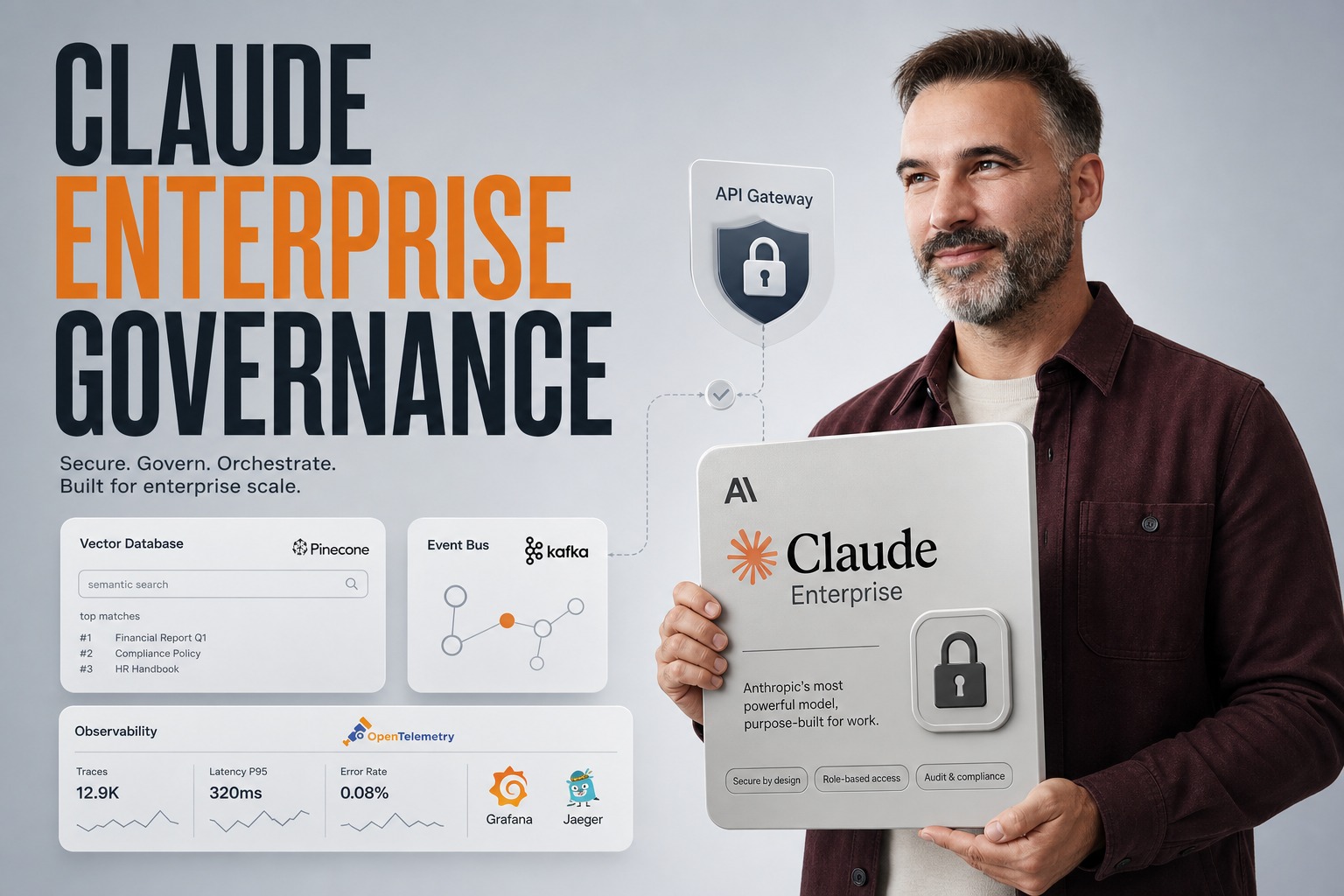
- API Gateway – Envoy or AWS API Gateway enforces OAuth2 access tokens, rate limiting, and mutual TLS.
- Orchestration Layer – A Kubernetes-native service built with cloud-software-development patterns running LangChain or CrewAI agents, responsible for routing requests to the appropriate model or tool.
- Model Layer – Anthropic Claude Enterprise hosted in a VPC-isolated region, reachable only via private link.
- Data Store – PostgreSQL for structured metadata, TimescaleDB for time-series audit logs, and a vector DB (Pinecone or Qdrant) for embeddings.
- Secure Cache – Redis with TLS for short-lived session state and idempotency keys.
- Message Bus – Apache Kafka for event-driven pipelines (e.g., async RAG enrichment, webhook notifications).
- Observability Stack – OpenTelemetry collectors feeding Grafana Loki, Prometheus, and Jaeger.
Data pipeline
- Incoming request hits the API Gateway, authenticated via OAuth2 client credentials.
- Gateway validates token scopes (e.g.,
read:customer, invoke:claude) and forwards to the Orchestration Service over gRPC. - Orchestration Service extracts context, checks the policy engine (OPA), and determines if the request needs RAG (retrieval-augmented generation).
- If RAG is required, a vector search query is issued to the vector DB; results are cached for 5 minutes to reduce latency.
- The assembled prompt (user input + retrieved snippets + system instructions) is sent to Claude Enterprise via its private REST endpoint, respecting the configured token window (max 100k tokens).
- Claude returns a response; the Orchestration Service logs the full interaction (prompt, response, metadata) to PostgreSQL for audit, then streams the answer back through the API Gateway.
- Optional post-processing agents (e.g., AutoGen-based compliance checker) can mutate the response before delivery.
Model orchestration patterns
- Tool use agents – LangChain tool-calling lets Claude invoke internal APIs (e.g., inventory lookup) in a single turn, reducing round-trip latency from ~200 ms to < 50 ms for high-throughput use cases.
- Dynamic routing – A lightweight router (implemented with FastAPI) directs requests to either Claude Enterprise, a fine-tuned Claude-Lite instance, or a fallback open-source model based on token length and cost profile.
- Hybrid RAG – Combine dense vector retrieval (FAISS) with sparse BM25 for legal document QA, achieving 92% top-1 accuracy on a test set of 5k clauses.
APIs and integration points
- REST endpoints for synchronous calls (JSON payload, 200 ms–2 s latency).
- GraphQL mutation for batch inference, enabling selective field retrieval to keep token usage low.
- Webhooks for async events – e.g., when a compliance violation is detected, a POST is sent to the risk-engine service.
- Kafka topics (
claude.requests, claude.responses) for event-driven pipelines.
Infrastructure checklist
- Cloud provider: AWS (VPC, PrivateLink) or Azure (Private Link Service) – choose based on data-residency contracts.
- Containers: Docker images built from Python 3.11 base, deployed via Helm charts on a GKE/EKS cluster.
- Serverless fallback: CloudRun or Lambda functions for bursty low-latency tool calls.
- Scaling: Horizontal pod autoscaler (target 70% CPU) plus a custom rate-limit controller to keep Claude within its subscription limits (e.g., 5M tokens/day).
- Cost levers: Token caching, model routing, and batch processing can shave 30-40% off the raw Claude Enterprise bill.
- Failover: Multi-region active-active deployment with health-checked DNS routing; in a regional outage, traffic is redirected to a replicated VPC in another zone.
A well-engineered Claude Enterprise governance layer turns unpredictable LLM consumption into a predictable cost model.
Implementation strategy
Adopting Claude Enterprise governance should be treated as a phased transformation rather than a single rollout. A pragmatic roadmap helps align engineering, security, and product teams.
- Phase 1 – Discovery & policy definition – Map data flows, define residency zones, and create OPA policies for token caps and data classification.
- Phase 2 – Pilot sandbox – Deploy a single-tenant Claude instance in a dev VPC, integrate with a LangChain proof-of-concept agent, and instrument full audit logging.
- Phase 3 – Security hardening – Enable mutual TLS, enforce OAuth2 scopes, and configure encrypted at-rest storage for embeddings.
- Phase 4 – Production rollout – Shift to multi-tenant architecture, add Kafka event streams, and enable automated failover between regions.
- Phase 5 – Optimization & scaling – Introduce token caching, dynamic model routing, and cost-monitoring dashboards; iterate on prompt engineering based on observability data.
Common pitfalls
- Relying on default Claude rate limits without a token budgeting layer – leads to throttling during traffic spikes.
- Storing raw prompts in plaintext logs – violates GDPR and increases breach surface.
- Mixing synchronous and asynchronous response handling without idempotency keys – results in duplicate downstream actions.
- Neglecting to version prompts and system messages – hampers reproducibility and auditability.
Why Plavno's approach works
Plavno combines deep LLM expertise with enterprise-grade delivery practices. Our engineering-first methodology means we don't just hand you an API key; we build a governed AI service that plugs into your existing stack.
- We start with AI assistant development using LangChain and AutoGen, then layer governance.
- Our custom software development teams embed OPA policies directly into the orchestration layer.
- We provide end-to-end cybersecurity and penetration testing to certify the VPC isolation.
- Through Plavno Nova, we integrate observability dashboards that surface token usage, latency, and compliance alerts in real time.
- Our talent model – whether you need outsourcing, outstaffing, or a dedicated delivery pod – aligns with the scale of your AI ambition.
Conclusion
Claude Enterprise governance is the missing bridge that lets enterprises reap the productivity boost of Anthropic Claude without exposing themselves to data, compliance, or cost risk. By architecting a private, policy-driven layer that channels Claude through secure APIs, vector stores, and observable pipelines, businesses achieve measurable ROI while staying audit-ready. At Plavno, we have codified this pattern into a repeatable delivery framework that turns AI ambition into reliable, governed reality. Ready to move beyond a frontier model? Contact us to design a Claude Enterprise governance solution that fits your risk profile and growth trajectory.