Building an AI Incident Response Playbook for Agentic Security Tools
Building an AI Incident Response Playbook for Agentic Security Tools
September 22, 2026· min read·#AI#Tech·Reviewed by Plavno AI Engineering Team
Enterprises are deploying autonomous security agents that can scan logs, create tickets, and trigger firewall rules without human oversight. An AI incident response playbook provides a deterministic, auditable process to contain AI‑driven alerts.
Share this post
Enterprises are deploying autonomous security agents that can scan logs, create tickets, and even trigger firewall rules—all without human oversight. When those agents misbehave—whether through prompt injection, model drift, or an unexpected data‑exfiltration pattern,the damage spreads faster than a traditional SIEM can alert, and the cost of a delayed response can exceed $1 M per incident. An AI incident response playbook gives you a deterministic, auditable process that turns chaotic AI‑driven alerts into controlled containment and recovery steps.
Industry challenge & market context
Legacy IR pipelines treat assets as static servers; they lack a model registry, vector store, or tool‑use permission matrix.
Security automation playbooks often assume deterministic scripts; LLM‑based agents introduce stochastic output and token‑limit constraints that break hard‑coded playbooks.
Regulatory fines for data exposure (e.g., GDPR €20 M) outweigh the operational cost of building a dedicated AI‑centric response framework.
Incident escalation AI is hampered by ambiguous ownership—ML teams know model internals, security teams know breach law, but no single owner can act fast enough.
QUICK ANSWER
An AI incident response playbook defines clear escalation thresholds, human approval checkpoints, and automated remediation steps—typically acknowledging SEV1 alerts within 15 minutes, isolating the affected model endpoint in under 30 seconds, and rolling back to a known‑good version in 2 minutes.
Technical architecture and how AI incident response playbook works in practice
The core of an AI‑centric IR system is a set of loosely coupled services that can observe, decide, and act without bringing the entire estate down. Below is a reference architecture that has grown out of real‑world deployments.
API Gateway (Envoy or Kong) – terminates TLS, enforces OAuth2 scopes, routes REST/GraphQL calls to downstream services.
Ingestion Layer – Kafka topics for alerts, prompt logs, and tool‑use traces. A Flink job normalises timestamps, enriches with asset tags, and writes to a time‑series store.
Model Registry & AI Bill of Materials (AIBOM) – PostgreSQL + a JSONB column storing provider, version, training data provenance, and fine‑tuning hashes. This satisfies the “model as asset” requirement highlighted in the industry challenge.
RAG Store – Milvus vector DB behind a gRPC service; stores embeddings of policy documents, threat intel, and reference code snippets. Retrieval latency < 20 ms for 10‑million vectors.
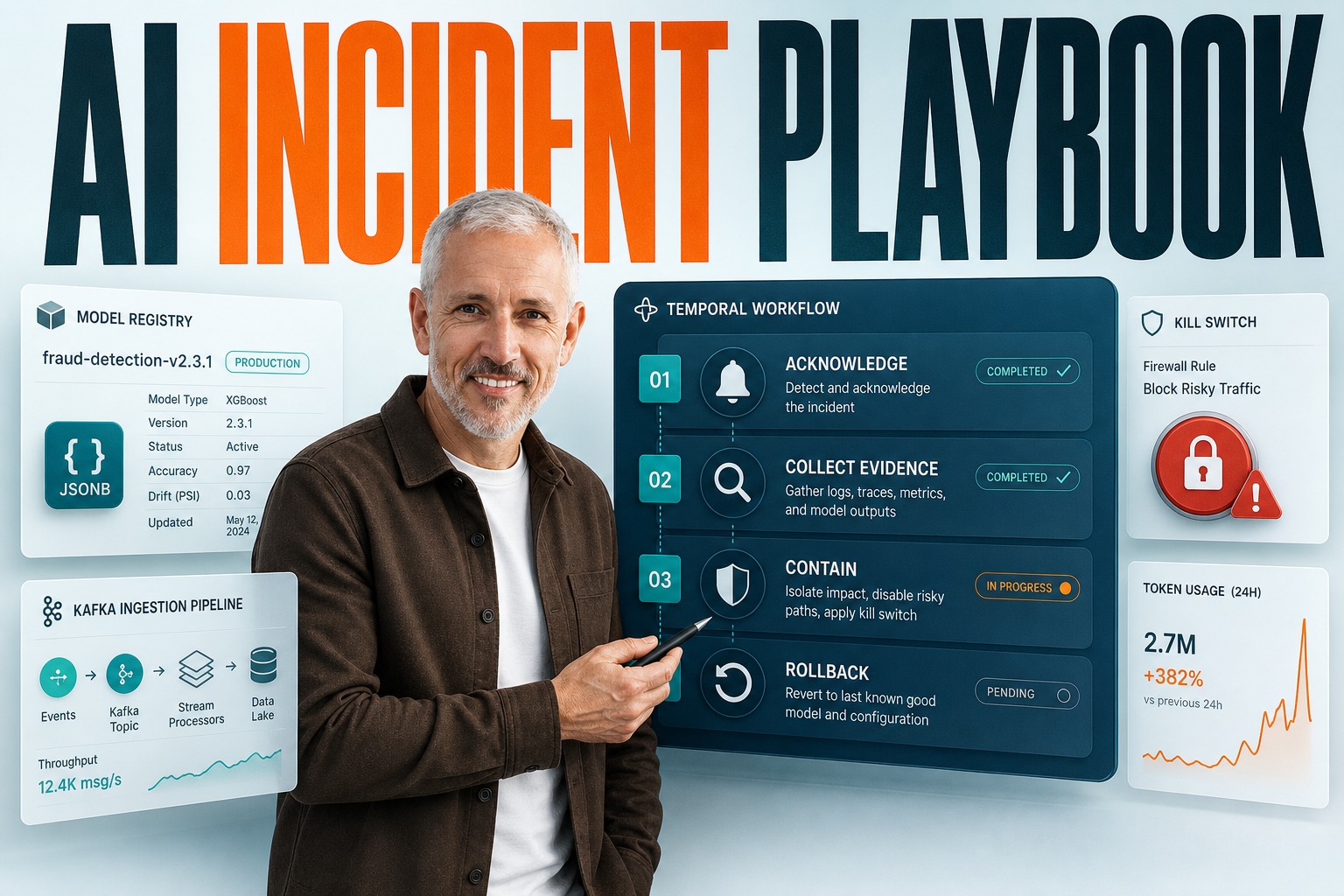
Orchestration Engine – Temporal or Cadence workflows encode the playbook steps. Each workflow receives a structured incident payload and executes a deterministic sequence: acknowledge, collect evidence, run containment, and close.
Agent Layer – LangChain or CrewAI runs as a Python microservice. It can call tools (firewalls, IAM, ticketing) via SDKs. The agent’s system prompt defines its authority level and includes a “kill‑switch” clause that refuses any action beyond its scope.
Observability Stack – OpenTelemetry traces from every microservice funnel into Grafana Loki (logs) and Tempo (traces). Alerting rules in Prometheus fire when latency > 3 s or when token‑usage spikes > 2× baseline.
Data flow example:
Security sensor emits a suspicious token‑usage surge → Kafka → Flink enriches with model ID from the registry → writes to incident_raw topic.
Temporal workflow evaluate_incident reads the event, pulls the latest model metadata and latest RAG retrieval logs, and invokes a LangChain agent with a prompt: “Is this pattern indicative of prompt injection? Provide confidence and remediation suggestions.”
The agent returns a JSON with severity: SEV2, confidence: 0.87, and a remediation list. The workflow then triggers automated steps (see next section) and notifies the on‑call via Slack webhook.
Prompt injection often looks like a benign user query; without a dedicated escalation threshold, teams waste hours chasing false positives.
Key design patterns that keep the playbook reliable:
Event‑driven, idempotent actions – every containment step (e.g., revoking an API key) is wrapped in a PUT /keys/:id/revoke call that returns the prior state, enabling a safe rollback.
Circuit breakers – the firewall‑block tool will refuse to block more than 100 IPs within a 5‑minute window, preventing an over‑aggressive kill‑switch from taking down legitimate traffic.
Rate‑limited token usage monitoring – a Prometheus rule caps LLM inference requests at 1 k tpm per model; exceeding this triggers SEV1 escalation.
Human‑in‑the‑loop checkpoints – actions with blast radius > “disable user account” require explicit approval via an internal “Approve” button in the incident UI, recorded in an audit log.
AI AUTOMATION
Ready to harden your AI agents?
Our AI‑automation service delivers a production‑grade security automation playbook that scales across clouds and regions.
By codifying AI‑specific escalation thresholds and automating low‑risk containment, enterprises see tangible financial and operational gains.
Mean Time to Contain (MTTC) drops from 45 minutes to under 5 minutes for SEV2 incidents, a 89 % improvement.
False‑positive reduction—AI‑driven triage cuts noisy alerts by 70‑90 % (see our case study below).
Compliance cost avoidance—automated audit trails satisfy NIST 800‑53 and GDPR “record of processing activities” requirements, eliminating up to $250 k per audit.
Infrastructure saving—scoped kill switches avoid full‑system shutdowns, preserving 99.9 % availability and saving $0.15 per CPU‑hour on average.
15 min
Target time to acknowledge a confirmed data‑exfiltration incident per the severity matrix.
Automation is only as good as its boundaries; explicit blast‑radius limits turn an AI‑driven playbook into a net‑positive risk manager.
Implementation strategy
Step 1 – Asset inventory: Populate the Model Registry and AIBOM; tag each model with owners, data residency, and allowed tool set.
Step 2 – Define escalation thresholds: Use historical token‑usage patterns to set SEV1–SEV4 limits (e.g., > 2× baseline for 5 minutes → SEV2).
Step 3 – Build the Temporal workflow library: Encode each severity’s containment actions (API‑key revocation, RAG index quarantine, model rollback).
Step 4 – Integrate human approval UI: Slack buttons backed by an OAuth‑protected service that records approver ID and timestamps.
Step 5 – Deploy to a staging cluster: Run blue‑green releases in Kubernetes (EKS/GKE) with canary traffic to validate latency < 200 ms per decision.
Step 6 – Exercise the playbook: Conduct tabletop drills, simulate prompt‑injection attacks, and verify rollback times.
Step 7 – Scale & monitor: Enable auto‑scaling of the LangChain microservice (CPU target 70 %) and set Prometheus alerts on workflow failures.
Common pitfalls (avoid these traps):
Relying on a single LLM provider—model drift can hide in updates; keep a fallback model version ready.
Missing idempotency—duplicate replay of a kill‑switch can lock out users permanently.
Over‑automating high‑impact actions—revoking broad API keys without a human sign‑off leads to service outages.
EXAMPLE USE CASE
A cybersecurity firm integrated Plavno’s AI incident layer to validate alarms, orchestrate response via voice/chat agents, and cut false alarms by 70‑90 %. The same setup achieved 30‑60 % faster dispatch of containment actions.
Plavno builds every component with enterprise rigor:
Our AI agents development team ships LangChain‑based agents that respect scoped tool permissions out of the box.
We couple those agents with a cloud‑software‑development platform that runs on multi‑region Kubernetes, providing automatic failover and sub‑millisecond latency for vector queries.
Our AI automation offering delivers a pre‑tested security automation playbook template that you can customize to your compliance regime.
Building an AI incident response playbook is no longer optional for enterprises that rely on autonomous agents. The right mix of deterministic escalation thresholds, human approval checkpoints, and scoped automated remediation turns a volatile AI stack into a reliable security asset. Partner with Plavno to embed that discipline into your AI‑first roadmap and convert risk into measurable business value.
Share this post
Contact Us
This is what will happen, after you submit form
Plavno experts contact you within 24h
Discuss your project details
We can sign NDA for complete secrecy
Submit a comprehensive project proposal with estimates, timelines, team composition, etc
Need a custom consultation? Ask me!
Plavno has a team of experts ready to start your project. Ask us!