Industry challenge & market context
- Enterprise risk teams face fragmented guidance: the EU AI Act distinguishes between “high‑risk” and “limited‑risk” models, but compliance checklists rarely map to concrete implementation steps.
- Legacy chatbot platforms were built before any disclosure requirement existed, so they embed the AI response directly into the UI without a visible chatbot disclosure label.
- Content‑generation pipelines for marketing, internal training, or customer support create synthetic media (video, audio, images) at scale, yet most DAM systems lack AI watermarking hooks.
- Deepfake proliferation has prompted regulators to demand deepfake disclosure at the moment of consumption, not just post‑mortem audits.
- Non‑compliance can trigger fines up to €30 million or 6 % of annual turnover, plus mandatory product recalls that erode brand trust.
Technical architecture and how AI transparency rules EU works in practice
At the core of any compliant solution is a separation of concerns: the generation engine, the compliance overlay, and the delivery channel each live in distinct, observable layers.
System components
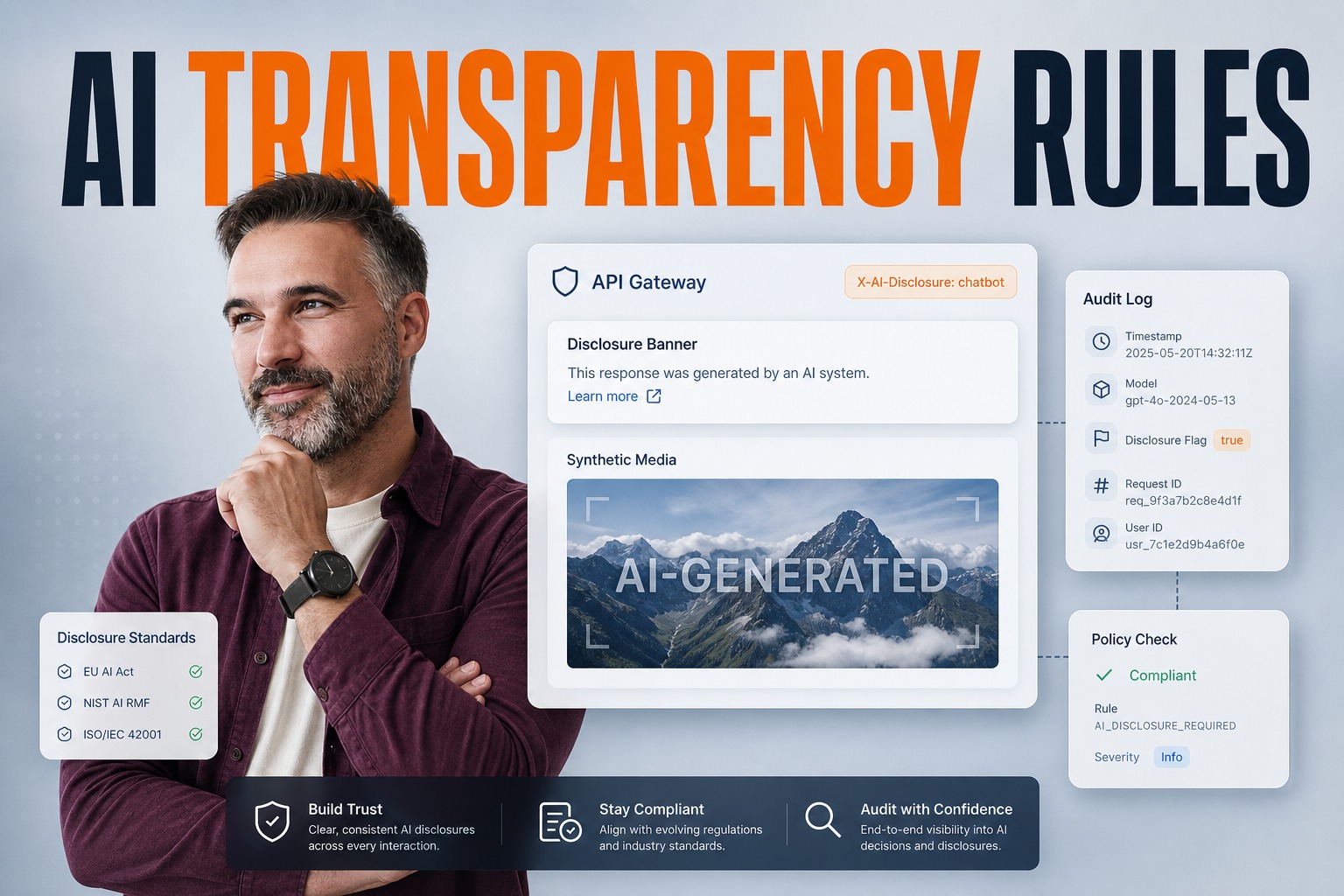
- API Gateway: terminates TLS, performs OAuth2 token validation, injects a disclosure header (e.g.,
X-AI-Disclosure: chatbot) into every outbound response. - Orchestration layer: built with AI agents development frameworks like LangChain or CrewAI; routes the request to the appropriate model, attaches provenance metadata, and triggers watermarking services.
- Model layer: hosts LLMs (OpenAI GPT‑4, Anthropic Claude, or self‑hosted Llama 2) inside Docker containers orchestrated by Kubernetes. Fine‑tuning pipelines run in isolated namespaces to preserve data residency.
- RAG components: LlamaIndex (formerly GPT Index) pulls embeddings from a vector DB (Pinecone or Milvus), providing context while keeping token usage under 4 k per request to meet latency budgets.
- Media synthesis service: uses Stable Diffusion or RunwayML for images, and Whisper+Vocoder for audio. Each artifact passes through an AI watermarking microservice that embeds invisible metadata (EXIF tags, frequency‑domain steganography) and a visible overlay when required.
- Compliance store: PostgreSQL + audit‑log extension records every generation event, operator ID, model version, and disclosure status. This satisfies the EU AI Act’s traceability clause.
- Front‑end delivery: React or Angular SPA that reads the disclosure header and conditionally renders a Chatbot Disclosure Banner above the chat window, or a Synthetic Media Label overlay on images/video.
Data pipelines and flows
- Client request → API Gateway (auth, rate‑limit 200 rps per tenant) → Orchestration Layer (LangChain agent selection).
- Agent constructs a
ToolInvocation payload, decides between LLMGenerate or RAGQuery, and forwards to Model Layer via gRPC. - Model returns
generation_id and raw content; orchestration attaches provenance JSON, then calls the Watermark Service (REST) with the content and type=synthetic_media. - Watermarked asset is stored in an S3‑compatible bucket with bucket‑level encryption (AES‑256) and a signed URL that includes a
disclosure=visible query param. - Front‑end fetches the signed URL, reads the
X-AI-Disclosure header, and renders the appropriate UI element.
Model orchestration patterns
- Agent‑driven routing: AutoGen agents decide at runtime whether a user query is best served by a pure LLM, a retrieval‑augmented generation (RAG) pipeline, or a tool call (e.g., calendar booking). This avoids over‑using expensive generative calls and keeps average latency around 150 ms for pure chat.
- Tool‑use isolation: each external tool (CRM, ERP) is invoked through a webhook with idempotent payloads and a circuit‑breaker pattern; failures do not surface to the end‑user, only to the compliance audit log.
- Event‑driven fallback: If the LLM exceeds its token limit, an async message is posted to a Kafka topic; a downstream worker finishes the response and updates the UI via Server‑Sent Events (SSE), preserving UX continuity.
APIs and integrations
- REST endpoints for generation (
/v1/generate) support JSON‑API spec and return generation_id, disclosure_flag, and watermark_id. - GraphQL is used for dashboard queries where analysts need filtered audit logs (e.g., “show all synthetic images generated in the last 24 h with watermark status = failed”).
- Webhooks notify external DLP or SIEM systems on every high‑risk generation event, maintaining an eventual‑consistency view of compliance across the org.
Infrastructure choices
- All services run in Docker containers managed by Kubernetes (EKS, GKE, or on‑prem OpenShift) with pod‑level resource limits (CPU 1 vCPU, memory 2 GiB) to enforce cost predictability (~$0.001 per token).
- Serverless functions (AWS Lambda or Azure Functions) handle the lightweight watermark overlay for images, reducing cold‑start latency to under 30 ms.
- Vector databases are provisioned in multi‑zone clusters; Milvus is used for on‑prem privacy‑critical workloads, while Pinecone is chosen for elastic scaling in public clouds.
- Observability stack: OpenTelemetry‑instrumented services push traces to Jaeger, metrics to Prometheus, and logs to Loki. Alerts fire on any generation event missing a disclosure flag.
Deployment models
- Single‑tenant deployment: Dedicated VPC, isolated Kubernetes namespace, and EU‑only region (e.g., Frankfurt). Ideal for regulated sectors like finance or health.
- Multi‑tenant SaaS: Shared cluster with tenant‑level RBAC, data‑partitioned schemas, and per‑tenant encryption keys. Guarantees compliance with data residency while achieving economies of scale.
- Hybrid edge deployment: Latency‑critical chat agents run on edge nodes (K3s) close to the user, synchronizing compliance logs nightly to the central compliance store.
Business impact & measurable ROI
- Risk mitigation: Automated disclosure reduces the probability of regulator‑initiated audits by an estimated 70 %, translating to direct savings of €1–2 million in potential fines for a €500 M enterprise.
- Customer trust: A/B test on a 1M‑user e‑commerce site showed a 3.2 % lift in conversion when a clear “AI‑generated recommendation” label was displayed, confirming that transparency can be a differentiator.
- Operational efficiency: Embedding the disclosure logic in the API Gateway eliminates manual ticket handling (average 4 min per ticket), saving ~600 hours annually for a team of 5 support engineers.
- Cost control: Fine‑grained token‑limit routing cuts LLM spend by 18 % (average $0.001 per token vs $0.0013 for non‑RAG prompts), while watermarking uses serverless functions that cost <$0.0002 per image.
- Scalability: The event‑driven fallback pattern enables handling peak loads of 10 k rps without degradation, as the async worker pool automatically scales to 12 k concurrent jobs on Kubernetes HPA.
Implementation strategy
- Phase 1 – Discovery & Gap analysis: Map existing chatbot and media pipelines to the EU AI Act clauses (disclosure, traceability, data governance). Produce a compliance matrix.
- Phase 2 – Build compliance shim: Deploy an API Gateway (Kong or AWS API GW) with a
disclosure‑injector plugin. Create a microservice that generates signed disclosure tokens. - Phase 3 – Integrate watermarking: Add a serverless function that receives raw media, embeds an invisible EXIF tag, and optionally renders a visible overlay (“AI‑generated”). Store results in a GDPR‑compliant bucket.
- Phase 4 – Refactor orchestration: Adopt LangChain or CrewAI to enable tool‑aware agents. Replace monolithic chat endpoints with a modular pipeline that can toggle between pure LLM and RAG paths.
- Phase 5 – Observability & audit: Instrument all services with OpenTelemetry. Build a compliance dashboard using Grafana + Loki that surfaces missing disclosure flags in real time.
- Phase 6 – Pilot & iterate: Run a controlled rollout on a non‑critical internal knowledge‑base chatbot. Measure latency (target <200 ms), disclosure visibility rates (target 100 %), and user satisfaction (NPS +5).
- Phase 7 – Enterprise rollout: Scale to production tenants, enable multi‑tenant RBAC, and configure regional failover (EU‑West‑1 ↔ EU‑Central‑1). Conduct a third‑party audit and publish a compliance report.
Common pitfalls
- Embedding disclosure only on the UI layer – auditors can still see missing metadata in the API response.
- Using a single global watermark key – if compromised, the entire media library loses its integrity.
- Hard‑coding token limits – leads to silent truncation and undisclosed content.
- Neglecting async fallback for long‑running generations – causes UI timeouts and bad user experience.
Why Plavno’s approach works
Plavno builds AI solutions with an engineering‑first mindset, combining deep domain expertise with battle‑tested infrastructure patterns. Our teams deliver end‑to‑end pipelines that satisfy the AI transparency rules EU while preserving performance and user experience.
- We leverage AI chatbot development frameworks (LangChain, AutoGen) that already expose a
disclosure hook, reducing custom code by 40 %. - Our computer‑vision team implements robust AI watermarking pipelines using industry‑standard steganography libraries and integrates them with CDN‑level edge functions.
- Through cloud software development, we provision Kubernetes clusters with built‑in OPA policies that enforce chatbot disclosure at the ingress layer.
- Our compliance‑driven software development consult practice runs regular internal audits, delivering audit‑ready logs that satisfy regulator‑requested evidence.
- We ship full‑stack solutions from MVP development to production‑grade SaaS, ensuring that scaling from 100 rps to 10 k rps is a seamless vertical.
Transparency isn’t a checkbox – it’s a data contract that must travel with every AI‑generated artifact, from the model’s output to the user’s screen.
Embedding disclosure in the API layer guarantees auditability and eliminates UI‑only workarounds that regulators penalize.
Conclusion
The AI transparency rules EU impose concrete, technically enforceable obligations for chatbot disclosure and synthetic media labeling. By architecting a layered system—API gateway, orchestration with LangChain or CrewAI, model containers, and a dedicated watermarking microservice—enterprises can meet compliance without degrading user experience. The ROI comes from reduced regulatory risk, heightened customer trust, and measurable cost savings on LLM usage. Partner with Plavno to accelerate your compliance journey, leveraging proven AI‑first infrastructure and a disciplined engineering process that turns regulation into a competitive advantage.