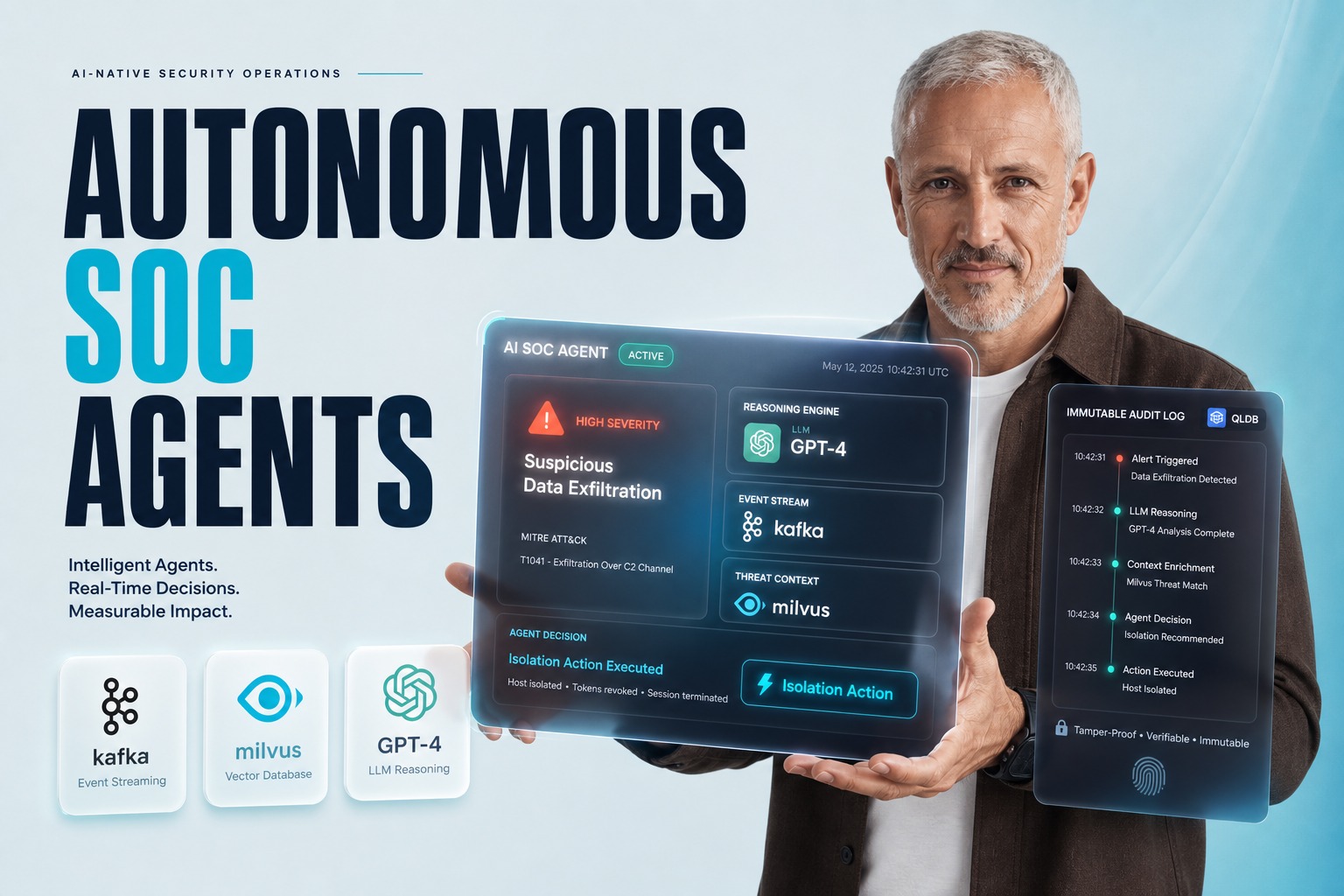
AI SOC Agents: How Autonomous Security Operations Centers Work in 2026
AI SOC Agents: How Autonomous Security Operations Centers Work in 2026
September 15, 2026· min read·#AI#Tech·Reviewed by Plavno AI Engineering Team
Enterprises still waste hours each week untangling noisy alerts, manually stitching logs, and chasing false positives—often > 50% of the alerts never lead to a real incident. In 2026, AI SOC agents have matured from experimental chat‑bots to autonomous agents that triage, correlate, and start investigations in under two minutes.
Share this post
Enterprises still waste hours each week untangling noisy alerts, manually stitching logs, and chasing false positives—often > 50% of the alerts never lead to a real incident. In 2026, AI SOC agents have matured from experimental chat‑bots to autonomous agents that triage, correlate, and start investigations in under two minutes, reshaping the economics of security operations.
QUICK ANSWER
AI SOC agents automatically ingest alerts, enrich them with threat intel, and run multi‑step investigations using LLM‑driven agents. By the time a human analyst sees the case, the agent has reduced false positives by 70‑90% and provided a concise, evidence‑backed summary in under 2 minutes.
Technical architecture and how AI SOC agents work in practice
The core of an autonomous SOC is a layered microservices stack that treats a Large Language Model (LLM) as an orchestration engine, not a static chatbot. The following components are typical for a production‑grade deployment:
API Gateway: Enforces OAuth2, RBAC, and rate limiting; terminates TLS; forwards authorized calls to internal services.
Ingestion Layer: Kafka or AWS Kinesis streams raw JSON/syslog from endpoints, firewalls, cloud APIs, and SaaS. A Python‑based normalizer (often using OCSF) writes events to a time‑series DB (e.g., ClickHouse).
Embedding Service: A fast GPU‑enabled model (e.g., Sentence‑Transformer or OpenAI embeddings) converts log snippets and runbook text into vectors stored in Milvus or Pinecone.
Orchestration Layer: Built with LangChain, CrewAI, or AutoGen. It creates a “triage agent” and an “investigator agent”, maintains state in Redis, and routes tool calls based on confidence thresholds.
Model Layer: Calls hosted LLMs (GPT‑4, Claude 3, or self‑hosted Llama 3 via vLLM) via REST. Retrieval‑Augmented Generation (RAG) pulls the top‑k relevant vectors to stay within token limits.
Tool Layer: Secure, idempotent wrappers exposing REST/GraphQL endpoints for SIEM (Splunk), EDR (CrowdStrike), IAM (Azure AD/Okta), and threat‑intel feeds. Each wrapper implements circuit‑breaker patterns and exponential back‑off.
Cache & State Store: Redis for short‑lived context, Postgres for case records, and an immutable audit log (e.g., AWS QLDB) for compliance.
Observability Stack: OpenTelemetry agents on every service, Grafana dashboards for latency, and Jaeger traces that record the exact agent reasoning path.
Data flow example:
1. Alert ingestion: A CrowdStrike EDR alert lands on Kafka, the normalizer tags it with OCSF schema, and stores the raw event in ClickHouse.
2. Embedding & RAG prep: The alert’s description is embedded and stored in Milvus; related runbooks are pre‑indexed.
3. Webhook trigger: The SIEM emits a webhook; the orchestration layer spawns a “Triage Agent”.
4. First decision: The agent queries the vector DB for similar incidents (k‑NN search) and calls the LLM with a concise prompt. Within 30 seconds it classifies the alert as true positive with 94% confidence.
5. Investigation path: The “Investigator Agent” calls the EDR GraphQL API to fetch the full process tree, the IAM REST API for recent sign‑ins, and the threat‑intel feed for hash reputation—all in parallel via asyncio.
6. Evidence assembly: Results are merged, summarized, and written to the case store. A human‑readable narrative is generated (≈150 tokens) and attached to a ticket.
7. Automated response: If confidence > 0.98, the agent invokes the isolation endpoint on CrowdStrike. The action is logged, and a circuit‑breaker ensures no more than 5 API calls per second to avoid throttling.
Even with the most advanced SIEM, > 50% of alerts never turn into incidents. An autonomous agent that can cut that noise to a single actionable signal saves both time and money.
AI AUTOMATION
Ready to replace manual triage?
Our AI SOC platform integrates with your existing stack and delivers autonomous threat triage in under two minutes.
Reduced false positives: 70‑90% drop translates to ~120 hours saved per analyst per month.
Faster MTTR: Average investigation time shrinks from 45‑60 minutes to ≈90 seconds (see Simbian’s benchmark)【https://simbian.ai/blog/how-does-ai-soc-work】.
Cost efficiency: Agents run on spot‑priced GPU instances; a 4‑node Kubernetes cluster can handle 10,000 alerts/sec for <$0.15 per 1 M LLM calls.
Compliance auditability: Immutable case records stored in AWS QLDB or on‑premises PostgreSQL satisfy PCI‑DSS 10‑2 and GDPR Art. 30.
Talent leverage: Analysts spend 80% of their time on high‑impact threat hunting instead of rote triage.
AI SOC agents are not “rules on steroids”; they are reasoning engines that plan, execute, and adapt like a senior analyst, but at machine speed.
Implementation strategy
Phase 1 – Foundations: Deploy Kafka ingestion, OCSF normalizer, and ClickHouse store. Validate end‑to‑end log flow from at least three sources (EDR, IAM, Cloud).
Phase 2 – Embedding & Retrieval: Set up Milvus, run nightly batch jobs to embed historical logs and runbooks. Tune k‑NN similarity thresholds.
Phase 3 – Agent Framework: Choose LangChain (Python) or CrewAI (Node) and implement a “Triage Agent” with state stored in Redis. Connect to OpenAI GPT‑4 via REST.
Phase 4 – Tool Integration: Wrap SIEM, EDR, and IAM APIs behind GraphQL/REST adapters. Apply circuit‑breaker (Polly) and rate‑limit (token bucket).
Phase 5 – Governance: Enforce OAuth2 scopes per tenant, log every tool call to an immutable audit trail, and configure OpenTelemetry tracing.
Phase 6 – Pilot & Scale: Run a 30‑day pilot on a non‑critical business unit. Measure false‑positive reduction, MTTR, and analyst satisfaction. Iterate the prompt library and fine‑tune the embedding model.
Common pitfalls
Over‑loading the LLM prompt with raw logs; always use RAG to keep token count < 4 k.
Neglecting idempotency – repeated API calls can cause duplicate isolation actions.
Missing observability – without tracing you cannot debug why an agent chose a particular response.
Ignoring data residency – vector DBs and LLM inference must stay within corporate VPC for regulated industries.
Why Plavno’s approach works
Plavno builds AI‑first solutions on a proven, enterprise‑grade stack. We start with a cloud‑native microservices architecture, then layer custom AI agents that speak directly to your existing security tools. Our teams have delivered end‑to‑end AI SOC pipelines for Fortune 500 customers, handling millions of events per day while keeping latency under 200 ms per agent decision.
Key differentiators:
Modular agent framework using LangChain and AutoGen, allowing you to swap LLM providers or add new tool adapters without rewriting business logic.
Hybrid deployment options: on‑premises VPC for vector stores, or fully managed Kubernetes on AWS/GCP with auto‑scaling node pools.
Security‑first tooling: every API call passes through our zero‑trust gateway with fine‑grained RBAC.
Observability as code: OpenTelemetry collectors deployed via Helm charts, storing traces in Loki for rapid forensics.
Continuous learning loop: feedback endpoints let analysts grade investigation quality; we fine‑tune the LLM on proprietary data nightly.
EXAMPLE USE CASE
A cybersecurity firm integrated Plavno’s AI incident layer, cutting false alarms by 70‑90% and accelerating dispatch by 30‑60%, delivering faster containment and lower operational cost.
AI SOC agents are no longer a research prototype—they are a production‑ready layer that compresses weeks of analyst work into seconds, delivers auditable evidence, and lets security teams focus on strategic threat hunting. If your organization is ready to move beyond rule‑based SOAR and into true autonomous security, let’s start a conversation.
Share this post
Contact Us
This is what will happen, after you submit form
Plavno experts contact you within 24h
Discuss your project details
We can sign NDA for complete secrecy
Submit a comprehensive project proposal with estimates, timelines, team composition, etc
Need a custom consultation? Ask me!
Plavno has a team of experts ready to start your project. Ask us!