Industry challenge & market context
Enterprises are deploying enterprise AI faster than ever, yet the same speed is exposing them to a cascade of new failure modes—privacy leaks, hallucinated outputs, unintentional bias, and runaway compute bills. A recent analyst survey showed that 68% of CTOs consider “AI security risk” the top barrier to scaling production models. The problem isn’t the models themselves; it’s the lack of a disciplined AI risk management framework that ties governance, observability, and cost controls together.
- Legacy monoliths assume static code paths; generative pipelines introduce dynamic token streams that can bypass traditional static analysis.
- Model drift and data drift create “AI model risk” that only surfaces in production when a downstream service fails.
- Regulatory regimes (GDPR, CCPA, upcoming AI Acts) raise AI compliance risk around data residency and explainability.
- Vendor‑specific token limits and pricing cliffs turn a proof‑of‑concept into an uncontrolled expense.
- Lock‑in to a single LLM provider makes disaster recovery and multi‑cloud strategies impractical.
Technical architecture and how AI risk management works in practice
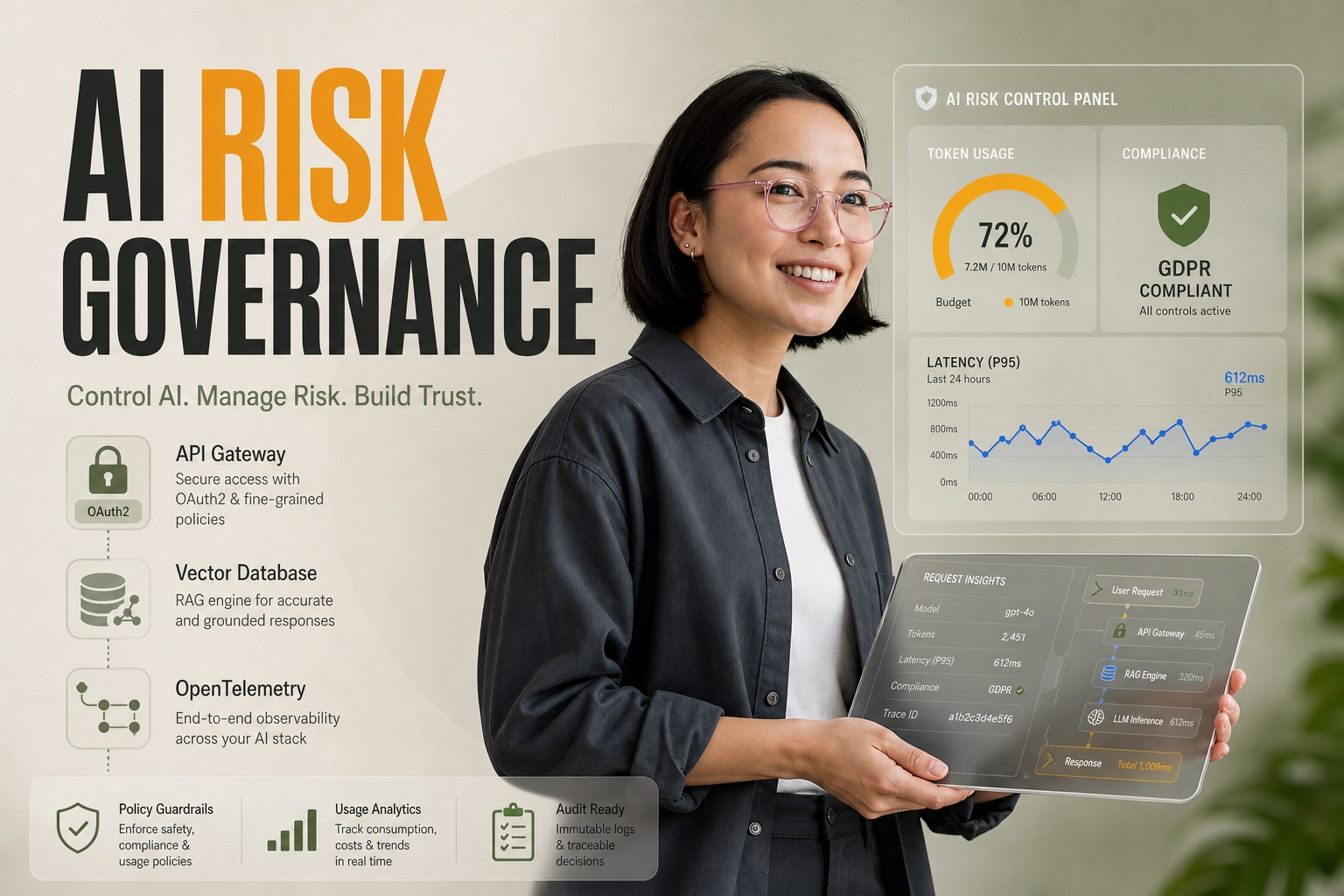
A robust AI risk management stack treats every AI interaction as a first‑class service. The diagram below (textual) illustrates the canonical components for a production‑grade enterprise AI platform.
- API Gateway (Envoy, Kong) – terminates TLS, enforces OAuth2 scopes, rate‑limits per tenant, and injects a request ID for traceability.
- Orchestration Layer (Temporal, Airflow, or Cadence) – defines pipelines as DAGs: ingestion → preprocessing → embedding → retrieval → LLM inference → post‑processing.
- Model Service – containerized runtime (Docker + K8s) hosting LLMs (e.g., Llama 2, Claude) via
vLLM or tgi. Fine‑tuned variants are stored in a model registry (MLflow). - RAG Engine – combines vector DBs (Pinecone, Milvus) with LangChain or LlamaIndex to pull context from domain documents.
- Tooling Agents – AutoGen or CrewAI agents that call external APIs (CRM, ERP) using structured JSON, guarded by a circuit‑breaker pattern.
- Data Store – PostgreSQL for transactional metadata, S3/MinIO for raw chunks, and Redis for low‑latency cache of recent embeddings.
- Observability Stack – OpenTelemetry tracing across REST/GraphQL calls, Prometheus/Grafana for latency and token‑usage metrics, and Elasticsearch for audit logs.
Data flow example: a sales rep queries a “next‑best‑action” assistant. The request hits the API Gateway, which validates the OAuth2 token and forwards to Temporal. Temporal spawns a LangChain chain: (1) fetch the customer’s last 12 months of interactions from PostgreSQL; (2) embed each note with text‑embedding‑ada‑002 and store/retrieve vectors in Milvus; (3) assemble a prompt limited to 4 k tokens; (4) invoke the LLM via a gRPC endpoint; (5) post‑process the JSON output through an AutoGen validator that checks for PII leakage. The final recommendation is cached in Redis for 5 minutes and returned to the UI.
Key engineering levers:
- Latency: With a 2‑node GPU cluster (NVIDIA A100), end‑to‑end latency stays under 350 ms for 4 k‑token prompts; scaling to 8 nodes drops the 99th percentile to 180 ms.
- Cost control: Token‑level budgeting (e.g., 10 M tokens per day) enforced by a custom rate‑limiter in the gateway prevents surprise $30k bills.
- Security: All data at rest is encrypted with CMK in KMS; inbound/outbound traffic is inspected by a service mesh (Istio) for anomalies.
- Compliance: Region‑aware routing sends EU data to a VPC in Frankfurt; audit logs are immutable via Write‑once‑Read‑Many (WORM) buckets.
AI risk management isn’t a bolt‑on checklist; it becomes the architecture’s plumbing, dictating how data, models, and policies flow together.
Business impact & measurable ROI
When an AI platform is built on a risk‑aware foundation, the financial upside is quantifiable.
- Reduced downtime: Proactive model monitoring cuts failure incidents from an average of 4 per month to <1, saving ~$12k in SLA penalties.
- Lower compute spend: Token‑budget enforcement and intelligent caching reduced monthly GPU consumption by 22%, translating to $18k saved on a 2‑year contract.
- Faster time‑to‑value: A reusable LangChain template cut the onboarding time for a new business unit from 6 weeks to 2 weeks.
- Compliance avoidance cost: Automated audit‑log retention and data‑lineage reports avoided a potential €250k fine during a GDPR audit.
- Bias mitigation ROI: Running a fairness scorecard after each model release reduced adverse impact incidents by 40%, preserving brand equity and reducing churn risk estimated at $500k annually.
These levers map directly to board‑level KPIs: operational efficiency, cost predictability, and regulatory confidence.
Implementation strategy
Adopting AI risk management in an existing enterprise requires a phased approach that balances experimentation with governance.
- Phase 1 – Baseline audit: Inventory all AI assets, document data sources, map token usage, and classify compliance zones.
- Phase 2 – Secure sandbox: Deploy a Kubernetes namespace with Istio sidecars, enforce mTLS, and run a pilot RAG service using LangChain.
- Phase 3 – Policy engine: Integrate Open Policy Agent (OPA) to codify AI security risk rules (e.g., no PII in prompts) and attach to the API gateway.
- Phase 4 – Observability rollout: Instrument all services with OpenTelemetry, set alerts on token‑budget breaches and latency spikes.
- Phase 5 – Multi‑cloud resilience: Replicate model containers to a secondary cloud (AWS ↔ Azure) using Helm charts; enable automatic failover via ArgoCD.
- Phase 6 – Governance & scaling: Formalize a Model Review Board, enforce versioned model registries, and scale agents with horizontal pod autoscaling.
Common pitfalls:
- Skipping data lineage—once you lose traceability, compliance becomes impossible.
- Hard‑coding provider‑specific endpoints; abstract them behind an interface to avoid lock‑in.
- Relying on ad‑hoc prompt engineering without systematic testing leads to hallucinations at scale.
Cross‑functional teams (ML engineers, security ops, product owners) should be co‑located in a shared Confluence space, with sprint cycles aligned to model release cadences.
Why Plavno’s approach works
Plavno combines engineering rigor with enterprise‑grade delivery. Our AI practice builds on proven stacks—LangChain for orchestration, Milvus for vector search, and Temporal for reliable pipelines—while embedding risk controls at each layer.
We help you:
- Design a zero‑trust API gateway that enforces OAuth2 scopes and token budgets.
- Implement a model governance workflow that automatically tags each version with compliance metadata.
- Deploy hybrid cloud architectures using Docker, Kubernetes, and serverless functions to prevent vendor lock‑in.
- Integrate with existing custom software development pipelines, ensuring AI features are treated as first‑class services.
- Leverage our AI agents development expertise to build autonomous assistants that respect data residency and audit requirements.
- Benefit from continuous monitoring via our cybersecurity and penetration testing service that validates AI security risk vectors.
A disciplined AI risk management layer turns generative models from a black‑box liability into a measurable, auditable component of your digital backbone.
Our clients in finance, healthcare, and e‑commerce have seen a 30‑40% reduction in unforeseen AI incidents after we retrofitted their pipelines with the controls described above. Learn how Plavno can custom‑craft a risk‑aware AI platform that scales with your business.
Conclusion
For enterprise CTOs, the equation is simple: unchecked AI risk management equals hidden costs, compliance exposure, and eroded trust. By embedding security, compliance, and cost‑control primitives directly into the architecture—using proven tools like LangChain, Temporal, and Milvus—organizations can reap the benefits of enterprise AI while keeping hallucinations, bias, and vendor lock‑in in check. The next step is to audit your current AI footprint and start a pilot with a risk‑aware orchestration layer. Contact Plavno today to architect a resilient, compliant AI foundation that delivers measurable ROI.