Buying enterprise software was once a deterministic game: you checked a feature matrix, verified uptime SLAs, and negotiated seat licenses. Today, the rise of generative AI has turned software procurement into a probabilistic gamble. CTOs and procurement officers are no longer just buying logic; they are buying behavior, creativity, and non-deterministic outputs. This shift requires a fundamental rethinking of how enterprises evaluate, purchase, and govern technology. The old playbook of RFPs (Requests for Proposals) focused on static capabilities is insufficient when the software can hallucinate, drift in behavior, or incur unpredictable costs. This is the new reality of AI Procurement, where technical depth and legal rigor must intersect to separate viable solutions from expensive science experiments.
Industry challenge & market context
The rush to adopt AI has created a chaotic vendor landscape. Enterprises are bombarded with pitches from "AI-powered" startups, many of which are merely thin wrappers around GPT-4 APIs. This saturation creates significant noise for procurement teams trying to identify genuine value. The core challenge is that software procurement frameworks are designed for stable systems, whereas AI systems are inherently dynamic and stochastic. When you buy a CRM, you expect the same input to yield the same output. When you buy an AI agent for contract review, the output depends on the model version, temperature settings, and the context window. This variability introduces risks that traditional procurement playbooks are ill-equipped to handle.
The biggest risk in modern AI procurement isn't technical failure; it is the integration of a non-deterministic component into a deterministic business process without governance rails.
Legacy approaches fail because they focus on "features" rather than "architecture." A vendor might claim "advanced NLP capabilities," but without understanding the underlying stack—whether they use RAG (Retrieval-Augmented Generation), fine-tuning, or simple prompt engineering—procurement cannot assess accuracy or data privacy risks. Furthermore, the rapid pace of model evolution means that a vendor’s solution might be state-of-the-art in Q1 and obsolete by Q3. This creates a massive bottleneck where legal and security teams block deployments due to valid concerns about data leakage, IP ownership, and compliance.
- Vendor opacity: Many AI vendors treat their model selection and prompting strategies as trade secrets, making it nearly impossible to perform a meaningful AI evaluation.
- Data residency and leakage: Sending proprietary enterprise data to public model endpoints (like OpenAI or Anthropic) triggers immediate red flags for legal and compliance teams.
- Unpredictable cost structures: Token-based pricing is foreign to finance teams accustomed to per-user licensing, leading to budget overruns as usage scales.
- Model drift and degradation: Unlike traditional software that bugs out visibly, AI models degrade silently, requiring continuous monitoring strategies that procurement contracts rarely mandate.
- Integration complexity: Dropping an AI chatbot into a legacy stack often requires modernizing the surrounding infrastructure (APIs, vector stores), which is rarely accounted for in the initial purchase price.
Technical architecture and how AI Procurement works in practice
To effectively evaluate an AI solution, procurement teams—guided by architects—must look past the UI and inspect the pipeline. A robust AI solution is not just a model; it is a complex orchestration of data ingestion, retrieval, and generation logic. When Plavno evaluates a solution or builds one for a client, we dissect the architecture into specific layers. If a vendor cannot explain how data flows through these layers, they are a liability.
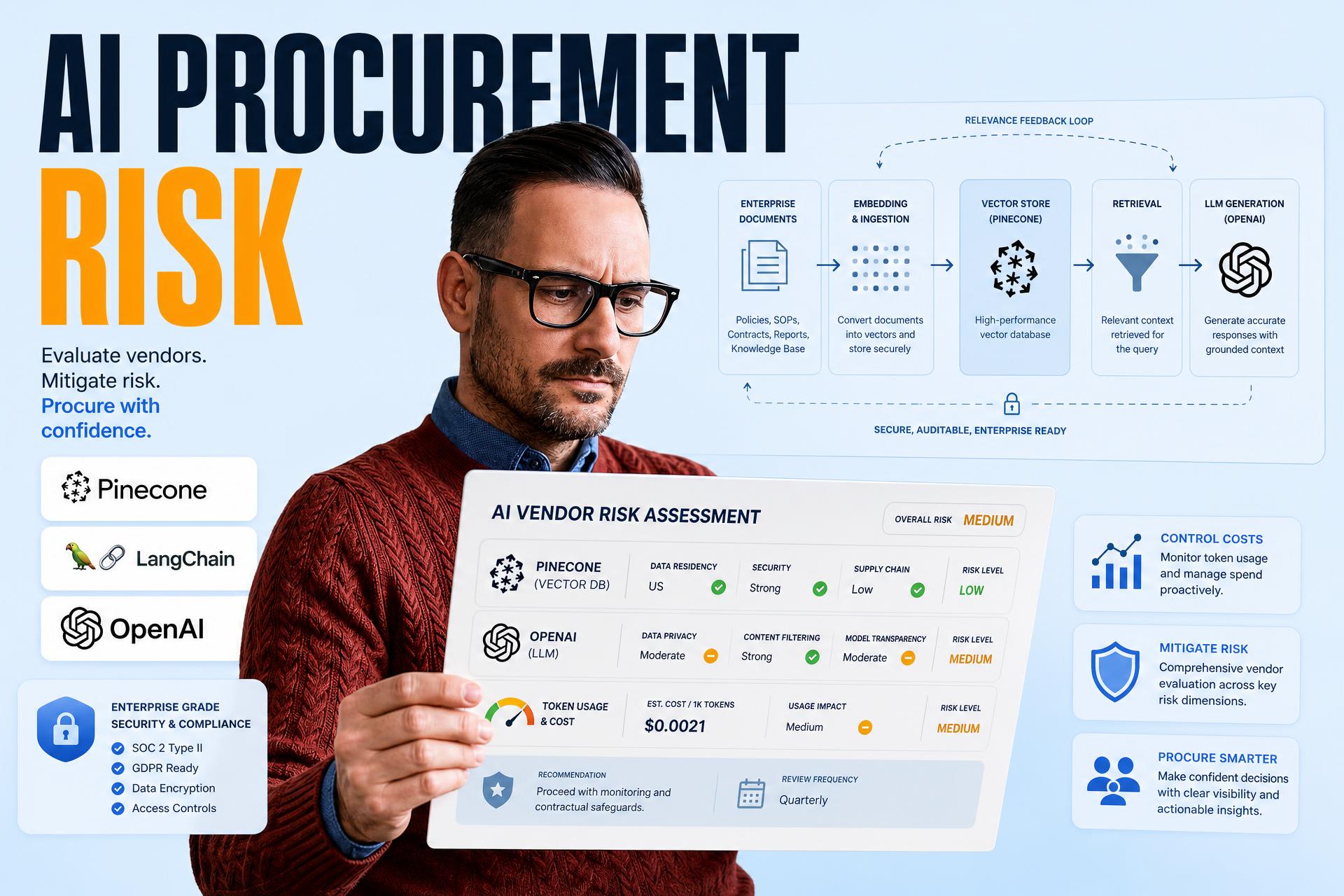
The foundation of most modern enterprise AI is the RAG architecture. Instead of relying on a pre-trained model's internal knowledge, the system retrieves relevant data from a trusted enterprise source and feeds it to the model as context. In AI Procurement, you must verify if the vendor has implemented this correctly. Do they use a vector database like Pinecone, Milvus, or Weaviate? How do they handle chunking strategies and embedding models? If they simply dump your PDFs into a context window, they will hit token limits and incur massive latency issues.
Consider a scenario where an enterprise deploys an AI assistant for IT support. When a user asks, "How do I connect to the VPN from a Linux machine?" the system should not rely on the model's training data. It should query a vector store containing the company's internal Confluence or SharePoint docs. The retrieval layer finds the relevant chunks, passes them to the orchestration layer (built on frameworks like LangChain or LlamaIndex), which constructs the prompt for the LLM. The LLM generates the answer, and the system returns it. If the vendor cannot demonstrate this flow—showing where the vector DB lives and how embeddings are updated—they are selling a black box.
- Orchestration Layer: Look for frameworks like LangChain, LlamaIndex, or AutoGen. This layer manages the logic, memory, and tool use. It determines if the AI can actually perform actions (calling APIs) or just chat.
- Model Layer: Is the vendor locked into a single provider (e.g., only OpenAI), or do they use a model router (like LiteLLM or Azure AI Studio) to switch between GPT-4, Claude 3, or Llama 3 based on cost and latency requirements?
- Data Pipeline: How does data get into the system? Is there a robust ETL process using tools like Airflow or dbt to sync data from SQL databases or object stores (S3) into the vector database?
- Infrastructure: Is the solution running on serverless functions (AWS Lambda) for cost efficiency, or on Kubernetes (EKS/GKE) for long-running agents? Are they using GPU instances for hosting open-source models to ensure data privacy?
- Security & Governance: How is authentication handled? Is it OAuth2/OIDC? Do they implement PII redaction before data hits the embedding model? Is there an audit trail logging every prompt and response for compliance?
Integration patterns are equally critical. An AI tool cannot exist in a vacuum. It needs to talk to your ERP, CRM, or ticketing system. You need to ask if the vendor supports event-driven architectures (using Kafka or RabbitMQ) to trigger AI workflows asynchronously, or if they rely on brittle synchronous REST calls. For example, in a multi-agent system, one agent might draft an email while another verifies facts. If the communication between these agents isn't idempotent and resilient to network failures, the system will crash under load.
A vendor that cannot explain their vector database schema, embedding model choice, or context window management strategy is not selling a product; they are selling a subscription to an API key.
Business impact & measurable ROI
Adopting a rigorous enterprise software selection process for AI yields tangible financial and operational benefits. The most immediate impact is cost control. By understanding the architecture—specifically the difference between using a closed-source API versus a self-hosted open-source model—enterprises can reduce inference costs by 50-80%. For instance, using a quantized Llama 3 model running on NVIDIA GPUs in your own VPC can be significantly cheaper for high-volume tasks than relying on OpenAI's GPT-4, especially if you optimize the prompt size.
ROI in AI is not just about cutting costs; it is about throughput and accuracy. A well-architected AI procurement process ensures you select tools that actually solve the problem. If you are evaluating a code-generation tool, you should measure the acceptance rate of the suggestions. If you are buying a customer support bot, you measure containment rates (how many issues are resolved without human intervention). However, these metrics are only achievable if the underlying system is reliable. A flaky AI agent that hallucinates policies creates more work for human reviewers, destroying ROI rather than creating it.
- Reduced Time-to-Value: A technical procurement process accelerates the PoC (Proof of Concept) phase. Instead of spending months on legal wrangling over data usage, you establish clear boundaries (e.g., data stays in VPC), allowing engineering teams to start integration immediately.
- Risk Mitigation: By vetting for security features like PII masking and role-based access control (RBAC), you avoid regulatory fines and reputational damage. This is critical in sectors like healthcare or fintech.
- Operational Efficiency: Selecting solutions with proper observability (integrating with tools like Datadog or LangSmith) allows operations teams to monitor token usage and latency, enabling proactive optimization before costs spiral.
- Vendor Independence: Procuring solutions that support multiple model backends prevents lock-in. If a vendor raises prices or a model degrades, you can switch routing to a competitor without rewriting the application.
Calculating ROI requires looking at the "cost per intelligence." Traditional software costs are fixed per seat. AI costs are variable per transaction. A robust procurement strategy will negotiate not just a flat fee, but a hybrid model that includes a base support fee plus a transparent pass-through of compute costs. This aligns the vendor's incentives with the enterprise's goal of efficiency.
Implementation strategy
Implementing a new AI solution requires a phased approach that bridges the gap between legal scrutiny and engineering reality. You cannot buy a generic "AI platform" and expect it to work out of the box. Success comes from a tightly scoped pilot that validates both technical feasibility and business value.
- Discovery and Scoping: Define a specific, high-value problem (e.g., "automate invoice processing"). Avoid broad initiatives like "improve customer experience." Gather the technical requirements: latency needs (must the bot respond in under 2 seconds?), data sources, and security constraints.
- Technical PoC: Run a 4-6 week Proof of Concept. Do not rely on the vendor's demo environment. Require the vendor to deploy the solution in a sandbox environment connected to a sanitized copy of your actual data. Test for edge cases: what happens when the retrieval finds no relevant documents? How does the system handle ambiguous queries?
- Security and Compliance Review: This runs in parallel with the PoC. Conduct a penetration test on the AI endpoints. Verify that data in transit is encrypted (TLS 1.3) and data at rest is encrypted. Ensure the vendor can sign a BAA (Business Associate Agreement) if handling health data.
- Performance Evaluation: Measure the system against a "golden dataset"—a set of inputs and ideal outputs. Calculate precision and recall. If the AI is summarizing documents, use ROUGE or BLEU scores to benchmark quality against human performance.
- Production Rollout: Start with a "shadow mode" where the AI generates responses but a human must approve them before they are sent. Gradually increase the automation level as confidence in the system grows.
Common pitfalls often derail this process. One major mistake is ignoring the feedback loop. AI models require continuous fine-tuning based on user interactions. If your procurement contract doesn't include ongoing model maintenance and retraining, the system's accuracy will degrade over time. Another pitfall is underestimating infrastructural dependencies. AI agents often require access to APIs that legacy systems don't expose. You may need to budget for custom software development to build wrapper APIs around your mainframe or ERP systems before the AI can interact with them.
- Over-reliance on zero-shot prompting: Vendors often claim their system works "out of the box" without fine-tuning. In enterprise settings, domain-specific language usually necessitates at least few-shot prompting or fine-tuning.
- Neglecting latency: Complex RAG pipelines with multiple retrieval steps can add seconds of latency. If the user experience is sluggish, adoption will fail regardless of accuracy.
- Ignoring observability: Procurement often demands uptime guarantees but forgets to demand logging. Without logs of prompts and responses, you cannot debug why the AI gave a wrong answer.
Why Plavno’s approach works
At Plavno, we do not treat AI as a magic wand; we treat it as an engineering discipline. Our approach to AI Procurement and implementation is grounded in building resilient, scalable architectures that integrate seamlessly with your existing ecosystem. We understand that buying AI is different from buying SaaS, which is why we offer services that span the entire lifecycle—from AI consulting to full-scale AI development.
We specialize in navigating the complexities of the modern AI stack. Whether you need AI assistants for internal knowledge management or complex AI automation for operational workflows, we build using industry-standard frameworks like LangChain and LlamaIndex, deployed on robust infrastructure like Kubernetes and serverless environments. We ensure that your data remains secure—leveraging VPC peering, private endpoints, and local embedding models—so your legal team can sleep at night.
Our experience spans diverse industries, allowing us to bring cross-domain best practices to your specific vertical. Whether we are developing fintech solutions that require fraud detection precision or medtech applications that demand strict HIPAA compliance, we prioritize architectural rigor over hype. We don't just buy vendors; we build the capability in-house or help you select the right components to assemble a durable solution.
Furthermore, we recognize that AI is often part of a larger digital transformation. Our expertise in digital transformation and web development ensures that the AI layer integrates perfectly with your frontend and backend systems. We focus on observability, implementing tracing and monitoring so you have full visibility into token usage, costs, and model performance.
Choosing Plavno means choosing a partner who speaks both languages: the language of business ROI and the language of vector databases, transformers, and orchestration. We help you cut through the vendor noise to find solutions that actually work, deployed on infrastructure that scales.
The landscape of AI Procurement is complex, but it is navigable with the right technical partner. Don't let the black box nature of AI stall your innovation. Engage with a team that can open the box, inspect the gears, and ensure it drives your business forward.
Ready to move beyond the hype and build enterprise-grade AI? Get a project estimate from Plavno today.