Industry challenge & market context
Enterprises are buying AI at the speed of a software sprint, but most procurement processes still resemble the 2010s “license‑per‑seat” model. The result is:
- Hidden data‑privacy exposure when vendors train on customer logs without explicit consent.
- Cost overruns because token‑based pricing (e.g., $0.0002 per 1k tokens) scales non‑linearly with query volume.
- Vendor lock‑in caused by proprietary SDKs that cannot be swapped for an open‑source alternative.
- Operational bottlenecks when the AI service cannot be orchestrated with existing event‑driven pipelines.
- Compliance gaps: GDPR, CCPA, and industry‑specific regulations (HIPAA, FINRA) are often an afterthought.
Technical architecture and how AI procurement works in practice
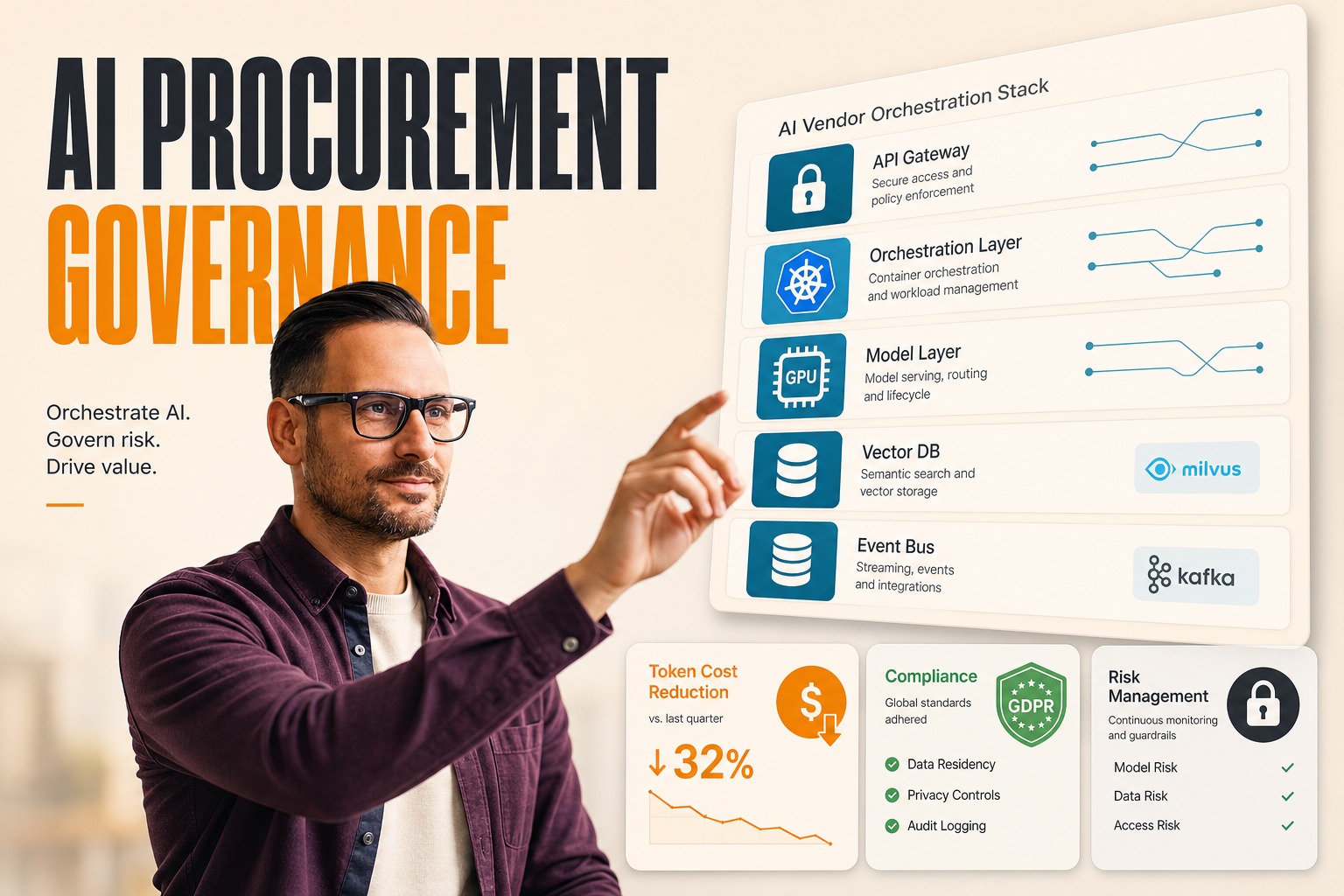
A robust AI procurement framework treats the vendor as a collection of reusable services rather than a monolith. Below is a reference architecture that maps directly to an enterprise RFP.
- API gateway – Edge‑level reverse proxy (Envoy or AWS API GW) that terminates OAuth2, enforces rate limits and provides request tracing.
- Orchestration layer – Kubernetes‑hosted service (e.g., Argo Workflows or Temporal) that coordinates LangChain or CrewAI pipelines, injects context, and handles retries with exponential back‑off.
- Model layer – Containerized inference servers (vLLM, TensorRT‑Infernce) exposing REST/GRPC endpoints. Supports multi‑model routing (e.g., GPT‑4‑Turbo for chat, Llama‑2‑70B for fine‑tuning).
- Data store – Combination of PostgreSQL for metadata, Redis for session caching, and a vector DB (Pinecone or Milvus) for embeddings.
- Event bus – Kafka or Pulsar topics for async ingestion of logs, webhooks, and RAG document updates; guarantees at‑least‑once delivery with idempotent consumers.
Data pipeline example: a sales‑assistant request arrives via HTTPS, the API gateway validates the JWT, forwards to the orchestration layer, which retrieves the latest product catalog embeddings from Milvus, assembles a prompt with LangChain’s RetrievalQA chain, calls the model layer, and streams the answer back through a server‑sent‑event channel. All intermediate states are logged to OpenTelemetry for observability.
- Model orchestration patterns – RAG (retrieval‑augmented generation) for knowledge‑base queries, tool‑use agents (AutoGen) for calling internal services, and fallback routing to a fine‑tuned specialist model when token limits (e.g., 8k vs 128k) are exceeded.
- Integration modalities – Synchronous REST for UI calls (latency < 200 ms 95th percentile), GraphQL for flexible data graphs, and webhook callbacks for long‑running batch jobs (e.g., document ingestion).
- Infrastructure choices – Multi‑region GKE clusters with node‑pools per model size, serverless functions (Cloud Run) for lightweight preprocessing, and spot‑instance autoscaling to reduce GPU cost by 30‑45 %.
- Deployment models – Single‑tenant VPC for regulated workloads (HIPAA), multi‑tenant namespace isolation for internal tools, and hybrid edge‑cloud deployment using CloudFront + Cloudflare Workers for sub‑100 ms response at the edge.
Business impact & measurable ROI
- Average token cost reduction of 22 % when the vendor supports dynamic context windows and selective embedding retrieval.
- Time‑to‑value (TTV) cut from 6 months to 8 weeks by reusing a pre‑built LangChain‑based orchestration template.
- Operational overhead drops 40 % after moving from manual model version upgrades to automated CI/CD pipelines (Argo CD + Helm) that verify compliance (e.g., audit‑log generation) on each rollout.
- Risk exposure halved by enforcing data residency at the vector‑DB layer (e.g., EU‑only Milvus cluster) and by using token‑level masking for PII before inference.
- Scalable throughput: a well‑engineered pipeline can sustain 5,000 RPS with 95th‑percentile latency < 300 ms on a mixed GPU fleet (A100 + T4), translating to 10‑15 % cost per query versus a pure SaaS endpoint.
Implementation strategy
Enterprises that follow a disciplined, phased approach avoid the common pitfalls of “plug‑and‑play” AI.
- 1. Define the AI RFP – List mandatory security controls (OAuth2, audit trails), required integration patterns (event‑driven, synchronous), and performance SLAs (latency, throughput).
- 2. Run a vendor sandbox – Deploy the vendor’s reference stack in an isolated namespace, connect to a synthetic data generator, and validate token‑rate limits, context‑window handling, and logging coverage.
- 3. Pilot with a low‑risk use case – Example: internal knowledge‑base chatbot using RAG. Measure cost per 1k tokens, latency, and user satisfaction (CSAT ≥ 4.2/5).
- 4. Iterate on orchestration – Replace monolithic calls with LangChain chains, introduce AutoGen agents for tool use, and add circuit‑breaker patterns around external APIs.
- 5. Scale to production – Shift from sandbox to multi‑region GKE, enable horizontal pod autoscaling based on GPU utilization, and enforce CI‑driven compliance checks.
- 6. Governance handoff – Establish a cross‑functional AI governance board (security, legal, product) and embed observability dashboards (Grafana + Loki + Tempo) for ongoing audit.
Common pitfalls:
- Skipping data residency checks and later discovering that embeddings were stored in a US‑only region, violating GDPR.
- Choosing a vendor that only offers a proprietary SDK, leading to costly re‑engineer when the model is deprecated.
- Under‑estimating token‑rate limits; a burst of 10 k RPS can trigger throttling and SLA breaches.
Most enterprises fail because they treat AI like a checkbox; the real differentiator is a composable architecture that lets you swap models, adjust context windows, and enforce governance without rewriting core services.
Why Plavno’s approach works
Plavno builds AI solutions on the same engineering principles that power mission‑critical enterprise software: container‑first, API‑centric, and observability‑driven. Our services span the full stack—from custom AI agents development and AI automation to secure cybersecurity testing of AI pipelines.
- We start every engagement with a concrete AI consulting sprint that drafts an AI RFP aligned to your compliance matrix.
- Our delivery model uses outstaffing and outsourcing hybrids, giving you dedicated engineers who own the end‑to‑end pipeline while you retain product ownership.
- We embed LangChain, CrewAI, and AutoGen into a Kubernetes‑native platform that can be deployed on‑prem, in a private cloud, or as a hybrid edge solution, ensuring data residency and latency targets.
- Every integration ships with OpenAPI specs, GraphQL schemas, and webhook contracts that your internal developers can consume without custom adapters.
- Our observability stack (Prometheus, Grafana, Loki, Tempo) provides real‑time token usage, cost attribution, and compliance audit trails out of the box.
When you evaluate an AI vendor, ask for a sandbox that exposes the full orchestration stack—not just a “playground” UI—so you can validate latency, security, and cost under realistic load.
Conclusion
AI procurement in 2026 is no longer about picking the biggest LLM; it’s about assembling a secure, observable, and cost‑controlled pipeline that can evolve as models mature. By applying the five‑step evaluation framework—security, delivery process, expertise, integrations, and ROI—enterprises reduce risk, accelerate time‑to‑value, and keep a clear line of sight on spend.
Ready to turn your AI RFP into a production‑grade solution? Contact Plavno to run a vendor sandbox, design a LangChain‑based orchestration, and embed enterprise‑grade governance from day one.