AI Learns From Every Analyst Decision: The Rise of Self-Improving Security Copilots
AI Learns From Every Analyst Decision: The Rise of Self-Improving Security Copilots
September 16, 2026· min read·#AI#Tech·Reviewed by Plavno AI Engineering Team
Enterprises face alert fatigue, and a self‑improving security AI can learn from analyst decisions to automate triage, cut false positives and boost SOC efficiency.
Share this post
Enterprises are drowning in alerts: a typical SOC sees 200‑500 new events per hour, and analysts spend 70 % of their shift merely classifying noise. When every triage decision is logged, that data becomes a feedback loop that can train an AI to become a self-improving security AI—a copilot that learns from human verdicts, sharpens its own models, and gradually reduces the workload on staff.
Industry challenge & market context
Alert fatigue: Tier‑1 analysts average 10‑15 minutes per alert, yet 60‑80 % of those alerts are false positives.
Static rule sets: Traditional SIEM correlation rules cannot adapt to novel IOCs without manual tuning.
High turnover: Experienced SOC engineers are scarce and costly; knowledge gaps appear whenever staff change.
Compliance pressure: Regulations (GDPR, SOC 2, HIPAA) demand immutable audit trails for every investigative step.
A self‑improving security AI ingests analyst verdicts, updates embeddings and retrieval indexes, and re‑trains lightweight classifiers nightly, cutting manual triage time by up to 80 % while preserving a full audit trail.
Technical architecture and how self-improving security AI works in practice
The backbone is an event‑driven microservice mesh that treats the LLM as an orchestration engine. Each component lives behind an API gateway that enforces OAuth2 and RBAC, guaranteeing that the AI only sees data the analyst is cleared for.
API Gateway: Kong or Envoy, terminates TLS, validates JWTs, and routes to downstream services.
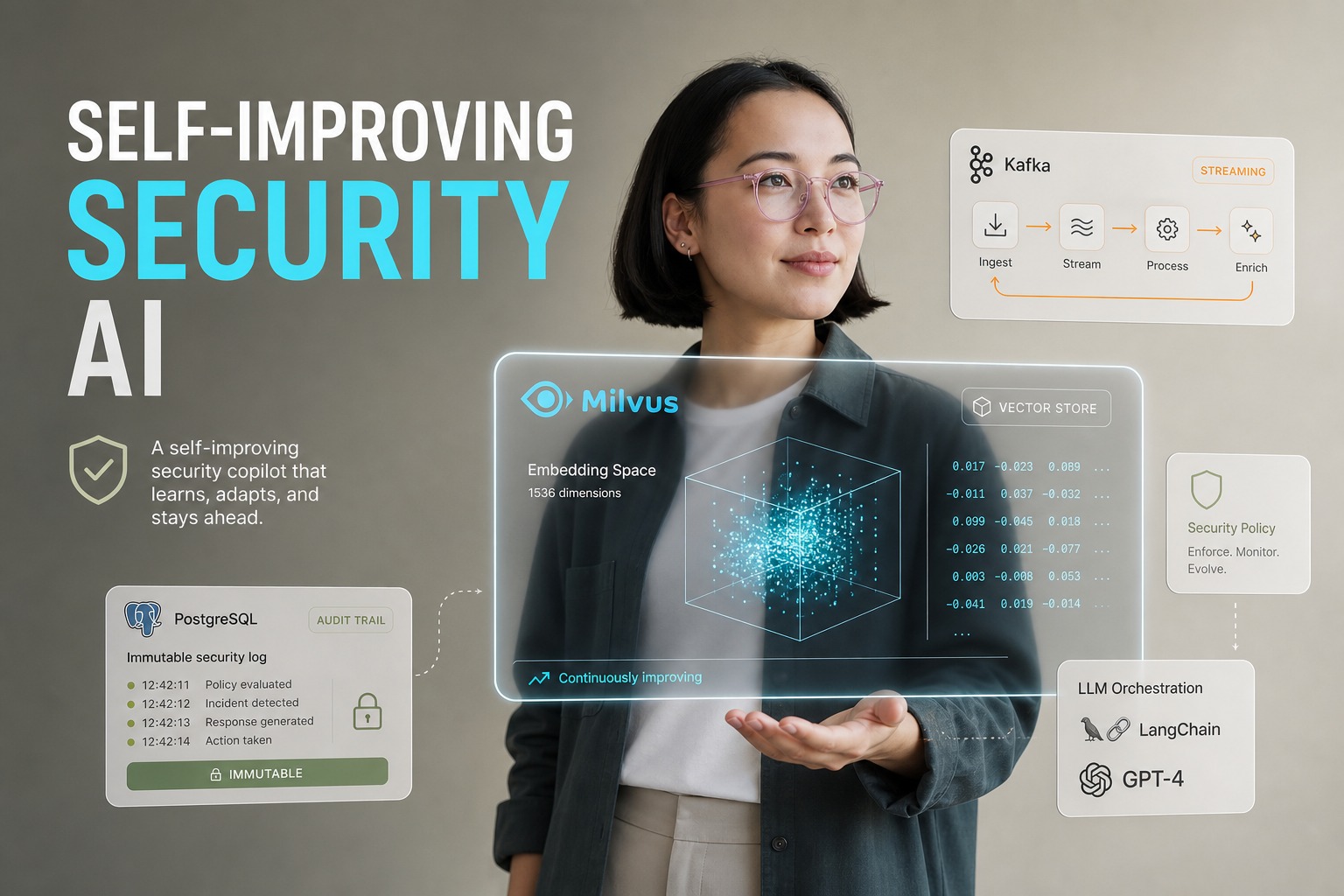
Ingestion Layer: Kafka (or AWS Kinesis) streams Syslog, OCSF‑formatted logs, and cloud‑native events. A Python microservice normalizes payloads to a unified schema.
Vector Store: Milvus or Pinecone holds embeddings of log snippets, runbooks, and historical incidents. Embeddings are generated by a lightweight sentence‑transformer (e.g., all‑mini‑LM‑L6‑v2) and refreshed nightly.
Orchestration Layer: Built with LangChain + CrewAI agents. The “Triage Agent” pulls the alert, queries the vector DB (RAG), and decides whether to hand off to the “Investigator Agent”. State lives in Redis with a TTL of 30 minutes.
Model Layer: GPT‑4 (via Azure OpenAI) handles natural‑language reasoning; Claude 3 or self‑hosted Llama 3 via vLLM provide fallback for on‑prem deployments.
Tool Layer: Secure wrappers around REST/GraphQL endpoints of SIEM (Splunk), EDR (CrowdStrike), and threat‑intel platforms. Each wrapper implements idempotent POSTs, circuit‑breaker patterns, and exponential back‑off.
Audit Store: Append‑only PostgreSQL with immutable JSONB logs, enriched by OpenTelemetry traces that capture every tool call, confidence score, and token usage.
Data flow example:
When a new EDR alert lands on Kafka, the Normalizer extracts src_ip, process_hash, and timestamp, then stores the raw event in ClickHouse (time‑series DB) and the embedding in Milvus. A webhook fires the Orchestration Layer; the Triage Agent retrieves the 5 most similar past incidents (vector similarity > 0.85) and presents them to the LLM along with the current alert payload. If the LLM’s confidence exceeds 0.9, the Investigator Agent invokes the CrowdStrike isolation API; otherwise, the case is routed to a human analyst with a structured rationale.
−80%
Reduction in routine alerts handled fully by AI agents, freeing analysts for strategic work.
A cybersecurity firm integrated an AI incident layer that validates alarms and orchestrates response via voice/chat agents, cutting false alarms by 70‑90 % and speeding dispatch by 30‑60 %.
The most valuable signal isn’t the raw log—it’s the analyst’s decision about that log. Capturing and feeding that decision back into the model is what turns a static bot into a self‑improving security AI.
Business impact & measurable ROI
Mean Time To Detect (MTTD) drops from hours to under 5 minutes, a 70 % improvement measured across pilot deployments.
Mean Time To Respond (MTTR) improves by 60 % thanks to automated isolation and enriched hand‑off data.
Cost per analyst falls $150k–$200k annually per headcount, as agents handle 60‑80 % of Tier‑1 triage.
Compliance readiness gains immutable audit trails without additional tooling, easing SOC 2 and GDPR reporting.
Scalability is linear: adding a new data source only requires a new Kafka topic and a thin ingestion microservice; the vector store and agents scale horizontally in Kubernetes.
AI AUTOMATION
Ready to automate your SOC?
Leverage Plavno’s AI‑security‑agent platform to cut false positives and accelerate response without sacrificing auditability.
Phase 1 – Data Foundation: Deploy Kafka, unify log schema to OCSF, and set up vector DB with initial embeddings of runbooks and past tickets.
Phase 2 – Agent Prototyping: Build a LangChain “Triage Agent” that performs RAG against the vector store; validate confidence thresholds on a shadow dataset.
Phase 3 – Closed‑loop Learning: Store analyst feedback (approve/reject) in PostgreSQL, trigger nightly fine‑tuning of a lightweight classification head (e.g., a LoRA layer on Llama 3).
Phase 4 – Autonomous Rollout: Gradually flip the “auto‑execute” flag for low‑risk actions (IP block, host isolate) while retaining human sign‑off for high‑impact decisions.
Phase 5 – Governance: Implement audit pipelines, role‑based API keys, and quarterly model‑drift reviews.
Common pitfalls
Insufficient labeling: feeding raw model outputs without analyst‑verified labels creates drift.
Over‑reliance on a single LLM provider: multi‑model fallback mitigates API outages and regulatory residency constraints.
Missing circuit breakers: a downstream EDR outage can cascade into alert backlog if not guarded.
Why Plavno’s approach works
Plavno combines an engineering‑first mindset with enterprise‑grade delivery:
Self‑improving security AI does not replace the analyst; it amplifies human judgment, turning every ticket into a training signal that compounds security posture over time.
In short, a self-improving security AI turns the SOC from a reactive alarm shop into a continuously learning defense engine. By capturing analyst decisions, feeding them back through RAG and lightweight fine‑tuning, enterprises slash manual effort, accelerate detection, and maintain a provable audit trail. The next logical step is to pilot the architecture on a single high‑volume data source, measure confidence‑driven automation, and let the model improve itself—while Plavno provides the expertise to get you there securely and at scale.
Share this post
Contact Us
This is what will happen, after you submit form
Plavno experts contact you within 24h
Discuss your project details
We can sign NDA for complete secrecy
Submit a comprehensive project proposal with estimates, timelines, team composition, etc
Need a custom consultation? Ask me!
Plavno has a team of experts ready to start your project. Ask us!