AI in Logistics: How Intelligent Agents Reduce Delays and Support Tickets
Discover how AI in logistics transforms supply chains. Intelligent agents reduce delays, automate WISMO queries, and optimize freight operations for better ROI.
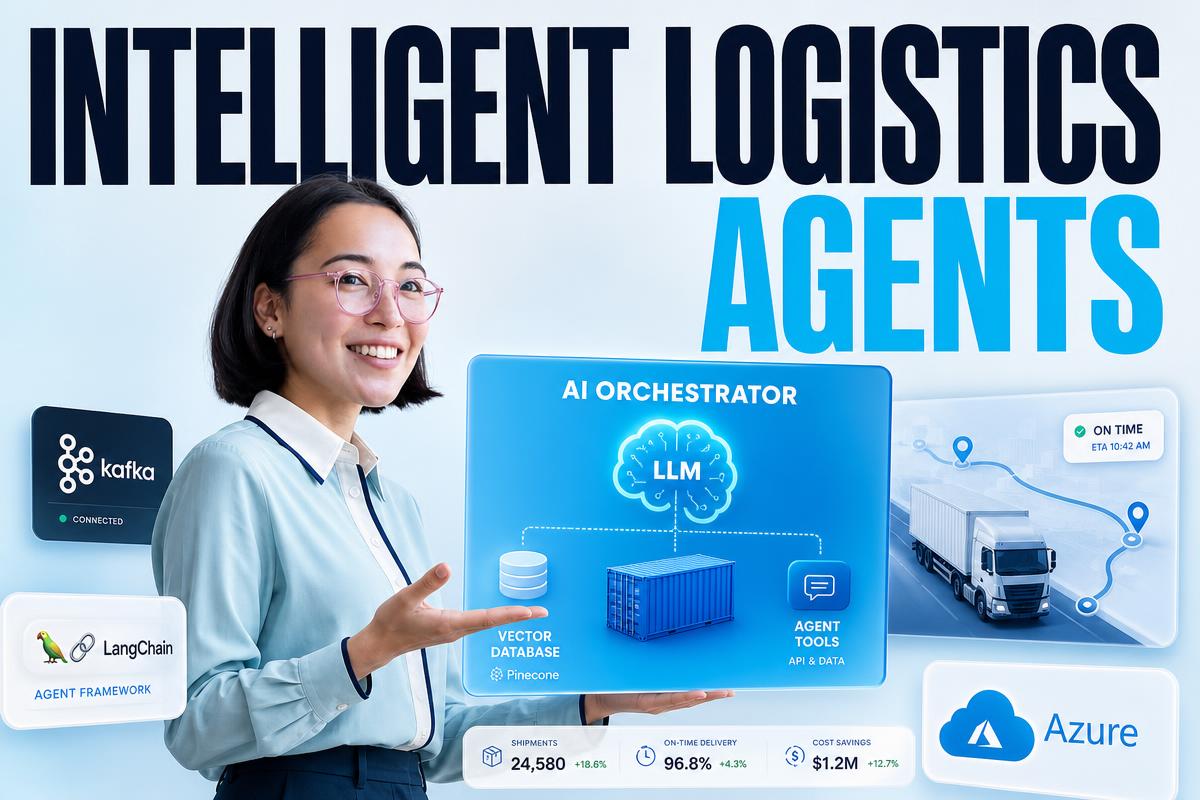
The modern supply chain is a fragmented, event-driven beast where data silos and legacy systems create a constant state of friction. For logistics providers and enterprise shippers, the inability to synthesize real-time data into actionable intelligence results in a cascade of operational failures: delayed shipments, reactive dispatching, and support teams drowning in repetitive "Where is my order" (WISMO) queries. The solution isn't better dashboards; it is autonomous orchestration. By applying AI in logistics, specifically through intelligent agents capable of reasoning and tool use, organizations can move from reactive monitoring to proactive resolution, fundamentally altering the economics of freight movement.
The logistics sector is plagued by a disconnect between the volume of data generated and the ability to process it meaningfully. Enterprise operations often rely on brittle EDI integrations, manual email threads with carriers, and disjointed Transportation Management Systems (TMS) that lack interoperability. When a shipment deviates from its schedule, the human cost of recovery is high. Support teams spend up to 40% of their time manually tracking freight across disparate carrier portals, while dispatchers struggle to re-optimize routes in real-time. Legacy automation fails here because it is rule-based; it cannot handle the ambiguity of a flat tire, a customs hold, or a vague carrier update. This creates a bottleneck where freight automation stalls, requiring human intervention for exceptions that should be resolvable algorithmically.
Implementing intelligent agents requires a shift from monolithic application design to a distributed, event-driven architecture where AI models are first-class citizens. At Plavno, we architect systems that treat Large Language Models (LLMs) not just as chat interfaces, but as reasoning engines that can orchestrate API calls, query databases, and trigger workflows. The core of this architecture is an agent framework—typically built on LangChain or CrewAI—that manages state, memory, and tool execution. This allows the system to understand context, such as "Shipment #1234 is delayed," and autonomously execute a sequence of actions: check the carrier API, query the vector database for contract SLAs, calculate the penalty, and draft a customer notification.
A robust implementation involves several distinct layers. The ingestion layer captures telemetry from carrier webhooks and IoT sensors, pushing events into a message queue like Kafka or RabbitMQ. The processing layer, running on Kubernetes or a serverless runtime like AWS Lambda, normalizes this data. The AI layer, utilizing models like GPT-4 or Llama 3 hosted on Azure or AWS Bedrock, performs reasoning and retrieval-augmented generation (RAG) to access unstructured data like PDF contracts. Finally, the integration layer exposes these capabilities via GraphQL or REST APIs, ensuring idempotency and circuit breakers are in place to handle downstream failures.
In practice, consider a scenario where a shipment is stalled at a port due to customs documentation. A traditional system would flag a status change. An intelligent agent system, however, would ingest the webhook event, identify the specific customs hold code, query the vector database for the correct documentation requirements, draft the required affidavit, and email it to the broker—all while updating the customer portal with a nuanced explanation. This level of automation transforms logistics AI from a passive observer into an active operator.
Deploying intelligent agents in logistics drives ROI by directly attacking the two largest cost centers: operational overhead and customer support churn. By automating the resolution of routine exceptions, companies can significantly reduce the "touch cost" per shipment. Furthermore, the speed of resolution directly correlates to customer retention; in an era where Amazon has set the expectation for transparency, providing instant, accurate updates is a competitive necessity. The technical efficiency gained through WISMO automation allows support teams to focus on high-value relationship management rather than data entry.
Successfully integrating AI in logistics requires a phased approach that prioritizes data hygiene and incremental value delivery. We advise against a "big bang" overhaul of legacy systems. Instead, start with a specific, high-impact domain—such as shipment tracking AI for a single lane or carrier—and build the agent architecture there. This allows the engineering team to fine-tune prompts, validate tool outputs, and establish trust in the AI's decision-making process before broadening the scope. Governance is critical; early implementation of guardrails and human-in-the-loop (HITL) review processes ensures that the agents remain compliant and accurate as they learn.
At Plavno, we do not treat AI as a buzzword or a plug-in; we engineer it as a core component of your software infrastructure. Our team of principal engineers and architects understands that freight automation demands high availability, low latency, and strict data governance. We build custom solutions leveraging modern stacks like Python, Node.js, and React, deployed on scalable cloud infrastructures. Whether you need to enhance your existing TMS with intelligent agents or build a new logistics platform from the ground up, our focus is on delivering robust, maintainable code that drives real business value. We specialize in AI agents development and AI automation, ensuring that your logistics operations are future-proofed against the increasing complexity of global supply chains.
Our expertise extends beyond just the AI layer. We understand the intricacies of logistics and supply chain software development, from EDI parsing to warehouse management system (WMS) integration. By partnering with Plavno, you gain a technical team capable of navigating the entire stack—from the database schema to the LLM orchestration layer. We ensure that your logistics AI initiatives are not just science projects, but production-grade assets that reduce delays, cut support costs, and improve customer satisfaction. If you are ready to transform your logistics operations, explore our AI development company services or custom software development capabilities to see how we can engineer a solution tailored to your specific needs.
The logistics landscape is unforgiving, but with the right technical architecture, the chaos becomes manageable. Intelligent agents provide the necessary layer of cognition to bridge the gap between raw data and operational excellence. By investing in this technology now, enterprises position themselves to scale efficiently while competitors remain bogged down by manual processes.
Contact Us
Plavno experts contact you within 24h
Discuss your project details
We can sign NDA for complete secrecy
Submit a comprehensive project proposal with estimates, timelines, team composition, etc
Plavno has a team of experts ready to start your project. Ask us!

Vitaly Kovalev
Sales Manager
