Automation was once limited to conveyors and robots, but AI in business is now handling tasks that once required human intelligence—analyzing data, predicting trends, and interacting with customers. And it's doing so with remarkable efficiency, delivering tangible benefits to businesses that embrace it. An experienced artificial intelligence development company can rapidly boost business profits without the need for costly infrastructure investments. Let's explore how AI works and why it's a game-changer.
Analyzing Data: From Intuition to Accuracy
Traditionally, business decisions were guided by intuition and experience. But thanks to developments in artificial intelligence (AI), businesses can now examine enormous datasets, identify intricate patterns, and find insights that human analysts might otherwise miss.
Examples of successful AI applications in addressing real-world business challenges:
Enhancing logistics accuracy by predicting delays. In one instance, an artificial intelligence (AI) system reduced delivery times by 18% by optimizing cargo flow distribution.
Improving financial planning through market data analysis. For example, one company used AI to anticipate a surge in raw material prices, allowing them to secure favorable contracts in advance.
Developing AI-driven virtual training systems that adapt to individual employees. According to internal company estimates, this personalized approach improved training efficiency by 25%.
Leveraging AI in retail to analyze customer behavior. By optimizing product placement on shelves, the system contributed to a 12% increase in sales.
Walmart harnesses AI to evaluate in-store shopping patterns, enabling its algorithms to anticipate product demand in the days ahead and dynamically adjust inventory levels. This strategic approach reduces both excess stock and shortages, ultimately saving the company millions of dollars annually.
Similarly, Netflix utilizes an AI-driven recommendation system that examines user behavior, including viewing patterns, duration, and skipped content. By offering personalized content suggestions, Netflix enhances customer satisfaction while simultaneously increasing revenue. It is estimated that the recommendation system contributes approximately $1 billion annually by improving subscriber retention.
Automating Routine: Fewer Errors, More Speed
Many business processes involve routine tasks such as order processing, record-keeping, and responding to customer inquiries. AI can automate these functions, allowing employees to focus on more strategic and creative work.
For example, financial institutions leverage artificial intelligence (AI) to automate the evaluation of loan applications. Advanced algorithms analyze borrower data, assess risk factors, and deliver decisions within minutes. This not only accelerates the approval process but also enhances accuracy by minimizing human error.
Another example is the use of AI-powered chatbots. Companies such as Sephora and H&M employ chatbots to interact with customers, answering inquiries, assisting with product selection, and resolving issues. This automation not only optimizes employee efficiency but also enhances the customer experience. Research indicates that the implementation of chatbots can reduce customer service costs by up to 30%.
Forecasting: Looking Ahead
AI goes beyond analyzing real-time data; it also forecasts future trends with remarkable precision. Amazon, for instance, leverages AI-driven predictive models that factor in seasonality, weather conditions, emerging market trends, and global events to anticipate demand. This proactive approach enhances logistical efficiency, ultimately lowering storage and shipping costs.
How Does AI Forecast Future Trends?
Collect data (historical prices, inflation, demand, economy).
Analyze dependencies: what influences price increases?
Learn from historical data and create a mathematical model.
Predict the future based on the patterns found.
The more complex the prediction, the more data and factors need to be taken into account. For example, predicting the weather requires millions of variables (temperature, humidity, pressure, etc.), but predicting the price of an apartment is a bit easier.
Key Approaches to AI Forecasting
Linear regression: old but working method. The simplest forecasting method. It assumes that if the price of apartments has been rising by 5% per year on average, it will continue to rise the same way.
When does it work? If the trend is stable and there are few sudden jumps.
When it doesn't work? If the market changes dramatically.
Machine learning: learning from data, not formulas. A more advanced method that does not rely on simple equations but looks for complex patterns. AI examines thousands of factors that can influence the forecast. Identifies hidden patterns that humans may not notice. Uses different algorithms such as random forests, gradient boosting, and neural networks.
Result: a more accurate prediction.
Deep neural networks: powerful but complex tools. While conventional machine learning algorithms are like smart analysts, neural networks are thousands of such analysts working simultaneously. Neural networks mimic the workings of the brain by analyzing data in layers. They are able to identify very complex dependencies that humans cannot observe. They are used for the most complex predictions (financial markets, medical diagnoses, analyzing satellite images).
But there is a problem: neural networks are a “black box". Even developers do not always understand why the model made this or that decision.
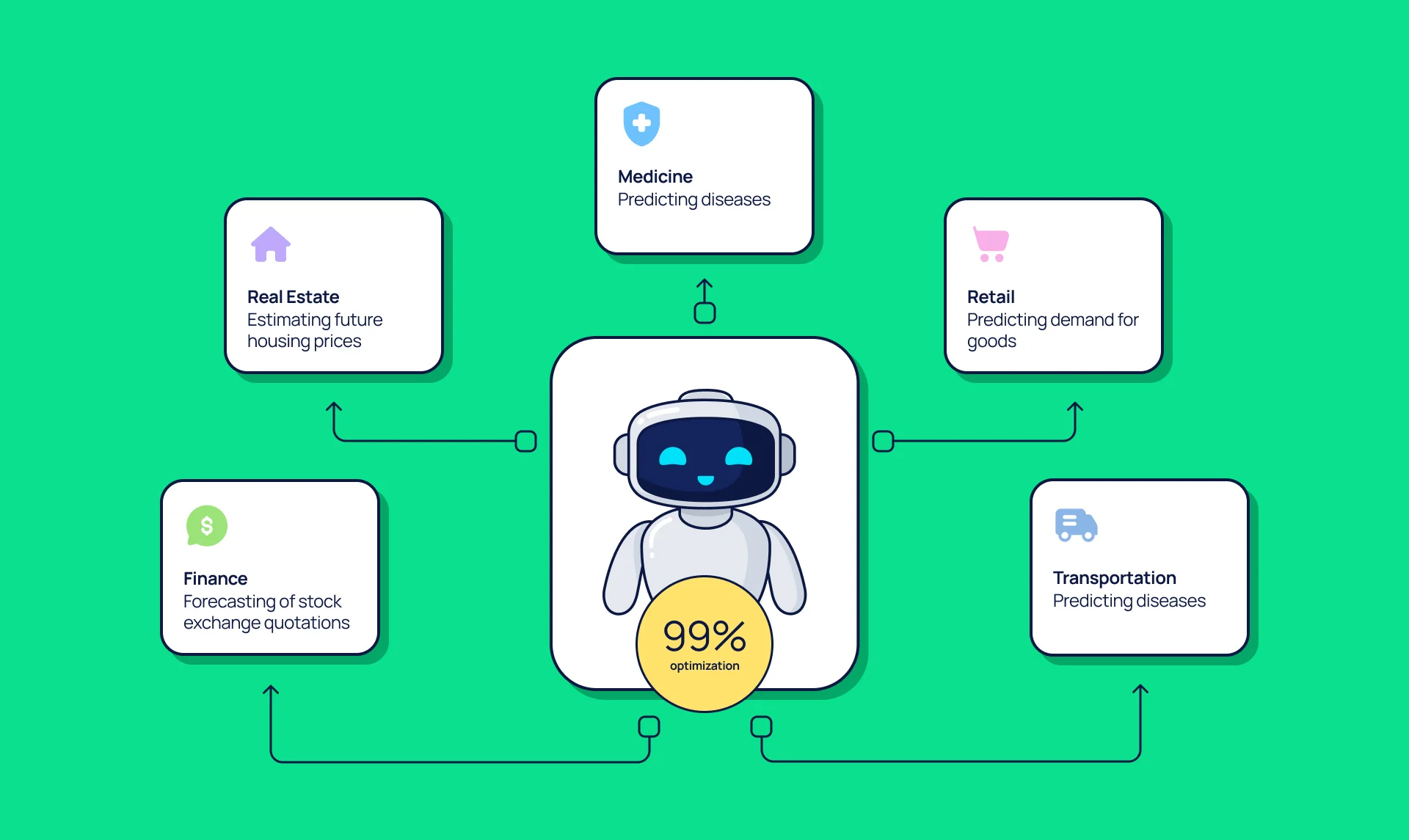
Where are AI predictive analytics currently being applied?
Real estate - estimating future housing prices.
Finance - forecasting of stock exchange quotations.
Medicine - predicting diseases.
Retail - predicting demand for goods.
Transportation - predicting traffic jams and accidents.
Artificial intelligence (AI) is also widely applied in the manufacturing sector. Siemens, for example, employs Artificial intelligence (AI) to predict equipment failures by analyzing real-time sensor data. These algorithms detect potential issues before they occur, allowing for proactive maintenance and minimizing downtime. Studies estimate that such predictive maintenance systems can reduce equipment maintenance costs by 20–30%.
Economic Impact: The Numbers Speak for Themselves
According to a McKinsey study, companies that actively implement AI experience an average profit increase of 10–15%. For example, General Electric leveraged AI to optimize its production processes, resulting in annual cost savings of $500 million. Similarly, British Airways integrated AI to analyze passenger data, which led to a $150 million increase in revenue from ancillary services.
Another notable example is Starbucks. The company employs an AI-driven system that analyzes purchasing behavior, weather conditions, and location data to deliver personalized promotions to customers. This strategic use of AI has contributed to a 20% increase in sales.
What's next?
In the forthcoming years, artificial intelligence (AI) technologies are poised to become a fundamental aspect of strategic management across various industries, including manufacturing and healthcare. In the medical field, for instance, AI is already being employed to predict the likelihood of patient complications, thereby improving outcomes and reducing treatment costs.
In the education sector, AI-based systems are being developed to design personalized learning plans that adapt to the progress of individual students, significantly enhancing both the quality and accessibility of education.
Furthermore, AI is enabling organizations to make more informed and expedient decisions, thereby uncovering new business opportunities. When coupled with advancements in virtual and augmented reality, these technologies have the potential to redefine management practices and revolutionize customer interaction.
Artificial intelligence (AI) is already reshaping businesses, enhancing operational efficiency and strengthening competitive advantage. In the future, its adoption will continue to expand, with more organizations leveraging artificial intelligence (AI) to optimize processes, reduce costs, and increase revenue. However, it is essential to recognize that artificial intelligence (AI) is not a universal solution. Effective implementation requires strategic planning, high-quality data, and continuous refinement to maximize its potential and ensure sustainable success.