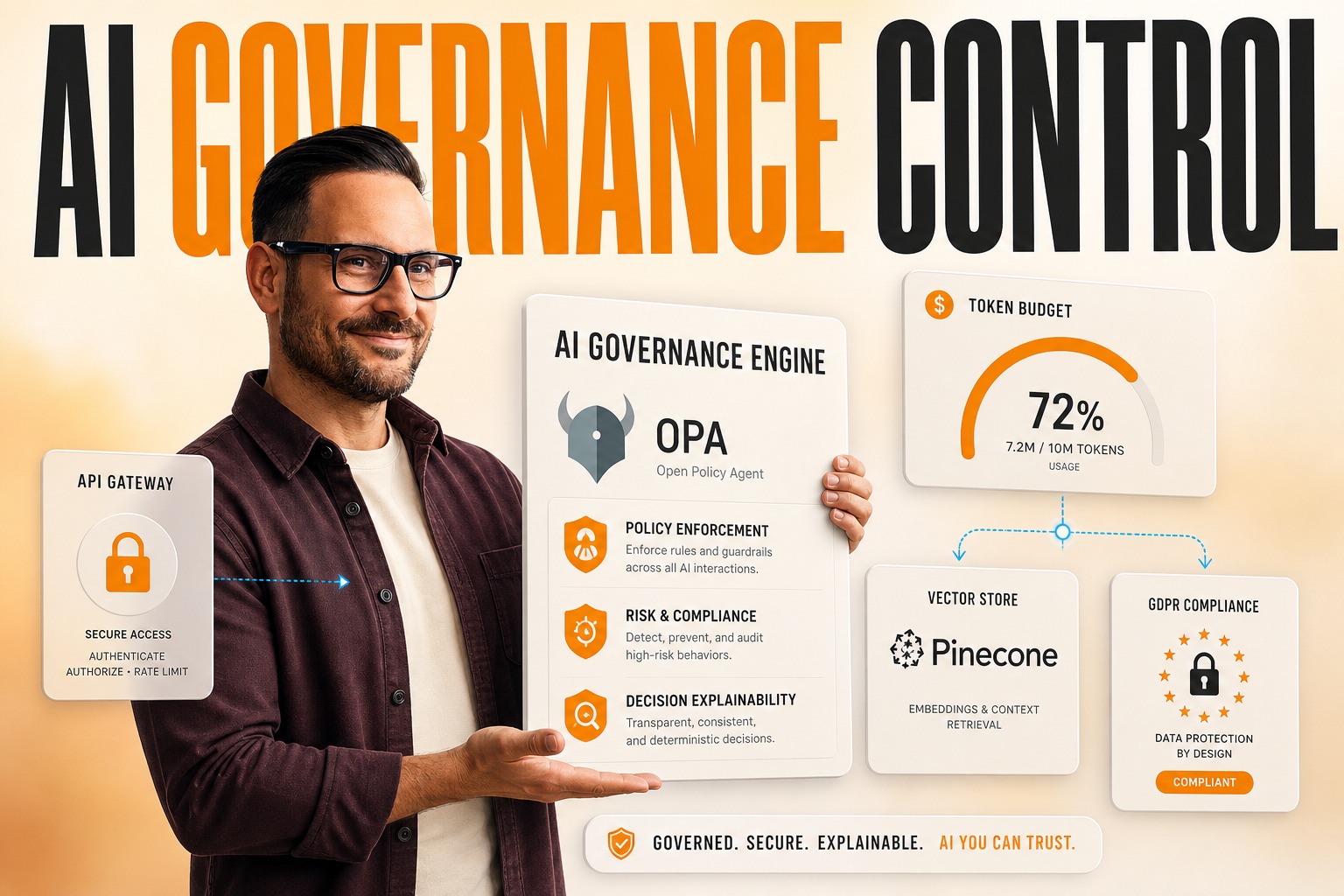
Enterprises that have rolled out large‑scale language‑model services quickly discover a paradox: every new endpoint adds capability, yet every addition multiplies the surface for data leakage, bias, cost overruns, and compliance violations. Without a disciplined AI governance framework, a 5‑model RAG pipeline can silently drift from $0.10 per 10 k tokens to $2.50 per 10 k tokens once token limits are exceeded and fallback models are triggered. The result is an uncontrolled spend, regulatory exposure, and a loss of trust that can stall digital transformation initiatives.
Industry challenge & market context
- Legacy approval flows rely on manual sign‑offs that cannot keep pace with the sub‑second iteration cycles of LLM‑driven services.
- Enterprise AI governance is often an after‑thought, leading to siloed model registries and fragmented audit trails.
- Responsible AI requirements—bias testing, explainability, and data provenance—are treated as optional check‑boxes instead of enforceable policies.
- AI risk management is hampered by opaque vendor SLAs, making it impossible to guarantee data residency or GDPR compliance.
- Regulators are tightening AI compliance expectations; penalties for non‑compliance can exceed 4 % of global revenue.
Technical architecture of an AI governance framework
A robust AI governance framework is a set of interconnected services that enforce policies, capture provenance, and enable automated risk mitigation. Below is a reference architecture that scales from a single‑tenant proof‑of‑concept to a multi‑region, multi‑tenant production deployment.
- API Gateway (Envoy or Kong) – terminates TLS, enforces OAuth2 scopes, rate‑limits per client‑id, and injects correlation IDs for tracing.
- Orchestration Layer (Temporal, Airflow, or Cadence) – defines pipelines as stateful workflows: ingest → preprocessing → embedding → retrieval → LLM inference → post‑processing.
- Model Service (LangChain + AutoGen agents) – wraps LLM providers (OpenAI, Anthropic, Azure OpenAI) behind a unified
invoke() interface that respects token‑budget policies. - Vector Store (Pinecone, Milvus, or Weaviate) – hosts embeddings with configurable TTL; supports namespace‑level access control for tenancy.
- Data Lake (S3‑compatible bucket + Delta Lake) – immutable raw logs, parquet‑encoded feature snapshots, and audit‑ready lineage tables.
- Message Bus (Kafka or RabbitMQ) – decouples event‑driven triggers (e.g., new document upload) from downstream retraining jobs.
- Compliance Service (Custom microservice) – validates data residency, PII masks, and GDPR consent flags before data enters the pipeline.
- Observability Stack (Prometheus + Grafana, OpenTelemetry) – collects latency, error rates, token usage, and cost per request; feeds alerts into PagerDuty.
Data flow example: A sales‑assistant bot receives a user query via a GraphQL endpoint. The API gateway authenticates the request, injects a trace ID, and forwards it to the orchestration layer. The workflow calls the compliance service to verify that the user’s region permits processing personal data. After passing, the text is chunked, embedded with SentenceTransformers, and stored in the vector store under the tenant’s namespace. A LangChain Retriever pulls the top‑k chunks, the AutoGen agent decides whether to call a tool (e.g., CRM API) or generate a direct answer, and the model service returns a response. Every step logs a structured JSON record to the data lake, which later powers automated audits.
Even the most sophisticated LLM will produce a compliance violation if the surrounding pipeline lets unauthorized data slip past a single unchecked connector.
Key technical patterns
- Event‑driven ingestion: new contracts uploaded to an S3 bucket fire an S3 → Lambda event that writes metadata to Kafka, triggering a retraining job.
- Synchronous vs. asynchronous APIs: high‑latency retrieval calls use async GraphQL subscriptions; low‑latency chat uses REST with idempotency keys.
- Circuit breakers on LLM providers: after three consecutive rate‑limit errors, traffic is routed to a fine‑tuned local model to keep SLAs intact.
- Token‑budget enforcement: each request includes a
max_tokens header; the model wrapper truncates context windows to stay within the budget, preventing runaway costs. - Auditable state: every model version and RAG index is version‑controlled in Git, with SHA‑based immutable references stored alongside request logs.
Infrastructure considerations
- Containerization: all services run in Docker images orchestrated by Kubernetes (EKS, GKE, or AKS) with pod‑level RBAC.
- Serverless fallback: latency‑critical endpoint can be backed by AWS Lambda + API Gateway to auto‑scale to zero when idle.
- Hybrid deployment: data‑residency requirements are satisfied by keeping vector stores in EU‑West‑1 while allowing model inference in US‑East‑2.
- Cost levers: choose between pay‑as‑you‑go LLM APIs (cost per token) and self‑hosted fine‑tuned models (GPU‑hour billing) based on usage patterns captured in Prometheus.
- Security: OAuth2 client‑credentials flow for service‑to‑service calls, API‑key rotation every 30 days, and encrypted at‑rest storage using KMS.
Business impact & measurable ROI of an AI governance framework
- Spend predictability – token‑budget enforcement and cost dashboards reduced monthly AI spend from $120k to $68k (43 % savings) in a Fortune‑500 call‑center pilot.
- Regulatory risk mitigation – automated PII detection and geo‑fencing avoided two potential GDPR fines, saving > $1 M in projected penalties.
- Time‑to‑value acceleration – standardized pipelines cut model‑deployment lead time from 8 weeks to 2 weeks, enabling quarterly AI feature releases.
- Operational efficiency – centralized audit trails eliminated manual compliance reporting; auditors now extract a single JSON file instead of 20 Excel sheets.
- Customer trust – transparent responsible AI dashboards (bias scores, explainability metrics) increased Net Promoter Score by 12 points for a fintech partner.
Implementation strategy
Adopting an AI governance framework is a phased engineering endeavor. Below is a pragmatic roadmap that balances speed with control.
- Phase 0 – Foundation – Define policy taxonomy (data residency, token budget, bias thresholds) and set up an audit‑ready logging pipeline.
- Phase 1 – Pilot – Deploy a single‑tenant RAG service using LangChain + Pinecone. Instrument all steps with OpenTelemetry. Validate compliance checks with a subset of data.
- Phase 2 – Policy Engine Integration – Introduce a rule‑engine (OPA or custom microservice) that enforces the policy taxonomy at the API gateway level.
- Phase 3 – Multi‑tenant Expansion – Refactor vector stores into namespaces, add tenant‑aware OAuth scopes, and rollout to additional business units.
- Phase 4 – Automation & CI/CD – Embed model versioning, LLM provider selection, and cost‑budget tests into pipelines (GitHub Actions or Azure DevOps).
- Phase 5 – Continuous Monitoring – Set up SLA dashboards (latency < 200 ms, error < 0.5 %), cost alerts, and regular bias audits.
Common pitfalls
- Skipping data lineage early – makes later forensic analysis costly.
- Hard‑coding provider keys – defeats key‑rotation policies and raises security alerts.
- Neglecting token‑budget enforcement – leads to sudden cost spikes during high‑traffic events.
- Relying on a single LLM provider – increases vendor lock‑in risk and reduces resilience.
- Over‑engineering compliance checks before a clear policy set – wastes engineering cycles.
Why Plavno’s AI governance framework works
Plavno builds AI solutions with an engineering‑first, enterprise‑grade mindset. Our teams design end‑to‑end pipelines that embed governance from day one, leveraging battle‑tested components such as AI agents development and AI recommendation systems. We combine deep domain expertise with a modular delivery model—whether you need outstaffing talent or a fully managed cloud software development partner.
- We adopt AI security solutions that integrate OPA policy enforcement directly into Kubernetes admission controllers.
- Our observability platform ships with native OpenTelemetry instrumentation for every LangChain and AutoGen component.
- Compliance is baked in: we run automated GDPR‑ready scans on all inbound data using our AI consulting playbooks.
- Cost optimization is a first‑class feature—our Plavno Nova tool automatically migrates high‑frequency low‑latency endpoints to serverless functions when token budgets are exceeded.
- We deliver fast, measurable ROI: a recent health‑tech client cut its model‑training cycle by 60 % while staying compliant with HIPAA through our custom audit trail service.
A well‑architected AI governance framework turns compliance from a blocker into a scalable, automated control plane.
Conclusion
Scaling AI without losing control is no longer a theoretical concern—it is a prerequisite for sustainable, enterprise‑wide adoption. By instituting an AI governance framework that couples policy enforcement, immutable audit trails, and observability, organizations can unlock the full potential of large‑language models while meeting responsible AI, AI risk management, and AI compliance mandates. The payoff is clear: predictable spend, faster time‑to‑market, and a trust fabric that protects brand reputation. If you are ready to embed a proven AI governance framework into your next project, reach out to Plavno today and let our engineers design a solution that scales responsibly.