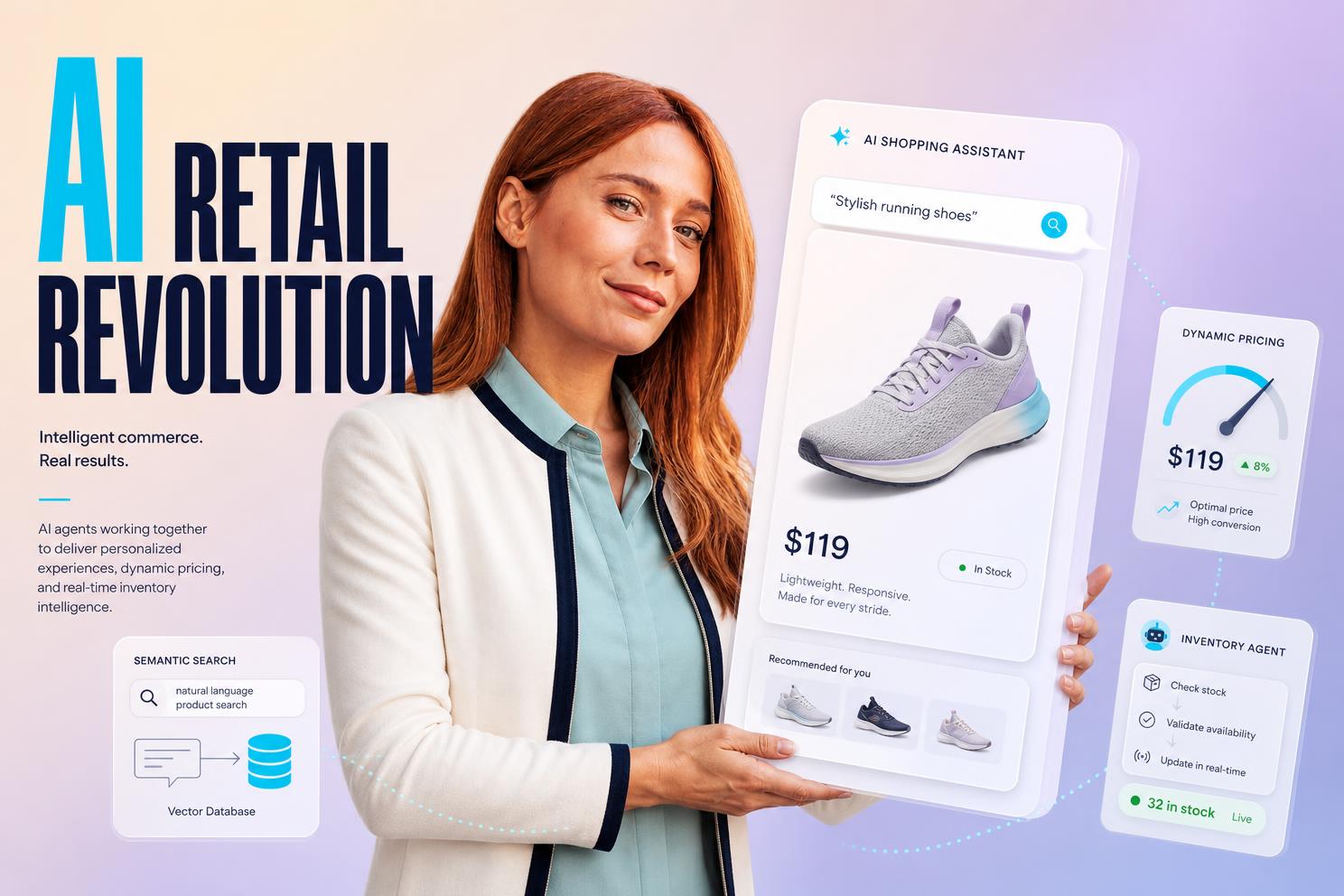
The retail landscape is saturated with "AI-powered" recommendation engines that suggest products you just viewed or already bought. This is table stakes. The real competitive edge for modern e-commerce lies not in marketing gimmicks, but in deep operational intelligence: automating complex supply chains, transforming customer support into proactive revenue generation, and building dynamic pricing models that react to market volatility in real-time. For CTOs and engineering leaders, the challenge is moving beyond pilot projects to implementing robust, scalable architectures that integrate Large Language Models (LLMs), vector databases, and event-driven pipelines into the core of the commerce platform.
Industry challenge & market context
Legacy e-commerce architectures are fundamentally reactive. They rely on rigid relational schemas and batch processing that cannot keep pace with the real-time nature of modern consumer behavior or supply chain volatility. The "add AI" strategy often results in fragile point solutions that increase technical debt rather than resolving it. Enterprise leaders face specific bottlenecks that prevent them from leveraging true retail AI.
- Data fragmentation across ERP, CRM, and PIM systems creates silos where inventory data is stale by the time it reaches the storefront, leading to overselling and stockouts.
- Legacy search architectures relying on keyword matching (Elasticsearch/Lucene) fail to understand user intent, resulting in high bounce rates for long-tail queries.
- Customer support costs are spiraling because legacy chatbots are decision-tree based, incapable of handling complex multi-turn conversations or context-aware order modifications.
- Pricing strategies are static or rule-based, unable to factor in real-time competitor pricing, demand surges, or inventory expiration dates dynamically.
- Security and compliance risks increase when proprietary data is sent to public model APIs without proper governance, audit trails, or PII redaction pipelines.
Technical architecture and how AI in ecommerce works in practice
Implementing effective AI in ecommerce requires a shift from monolithic application structures to a composable, event-driven architecture. We are not simply adding a chatbot widget; we are building an intelligent layer that sits atop your existing infrastructure, utilizing agents, retrieval-augmented generation (RAG), and semantic search to drive value.
A robust architecture typically consists of an API Gateway (Kong or AWS API Gateway) routing traffic to specific microservices. The core intelligence lies in the Orchestration Layer, often built with frameworks like LangChain or LlamaIndex running in Python or Node.js environments. This layer manages interactions with the Model Layer—hosting models like Llama 3 via vLLM or utilizing OpenAI/Azure OpenAI APIs—and the Data Layer, which combines traditional SQL/NoSQL stores with Vector Databases (Pinecone, Milvus, or Weaviate) for semantic retrieval.
Consider a practical implementation of an AI shopping assistant. When a user asks, "Do these running shoes come in wide width and size 10 for under $120?", the system executes a complex pipeline:
- The user query hits the API Gateway and is routed to the Intent Classification Service.
- The Orchestration Layer parses the query, extracting parameters (product type, size, width, price constraint).
- Instead of a simple keyword lookup, the system generates an embedding for the query and performs a similarity search against the product catalog stored in a Vector DB, retrieving semantically relevant items.
- Concurrently, an Inventory Agent queries the ERP system via a GraphQL API to verify real-time stock levels for the specific SKU/size combinations.
- The Pricing Agent applies dynamic pricing rules, checking current demand and inventory turnover rates to adjust the final offer.
- The LLM synthesizes the inventory status, pricing data, and product details into a natural language response, citing specific products that match the criteria.
The shift from keyword-based search to intent-based retrieval is the single highest-impact architectural change a retailer can make. It transforms the search bar from a filter into a conversational sales agent that understands context and nuance.
Infrastructure-wise, these workloads are best deployed on Kubernetes (EKS/GKE) to handle the variable compute requirements of model inference. State management is critical; while LLMs are stateless, the conversation context must be maintained in a fast store like Redis or DynamoDB, keyed by a session ID. For ecommerce automation tasks like inventory reordering, we utilize event-driven architectures. An "Inventory Low" event published to Kafka triggers a CrewAI or AutoGen agent workflow that analyzes historical sales velocity, supplier lead times, and current market trends to generate a purchase order, which is then pushed to the ERP for human approval.
Security must be baked in. We implement a "proxy" pattern for all LLM interactions. This proxy handles OAuth2 authentication, rate limiting, and crucially, data sanitization. Before data leaves the VPC, PII scrubbing pipelines (using Presidio or custom NER models) strip sensitive customer information. Audit logs are immutable and stored in a separate data lake for compliance reviews.
Business impact & measurable ROI
When we discuss AI in ecommerce, the conversation must move from "cool tech" to "dollars and cents." The ROI of a well-architected AI stack is measurable in conversion rates, margin protection, and operational efficiency.
- Conversion Rate Optimization: Semantic search and conversational assistants typically reduce search abandonment by 15-20% by handling natural language queries that keyword engines miss, directly lifting gross merchandise value (GMV).
- Support Cost Deflection: Tier-1 support tickets can be reduced by 40-60% by deploying LLM-driven agents that handle order tracking, returns, and FAQ resolution, freeing human agents for high-value escalations.
- Inventory Optimization: AI-driven demand forecasting reduces holding costs by minimizing overstock and preventing stockouts. Retailers see a 10-30% reduction in inventory carrying costs and a 5-10% increase in revenue capture from better availability.
- Dynamic Pricing Margins: Real-time pricing agents can recover 2-5% of margin that is typically lost to static pricing during demand spikes or competitor stockouts.
- Developer Velocity: By standardizing on an internal AI platform with reusable components (RAG pipelines, prompt management tools), engineering teams can ship new AI features 3x faster, reducing the time-to-market for new customer experiences.
The most significant ROI often comes not from customer-facing features, but from backend automation. An AI agent that can reconcile inventory discrepancies across three different warehouses automatically saves thousands of engineering hours and prevents revenue leakage.
Implementation strategy
Deploying these capabilities requires a phased approach that prioritizes high-impact, low-risk use cases before moving to complex, multi-agent systems. A "big bang" rewrite is a recipe for failure; instead, we advocate for a strangler pattern approach, gradually replacing legacy logic with AI-driven services.
- Assessment and Data Foundation: Audit existing data assets. Ensure product catalogs, customer history, and inventory logs are centralized and accessible. Establish a data lakehouse architecture (e.g., Snowflake or Databricks) to serve as the ground truth for your AI models.
- Infrastructure Setup: Provision the vector database, message queues (Kafka/RabbitMQ), and the orchestration layer. Implement the governance proxy for API security and cost monitoring (token tracking).
- Pilot - Intelligent Search: Launch a semantic search engine for a specific category. Measure lift in conversion and click-through rates (CTR) against the legacy keyword search baseline.
- Pilot - Support Automation: Deploy an internal AI shopping assistant for support agents (agent-assist) before exposing it to customers. This fine-tunes the RAG pipelines and ensures accuracy in responses.
- Scale - Dynamic Pricing & Inventory: Roll out agent-based workflows for back-office operations. Integrate these agents with existing ERP APIs using webhooks and idempotency keys to ensure exactly-once processing.
- Optimization and Fine-tuning: Move from generic foundation models to fine-tuned open-source models (e.g., Mistral or Llama) for specific tasks to reduce latency and API costs. Implement A/B testing frameworks to continuously optimize prompt strategies.
Common pitfalls to avoid include neglecting the "cold start" problem in vector databases (ensuring your embeddings are high quality), ignoring latency budgets (keeping inference under 500ms for real-time interactions), and failing to implement human-in-the-loop (HITL) workflows for high-risk decisions like refunds or large purchase orders.
Why Plavno’s approach works
At Plavno, we do not treat AI as a magic wand; we treat it as an engineering discipline. Our approach is grounded in building enterprise-grade, scalable software that integrates seamlessly with your existing stack. We specialize in AI agents development and AI automation, moving beyond simple chatbots to autonomous systems that execute business logic.
We understand that personalization AI requires more than just an algorithm; it requires a deep understanding of user privacy and data architecture. Whether you need to enhance your retail and ecommerce software or build a custom AI assistant, our team of principal engineers and architects designs systems that are resilient, observable, and cost-effective. We leverage modern stacks like Kubernetes, serverless functions, and vector databases to ensure your solution scales with your traffic.
Our engagement model is flexible, designed to augment your team or take ownership of entire modules. If you are looking to hire developers who understand both the nuances of machine learning development and the rigors of enterprise software, Plavno is the partner you need. We focus on AI consulting that delivers actionable roadmaps, followed by rigorous execution to build AI chatbots and agents that actually work.
The future of retail is not just about selling products; it is about orchestrating intelligent experiences. If you are ready to move beyond the hype and build a robust AI infrastructure, contact Plavno today. Let's discuss how we can transform your e-commerce solutions into a competitive advantage. You can also get a project estimate to start the conversation.
Product recommendations are only the beginning. The real value of AI in ecommerce is a fully integrated, intelligent enterprise that responds, adapts, and predicts. It is time to build that future.