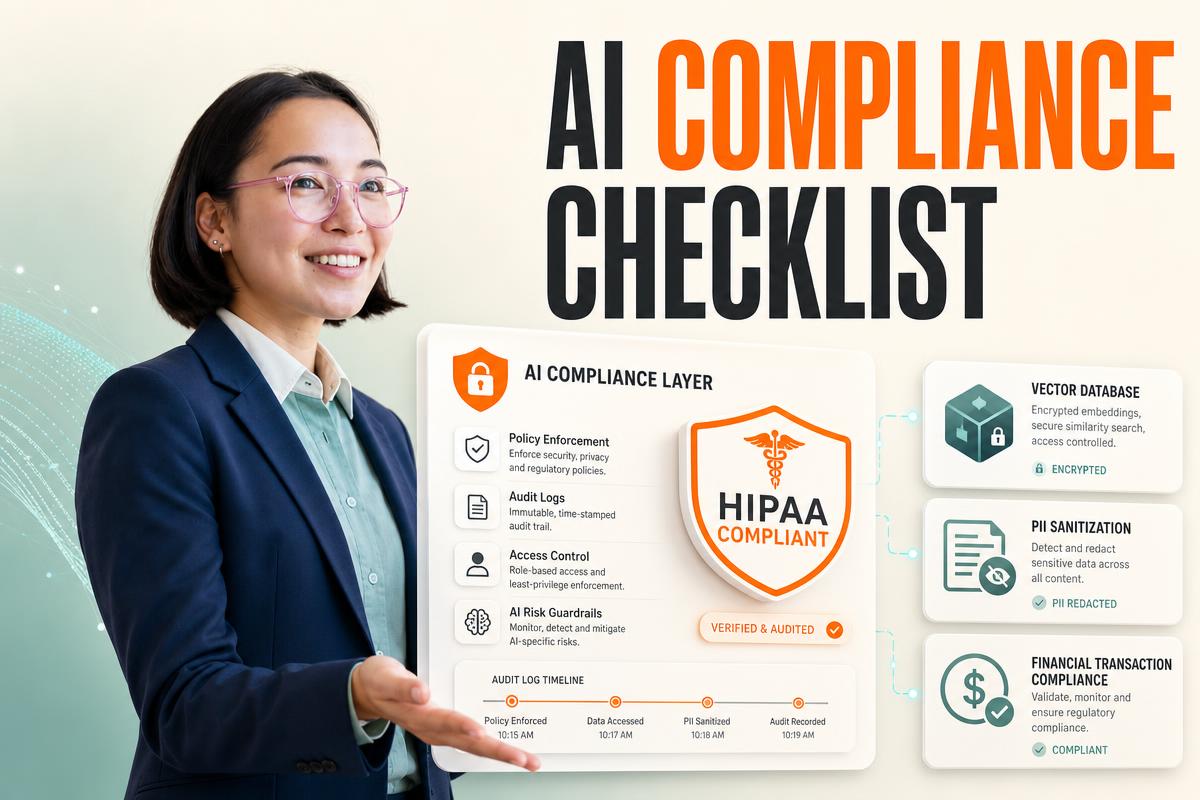
The integration of Large Language Models (LLMs) and generative AI into regulated sectors is no longer a futuristic concept—it is a present-day architectural imperative. However, the velocity of AI deployment clashes violently with the rigidity of regulatory frameworks. For CTOs and engineering leads in Healthcare, FinTech, and LegalTech, the challenge is not merely building intelligent features, but building them within a prison of strict compliance standards. A single data leak or a hallucination that violates patient confidentiality can result in millions in fines under HIPAA or GDPR. To navigate this, you cannot rely on generic AI wrappers; you need a rigorous, engineering-first AI compliance checklist that governs the entire lifecycle of your application, from data ingestion to model inference.
Industry challenge & market context
The enterprise adoption of AI is currently bottlenecked by three critical friction points: data privacy, auditability, and model opacity. Legacy compliance frameworks are static, designed for deterministic databases, whereas modern AI stacks are probabilistic and dynamic. This mismatch creates significant risks for organizations handling sensitive Personally Identifiable Information (PII) or financial data.
- Legacy governance tools fail to track vector embeddings and unstructured data flows, creating blind spots in data lineage.
- Black-box opacity in LLMs makes it nearly impossible to explain automated decisions to regulators, violating "right to explanation" clauses in GDPR AI mandates.
- Vendor lock-in with third-party model providers (like OpenAI or Anthropic) often conflicts with data residency requirements, where cross-border data transfer is prohibited.
- High hallucination rates in RAG (Retrieval-Augmented Generation) pipelines pose severe liability risks in fintech compliance and medical advice scenarios.
- The lack of standardized logging for prompt inputs and outputs complicates forensic analysis required during SOC 2 audits.
Compliance is not a tax on innovation; it is the architectural foundation that allows AI to operate safely in high-stakes environments. If you cannot audit your model's decision path, you are not building a product; you are building a liability.
Technical architecture and how AI compliance checklist works in practice
Implementing an effective AI compliance checklist requires a shift from monolithic application design to a composable, event-driven architecture where every data touchpoint is observable and controllable. We do not treat compliance as an afterthought wrapper; we bake it into the orchestration layer, the data pipeline, and the infrastructure configuration.
In a robust architecture, the compliance layer sits as a proxy between the client application and the AI inference engine. This layer handles authentication, input sanitization, prompt injection defense, and output filtering. Below is a breakdown of the components and data flows required to maintain HIPAA AI and GDPR AI standards.
System Components and Roles
- API Gateway: The entry point enforcing rate limits, OAuth2/OIDC authentication, and initial request validation. Tools like Kong or AWS API Gateway terminate TLS and manage JWT verification.
- Orchestration Layer: Built using frameworks like LangChain or LlamaIndex, this layer manages the logic flow, agent state, and tool calling. It must be instrumented to serialize the full chain of thought for audit logs without exposing sensitive system prompts.
- PII Sanitization Service: A dedicated microservice, often utilizing NER (Named Entity Recognition) models (e.g., Microsoft Presidio), to scan and redact sensitive data before it hits the embedding model or the LLM.
- Vector Database: Stores embeddings for RAG implementations. For compliance, this must support encryption at rest (AES-256) and role-based access control (RBAC) to ensure a user can only retrieve embeddings they are authorized to see. Weaviate, Pinecone, or Milvus are common choices here.
- Audit Logging Sink: An immutable data store (e.g., Amazon S3 with Object Lock or a WORM-compliant database) that stores every prompt, response, and context retrieval for forensic analysis.
- Model Gateway: A unified interface to multiple model providers (OpenAI, Anthropic, Llama 2). This abstracts the model provider, allowing you to swap models if a vendor changes their terms of service regarding data training.
Data Pipelines and Flows
Data flow in a compliant system is strictly unidirectional and compartmentalized. When a user initiates a request, the payload first hits the API Gateway where the user's identity is mapped to a specific tenant ID in a multi-tenant architecture. The request is then passed to the PII Sanitization Service. Here, sensitive entities like medical record numbers (MRN) or credit card numbers are replaced with synthetic tokens. This ensures that the raw PII never leaves the secure perimeter or reaches the third-party LLM endpoint.
Once sanitized, the query is converted into embeddings using a model deployed within your own VPC (Virtual Private Cloud) to maintain data residency. These embeddings are queried against the Vector Database. The retrieval logic must enforce strict filtering; for example, in a legaltech AI scenario, the system must ensure that a lawyer from Firm A cannot retrieve documents indexed under Firm B, even if the semantic similarity is high. This is achieved by embedding metadata filters (tenant_id, document_class) directly into the vector search query.
The retrieved context and the sanitized prompt are sent to the Model Gateway. The orchestration layer manages the context window, ensuring that token limits are respected and that the system prompt includes strict guardrails to prevent jailbreaking. The response from the LLM is then passed back through the PII service to re-insert the original sensitive data (re-tokenization), ensuring the user sees the correct information while the LLM only saw tokens.
Infrastructure and Deployment
- Containerization: All services are packaged as Docker containers and orchestrated via Kubernetes. This allows for strict network policies (NetworkPolicies) that isolate the AI cluster from the public internet, forcing all traffic through internal egress gateways.
- Observability: Distributed tracing using OpenTelemetry is mandatory. You must trace the latency of the embedding retrieval, the LLM inference time, and the PII processing overhead separately to identify bottlenecks. A typical compliant RAG query should target a total latency (p95) under 2 seconds for chat interfaces, though complex document analysis may take longer.
- Secrets Management: API keys for LLM providers and database credentials are injected into the pods at runtime using a vault like HashiCorp Vault or AWS Secrets Manager, never hardcoded in images.
- Hybrid Deployment: For highly regulated industries, we often recommend a hybrid approach. Keep the orchestration, vector database, and business logic on-prem or in a private cloud, and use a secure VPC endpoint to call the inference APIs.
- Idempotency and Retries: LLM APIs can be flaky or rate-limited. The orchestration layer must implement idempotent request keys so that if a network timeout occurs, the retry does not result in duplicate processing or double billing.
The most critical architectural decision for SOC 2 AI compliance is the immutability of logs. You must design a write-once, read-many pipeline for prompts and outputs that even your root admins cannot alter without triggering an alert.
Business impact & measurable ROI
Implementing a rigorous AI compliance checklist is often viewed as a cost center, but in reality, it is a significant ROI driver. By automating compliance checks within the software architecture, enterprises reduce the need for expensive manual legal reviews of every feature deployment.
From a risk perspective, the cost of a HIPAA violation can exceed $50,000 per incident, while GDPR fines can reach up to 4% of global turnover. Architectural compliance mitigates these catastrophic risks. Furthermore, a compliant architecture enables faster market entry. Instead of waiting months for legal clearance, a pre-validated "compliant-by-design" AI pipeline allows product teams to ship features in weeks, confident that data governance is handled.
Operationally, the integration of AI into workflows like healthcare software or fintech solutions drastically reduces manual overhead. For example, an AI agent capable of summarizing medical notes or analyzing loan applications can reduce processing time by 70-80%. However, this efficiency is only monetizable if the output is legally admissible and trustworthy. Compliance ensures the output is defensible.
There is also a tangible benefit in vendor negotiation. When you own your compliance layer and data pipeline, you are less beholden to the pricing and terms of a single AI provider. If a vendor raises prices or changes their data retention policy, your architecture allows you to route traffic to an open-source model (like Llama 3 or Mistral) hosted on your own infrastructure with minimal code changes. This flexibility protects your margins and prevents service disruption.
Implementation strategy
Deploying a compliant AI system is a multi-phase process that requires close collaboration between engineering, legal, and operations teams. You cannot buy this off the shelf; you must build it into your DNA.
Step-by-Step Roadmap
- Gap Analysis and Classification: Audit your current data stack. Classify all data assets by sensitivity level (Public, Internal, Confidential, Restricted). Identify where PII is stored and how it currently flows into your development environments.
- Define the Governance Framework: Establish policies for data retention (e.g., "User prompts must be deleted after 30 days unless opted-in for improvement") and model usage (e.g., "No PII in system prompts"). Document these policies as code (Policy-as-Code) using tools like OPA (Open Policy Agent).
- Build the Compliance Proxy: Develop the middleware that handles authentication, PII redaction, and prompt injection defense. Start with a simple allow-list/deny-list approach and evolve to LLM-based input scanning.
- Pilot the RAG Pipeline: Select a low-risk use case, such as an internal knowledge base for engineers or a customer support bot for non-sensitive queries. Deploy the vector store and orchestration layer. Focus on measuring retrieval accuracy and latency.
- Integrate Audit Logging: Connect your application logs to a centralized SIEM (Security Information and Event Management) system like Splunk or ELK Stack. Ensure that every interaction generates a Correlation ID that links the user intent, the model input, and the model output.
- Security Penetration Testing: Engage a third party to perform penetration testing specifically focused on AI vulnerabilities, such as prompt injection, model extraction, and data poisoning.
- Scale and Optimize: Once the pilot is validated, expand to high-risk workflows like legaltech AI document review or patient triage. Implement caching strategies (Redis) to reduce costs on repeated queries and optimize vector indexing for faster retrieval.
Common Pitfalls
Many organizations fail by relying solely on the model provider's "enterprise" terms of service. This is a dangerous assumption. You are responsible for how you use the API, not just the API itself. Another common mistake is neglecting the "Right to be Forgotten." In a vector database, deleting a user's record is not enough; you must also delete their associated embeddings, which requires a robust garbage collection mechanism in your pipeline. Finally, do not underestimate the complexity of context window management; stuffing too much context into a prompt increases costs and latency, and can degrade the quality of the compliance guardrails.
Why Plavno’s approach works
At Plavno, we do not treat AI as a magic black box. We treat it as another component in your software architecture that requires rigorous engineering, security, and scalability. Our approach is grounded in building custom software that fits your exact regulatory landscape, whether you are in Healthcare, FinTech, or LegalTech.
We specialize in the full stack of AI development, from AI consulting and strategy to the deployment of complex AI agents and automation systems. Our engineers are well-versed in the nuances of SOC 2 AI controls and HIPAA AI constraints. We design systems that leverage state-of-the-art frameworks like LangChain and AutoGen while ensuring that your data remains sovereign and your audit trails are immutable.
Whether you need to build a secure AI chatbot for customer service or a sophisticated recommendation system for financial products, we prioritize architectural integrity over hype. We help you navigate the trade-offs between using hosted models (like GPT-4) and deploying open-source models (like Llama 3) on your own infrastructure to meet strict data residency requirements. By partnering with Plavno, you gain a team that speaks both the language of large language models and the language of enterprise compliance.
Building a compliant AI product is a heavy engineering lift. If you are ready to move beyond prototypes and build a production-grade, compliant AI system, hire developers from Plavno who understand the stakes. We can help you define your AI compliance checklist, architect the necessary guardrails, and deliver a solution that drives real business value without compromising on security or governance.
The gap between "cool AI demo" and "compliant enterprise product" is wide, but it is bridgeable with the right architecture and the right team. Do not let regulatory uncertainty stall your innovation. Build it right, build it compliant, and build it with Plavno.