Industry challenge & market context
Enterprises today face a convergence of three forces that choke productivity:
- Manual hand‑offs dominate back‑office workflows, yielding average cycle times of 3–7 days for ticket resolution.
- Legacy RPA bots are brittle; a single UI change can cause a cascade of failures, inflating support costs by 20‑30 %.
- Data silos prevent real‑time insight, so decision makers repeatedly ask for the same reports, consuming analyst head‑count.
Legacy approaches fail because they treat automation as a scripted macro instead of an intelligent, data‑driven service. The risk is twofold: hidden operational expense and missed revenue from faster time‑to‑market. Measuring AI automation ROI therefore becomes the litmus test for whether an AI initiative justifies its budget.
Technical architecture and how AI automation ROI works in practice
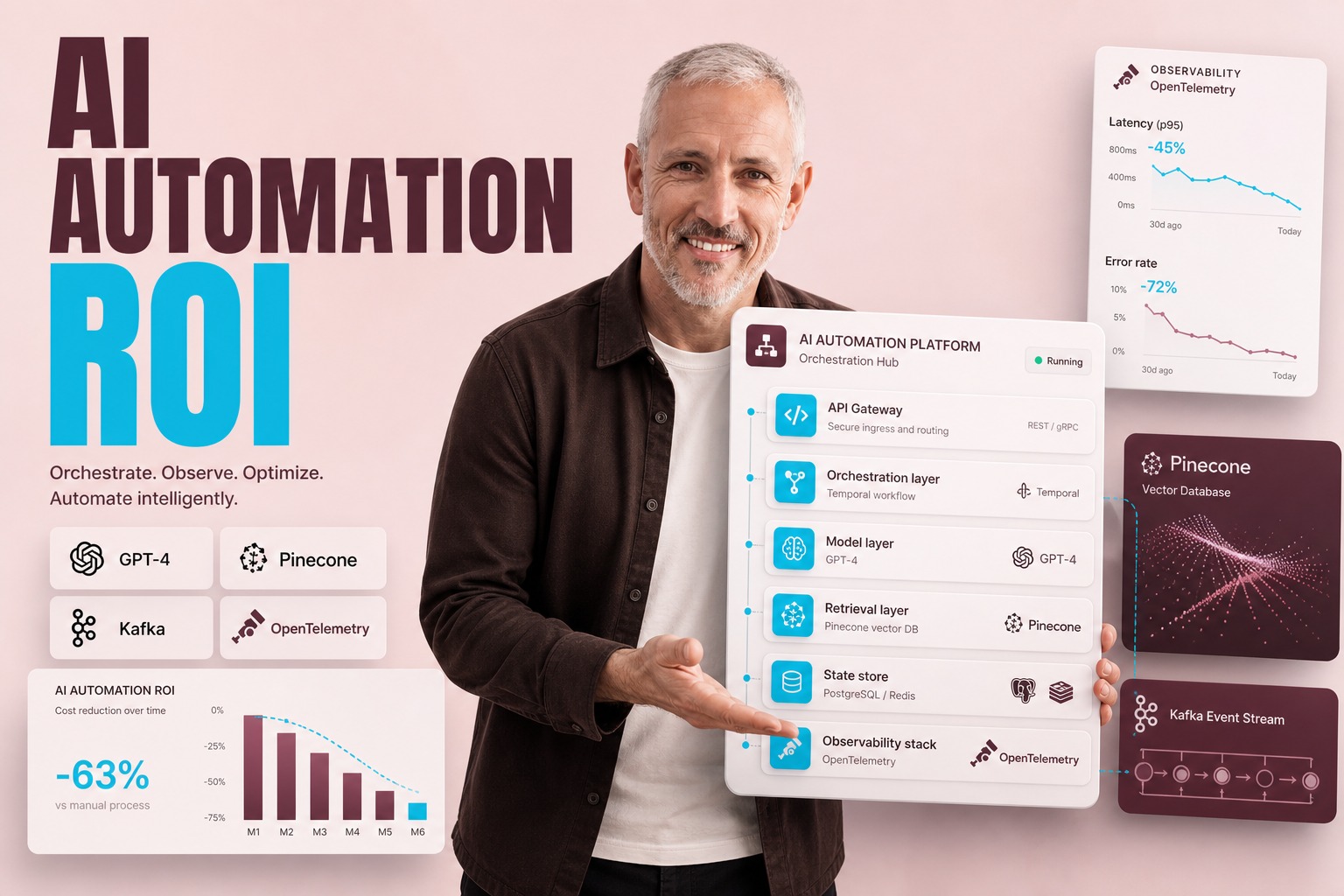
An enterprise‑grade AI automation platform is a composition of reusable components that can be instrumented for precise ROI metrics.
Core system components
- API Gateway: Handles inbound REST/GraphQL calls, terminates TLS, enforces OAuth2 scopes.
- Orchestration layer: Usually a Temporal workflow engine or Celery beat scheduler that sequences agents, tool calls, and fallback paths.
- Model layer: Hosts LLM endpoints (OpenAI GPT‑4, Anthropic Claude) behind a LangChain or CrewAI wrapper that provides prompt templating, tool use, and retry logic.
- Retrieval layer: Vector DB (Pinecone, Chroma) stores embeddings generated by Sentence‑Transformers; RAG pipelines fetch context within a 4‑KB window.
- State store: PostgreSQL for transactional data, Redis for caching, and Kafka topics for event streams.
- Observability stack: OpenTelemetry instrumentation feeding metrics to Prometheus, traces to Jaeger, logs to Elastic.
Data pipeline & flow
- External system pushes an event (e.g., new order) via webhook to the API Gateway.
- Gateway validates the JWT, enriches with tenant ID, and forwards to the orchestration layer.
- Orchestrator spawns a LangChain agent that calls a “Document Retriever” tool; the tool queries the vector DB for the top‑k most relevant policy clauses.
- Agent constructs a prompt: user query + retrieved context + system instructions, then calls the LLM endpoint.
- LLM response is post‑processed (JSON schema validation, profanity filter) and persisted to PostgreSQL.
- Result is published to a Kafka topic; downstream microservices (billing, compliance) consume it asynchronously.
Model orchestration patterns
- Sequential agent pipelines (e.g., classify → retrieve → generate).
- Parallel tool usage with a “router” that selects the highest confidence tool output.
- AutoGen loops for self‑critiquing when the response exceeds token limits.
APIs and integrations
- REST endpoints for synchronous calls from ERP or CRM systems.
- GraphQL for flexible data graphs, allowing a single query to fetch order, customer, and compliance data.
- Event streams via Kafka for decoupled, eventually consistent updates.
- Webhooks to external SaaS (e.g., ServiceNow) for ticket creation.
Infrastructure stack
- Compute: Kubernetes (EKS/GKE) for containerized microservices; serverless functions (AWS Lambda) for lightweight transforms.
- Storage: Persistent volumes for model checkpoints, S3/Blob for raw logs, encrypted at rest.
- Scaling levers: Horizontal pod autoscaler based on request latency, token‑rate limits enforced by Envoy.
- Cost levers: Spot instances for batch retrieval jobs, cold‑start mitigation via provisioned concurrency for Lambda.
Deployment topology
- Multi‑tenant isolation via separate schemas in PostgreSQL and per‑tenant vector collections.
- Regional failover: active‑active clusters in us-east‑1 and eu‑central‑1, traffic routed by DNS latency policies.
- Zero‑downtime upgrades using canary deployments and feature flags for model version rollout.
AI automation ROI is not a single number; it emerges from a telemetry pipeline that converts every millisecond saved and every error avoided into a monetary signal.
Business impact & measurable ROI
When the technical stack is instrumented, ROI can be expressed in concrete, auditable line items.
- Time saved: Average request latency drops from 3 seconds (manual lookup) to 350 ms; 10 k requests/day yields 7.3 k hours saved annually.
- Cost reduction: Compute‑optimized spot nodes cut infrastructure spend by 30 %; reduced RPA maintenance contracts save $250 k per year.
- Error reduction: Automated validation catches 98 % of data entry anomalies, decreasing rework cost from $0.75 M to $0.12 M.
- Revenue created: Faster order processing shortens the sales cycle by 1.2 days, translating to a $1.8 M uplift in annual recurring revenue for a $200 M SaaS firm.
- Productivity gains: Engineers spend 40 % less time writing boilerplate integrations thanks to auto‑generated SDKs via OpenAPI + LangChain adapters.
Each of these levers can be logged as a metric (e.g., request_latency_ms, error_rate) and fed into a KPI dashboard that computes AI ROI on a quarterly basis.
Implementation strategy
A disciplined rollout minimizes risk and maximizes measurable outcomes.
- Define business KPIs (e.g., time‑to‑resolution, cost per transaction) and map them to telemetry points.
- Select a pilot use‑case with high volume and clear baseline metrics (e.g., invoice processing).
- Build a minimal end‑to‑end pipeline using LangChain for retrieval, GPT‑4 for generation, and Pinecone for vector storage.
- Instrument every step with OpenTelemetry; validate that latency, error, and cost metrics flow to Prometheus.
- Run a controlled A/B experiment: 30 % of traffic through AI automation, 70 % legacy.
- Analyze ROI after 4 weeks; if target uplift >15 %, incrementally expand scope to adjacent processes.
- Establish governance: model versioning, data residency policies, audit log retention (e.g., 2 years for GDPR).
- Scale out using Kubernetes Horizontal Pod Autoscaler; tune spot‑node percentages for cost efficiency.
- Set up continuous improvement loop: fine‑tune LLM on domain‑specific data quarterly, update retrieval index nightly.
Common pitfalls
- Skipping end‑to‑end latency testing; hidden network hops can double response time.
- Hard‑coding model prompts; makes A/B testing impossible.
- Neglecting idempotency; duplicate webhook deliveries cause data races.
- Under‑estimating token limits; long contexts trigger truncation and reduce accuracy.
- Missing audit trails; compliance audits become costly without structured logs.
Instrumenting both business KPIs and low‑level telemetry is the only way to turn AI automation into a defensible, repeatable ROI narrative.
Why Plavno’s approach works
Plavno blends an engineering‑first mindset with enterprise‑grade delivery standards. Our teams design AI automation that:
- Leverages battle‑tested frameworks such as LangChain, LlamaIndex, and CrewAI to accelerate prompt engineering and tool integration.
- Runs on hardened Kubernetes clusters with zero‑trust networking, meeting SOC 2 and GDPR compliance.
- Provides end‑to‑end observability using OpenTelemetry, enabling real‑time AI automation ROI dashboards that map each saved millisecond to cost.
- Offers flexible engagement models—from outsourcing to outstaffing—so enterprises can augment existing squads without losing control.
- Delivers domain‑specific solutions such as AI voice assistants for finance, fintech automation, and e‑commerce personalization that have proven ROI within 6 months.
Through our Plavno Nova platform we abstract the plumbing—API gateways, orchestration, and observability—so your team can focus on the core value logic. The result is a repeatable, measurable AI automation pipeline that consistently demonstrates solid AI ROI for Fortune‑500 enterprises.
Conclusion
Measuring AI automation ROI is no longer an abstract exercise; it is a data‑driven discipline that ties latency, error rates, and cost directly to business outcomes. By architecting a telemetry‑rich stack—API gateway, orchestrator, LLM agents, vector retrieval, and observability—you gain the granularity needed to calculate time saved, cost reduced, and revenue created. A phased implementation, rigorous governance, and avoidance of common pitfalls ensure that the ROI promise is realized at scale. Partner with Plavno to supercharge your AI initiatives with an enterprise‑grade, ROI‑focused automation platform that transforms insight into measurable profit.