In 2026, the distinction between a conversational interface and an autonomous worker will define the competitive edge of enterprise software. While the market is currently saturated with basic wrappers around Large Language Models (LLMs), the real value lies not in generating text, but in executing complex workflows. The shift from passive AI chatbot systems to active, tool-using architectures is fundamentally changing how we approach business automation. Organizations that fail to distinguish between these two paradigms risk investing in expensive toys that generate support tickets rather than resolving them. The conversation has moved beyond "Can it talk?" to "Can it act?" and "Can it reason?"
Industry challenge & market context
The current landscape of conversational AI is plagued by a "demo-to-production" gap. Enterprises rushed to deploy chatbots in 2023 and 2024, only to find that while these systems could hallucinate polite responses, they could not actually touch the underlying business logic. The market is now correcting itself, moving toward autonomous AI agents that possess agency, memory, and the ability to utilize external tools. However, this transition introduces significant engineering and operational challenges that CTOs must navigate carefully.
- Legacy integration bottlenecks: Most enterprises run on decades-old infrastructure (mainframes, SOAP APIs, on-prem SQL). Connecting a stateless LLM to these systems without a robust middleware layer creates security vulnerabilities and latency issues.
- Context window limitations: While models are improving, feeding entire ERP databases into a prompt is technically and financially unfeasible. Retrieval-Augmented Generation (RAG) is necessary but introduces complexity in maintaining data freshness and relevance.
- Reliability and determinism: Chatbots are probabilistic; business processes require deterministic outcomes. A chatbot that misunderstands a user's intent is a nuisance; an agent that executes a wrong financial transaction is a liability.
- Cost management: Unoptimized token usage in conversational loops can spike cloud costs by 300% or more compared to traditional rule-based bots, without delivering proportional value.
- Skill gap: There is a shortage of engineers who understand both prompt engineering and enterprise architecture patterns (circuit breakers, idempotency, message queues) required to build production-grade agents.
Technical architecture and how AI agents vs chatbots works in practice
Understanding the difference between AI agents vs chatbots requires looking under the hood. A traditional chatbot is essentially a request-response loop driven by Natural Language Understanding (NLU). It maps an intent to a pre-scripted action or a purely text-based generation. An agent, conversely, is a system that uses an LLM as a reasoning engine to plan, select tools, execute code, and observe results before formulating a final answer.
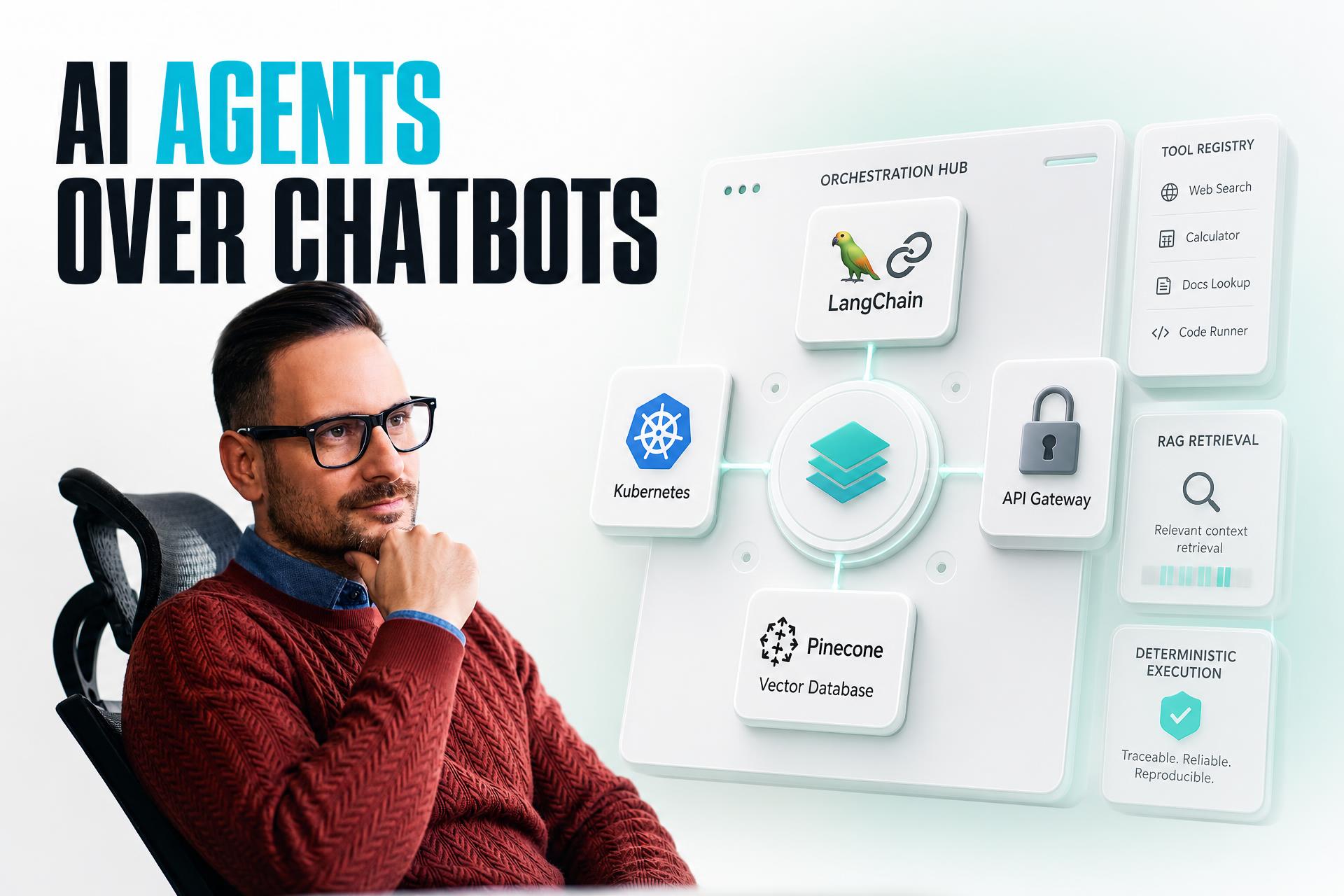
In a modern agent architecture, the LLM acts as the controller, but the heavy lifting is done by a deterministic orchestration layer. When a user asks an agent to "process this refund," the system does not just generate text. It breaks the request down: verify user identity (OAuth2), check transaction status (SQL query via API), validate refund policy (Vector DB lookup), and execute the refund (REST API call to payment gateway).
Core components of a production-grade agent system include the API Gateway, the Orchestration Layer (often using frameworks like LangChain or AutoGen), the Tool Registry, and State Management. The API Gateway handles authentication and rate limiting before the request hits the orchestration layer. The orchestration layer manages the agent loop, deciding which tools to invoke. The Tool Registry contains the definitions of available functions (APIs, database queries, Python scripts) that the agent is allowed to use. State Management is critical; unlike stateless chatbots, agents must maintain conversation history and task state across multiple turns, often using Redis or a distributed cache.
- Model orchestration and routing: We utilize frameworks like LangChain or LlamaIndex to manage the interaction between the LLM and the enterprise environment. The system often employs a "router" agent that determines whether a query requires simple retrieval (RAG) or complex tool use. For high-stakes environments, we might implement a "supervisor" pattern using AutoGen or CrewAI, where multiple specialized agents (e.g., a "Coder" agent and a "Reviewer" agent) collaborate to complete a task.
- Data pipelines and vector storage: The knowledge base is not static. We implement continuous data pipelines that ingest documents, chunk them, and create embeddings using models like OpenAI text-embedding-3 or open-source alternatives. These embeddings are stored in vector databases like Pinecone, Milvus, or pgvector. When a query comes in, the system performs a semantic search to retrieve relevant context, which is then injected into the LLM's system prompt. This ensures the agent operates on the most current business data without retraining the model.
- Tool use and API integration: This is the defining feature of an agent. We define tools using OpenAPI specs or Python functions. The agent is prompted to output a specific JSON structure representing a tool call rather than natural language. The backend parses this JSON, executes the function (e.g., creating a Salesforce opportunity), and feeds the result back to the LLM for final synthesis. This requires strict validation of inputs to prevent injection attacks.
- Infrastructure and deployment: We deploy these systems on containerized infrastructure using Kubernetes. This allows us to scale the "workers" (the parts that execute tools) independently of the "reasoners" (the LLM calls). Serverless functions (AWS Lambda) are often used for short-lived tool executions to keep costs low. Message queues (RabbitMQ, Kafka) decouple the ingestion of requests from the processing, ensuring the system can handle traffic spikes without dropping messages.
- Observability and tracing: Debugging a multi-step agent loop is difficult. We implement comprehensive tracing using OpenTelemetry to track the token usage, latency, and logic flow at every step. This allows us to identify exactly where an agent failed—was it a hallucination in the reasoning step, or a timeout in the API call?
The shift from chatbots to agents is a shift from "deflection" to "resolution." A chatbot's goal is to keep the user from talking to a human; an agent's goal is to complete the transaction so the human doesn't have to.
Business impact & measurable ROI
When evaluating AI agents vs chatbots, the financial implications are stark. Chatbots generally operate as a cost-center, designed to reduce the load on human support teams. Agents, however, function as revenue enablers and operational multipliers. The ROI calculation moves from "tickets deflected" to "transactions automated" and "time-to-value accelerated."
For a logistics client, moving from a status-check chatbot to an autonomous agent reduced the resolution time for shipping disputes from 48 hours to under 5 minutes. The agent didn't just tell the user where the package was; it queried the carrier API, verified the delay against the SLA, calculated the penalty, and initiated the credit memo approval workflow. This level of automation directly impacts the bottom line by freeing up high-value human resources for strategic tasks.
- Operational efficiency gains: Agents can operate 24/7 without fatigue, handling complex workflows that previously required tier-2 human intervention. We typically see a 40-60% reduction in manual processing overhead for back-office tasks like data entry, invoice reconciliation, and onboarding.
- Cost levers and optimization: While the inference cost of LLMs is higher than traditional scripts, the overall cost per transaction drops significantly. By optimizing the pipeline—caching frequent queries, using smaller models for routine tasks, and batching API calls—we can reduce the cost per automated interaction to pennies. Furthermore, the architecture allows for dynamic model routing, sending simple queries to cheaper, faster models (like Llama 3 or Mistral) and complex reasoning tasks to premium models (GPT-4o), optimizing the price-performance ratio.
- Risk reduction and compliance: Autonomous agents enforce consistency. Unlike humans, an agent does not deviate from the approved policy unless explicitly programmed to handle exceptions. Every action taken by an agent is logged, creating a perfect audit trail for compliance (SOC2, GDPR). This is critical in sectors like fintech and healthcare, where manual errors can result in massive fines.
- Scalability without linear hiring: Traditional scaling requires hiring and training more staff. With agents, scaling is a technical challenge of adding compute resources. A system designed with a microservices architecture can handle a 10x increase in load by simply adjusting replica counts in Kubernetes, a process that takes minutes, not months.
Architecturally, the difference is state. A chatbot is stateless and reactive; an agent maintains state, plans ahead, and modifies the environment. This requires a fundamental shift from building "interfaces" to building "processes."
Implementation strategy
Deploying autonomous AI agents is not a "plug and play" operation. It requires a disciplined approach to software engineering. We recommend a phased roadmap that prioritizes high-impact, low-risk workflows before moving to complex, multi-agent systems.
- Assessment and discovery: Identify the "bottleneck workflows." These are processes that are rule-based, high-volume, and involve digital data (e.g., processing insurance claims, extracting data from PDFs, basic code refactoring). Avoid starting with vague, open-ended tasks like "strategic market analysis."
- Infrastructure setup: Establish the "Agent Control Plane." This includes the vector database, the LLM gateway (for key management and routing), and the observability stack. Ensure your APIs are robust and documented; agents are only as good as the tools they can access. If your APIs are slow or unstructured, the agent will fail.
- Pilot development: Build a single-purpose agent with a narrow scope. Use frameworks like LangChain or LlamaIndex to wrap the LLM and connect it to one or two specific APIs. Implement a "human-in-the-loop" review mechanism where the agent drafts the action but requires approval before execution. This builds trust and allows you to refine the prompt engineering.
- Security and governance hardening: Implement strict guardrails. Use tools like NeMo Guardrails or custom validators to ensure the agent cannot execute unauthorized commands (e.g., "drop database"). Ensure all data access is mediated through proper OAuth2 scopes and service accounts. Audit logs must be immutable.
- Scaling and multi-agent orchestration: Once the pilot is stable, expand the tool registry. Introduce specialized agents (e.g., a "Researcher" agent that gathers data and a "Writer" agent that compiles the report). Use orchestration frameworks like CrewAI to manage the hand-offs between these agents.
Common pitfalls to avoid include over-reliance on the LLM's memory (always use a database for state), ignoring latency (users won't wait 20 seconds for a response without a loading indicator), and neglecting error handling (what happens if the external API is down? The agent must have a fallback strategy, such as queuing the request for retry).
Why Plavno’s approach works
At Plavno, we do not treat AI as a magic box. We treat it as a new component in the software engineering stack, subject to the same rigorous standards of testing, security, and scalability as any other enterprise system. Our approach is grounded in building robust architectures that integrate seamlessly with your existing infrastructure.
We specialize in AI agents development that goes beyond simple conversation. We design systems that utilize RAG for accurate context retrieval and tool-use for actual business execution. Whether you need to enhance your existing AI chatbot capabilities or build a new fleet of autonomous workers from scratch, our team of principal engineers ensures the solution is secure, compliant, and cost-effective.
Our expertise in AI automation allows us to identify the workflows that will deliver the highest ROI. We don't just deliver code; we deliver a measurable operational improvement. By leveraging our experience in custom software development, we ensure that your AI agents are not isolated silos but integrated parts of your broader digital ecosystem.
We understand that in 2026, the winners will be those who can execute faster and more accurately. Plavno builds the engines that make that possible. If you are ready to move beyond hype and deploy AI that actually works, contact us for a project estimate.
The debate between AI agents vs chatbots is settling into a clear consensus: chatbots are the interface, but agents are the infrastructure. Businesses that invest in action-oriented architectures today will define the standards of efficiency and customer experience for the next decade. The technology is ready; the question is whether your architecture is prepared to harness it.