Industry challenge & market context
Enterprise real‑estate platforms today juggle millions of leads, thousands of listings, and constantly shifting market prices. Legacy CRM stacks were built for manual pipelines, so they choke on:
- High‑velocity lead ingestion from web forms, chat widgets, and third‑party portals.
- Fragmented property data: MLS feeds, GIS layers, and internal valuation models living in siloed databases.
- Pricing volatility that outpaces batch‑processed analytics, leading to outdated comps on the front‑end.
- Regulatory compliance requirements (GDPR, CCPA) that demand auditable data flows.
- Scaling constraints: spikes during open houses or market booms can push latency above 2 seconds, breaking user experience.
These bottlenecks translate directly into lost revenue: agents spend up to 30 % of their day qualifying leads manually, and consumers abandon searches if property recommendations feel generic. The market opportunity for AI agents for real estate is therefore two‑fold—automate repetitive tasks and surface intelligence fast enough to keep prospects engaged.
Technical architecture and how AI agents for real estate works in practice
Below is a reference architecture that balances real‑time responsiveness with the heavy lifting required for large‑scale models.
Core components
- API Gateway – Handles external REST/GraphQL traffic, enforces OAuth2, rate limits, and request tracing.
- Orchestration Layer – Powered by AI agents development frameworks such as LangChain, CrewAI, or AutoGen. It routes user intents to appropriate tool‑use agents.
- Model Service – Hosts LLMs (e.g., Llama 2, Mistral) behind a vLLM‑compatible inference server (Python, GPU‑accelerated). Supports embeddings generation for vector search.
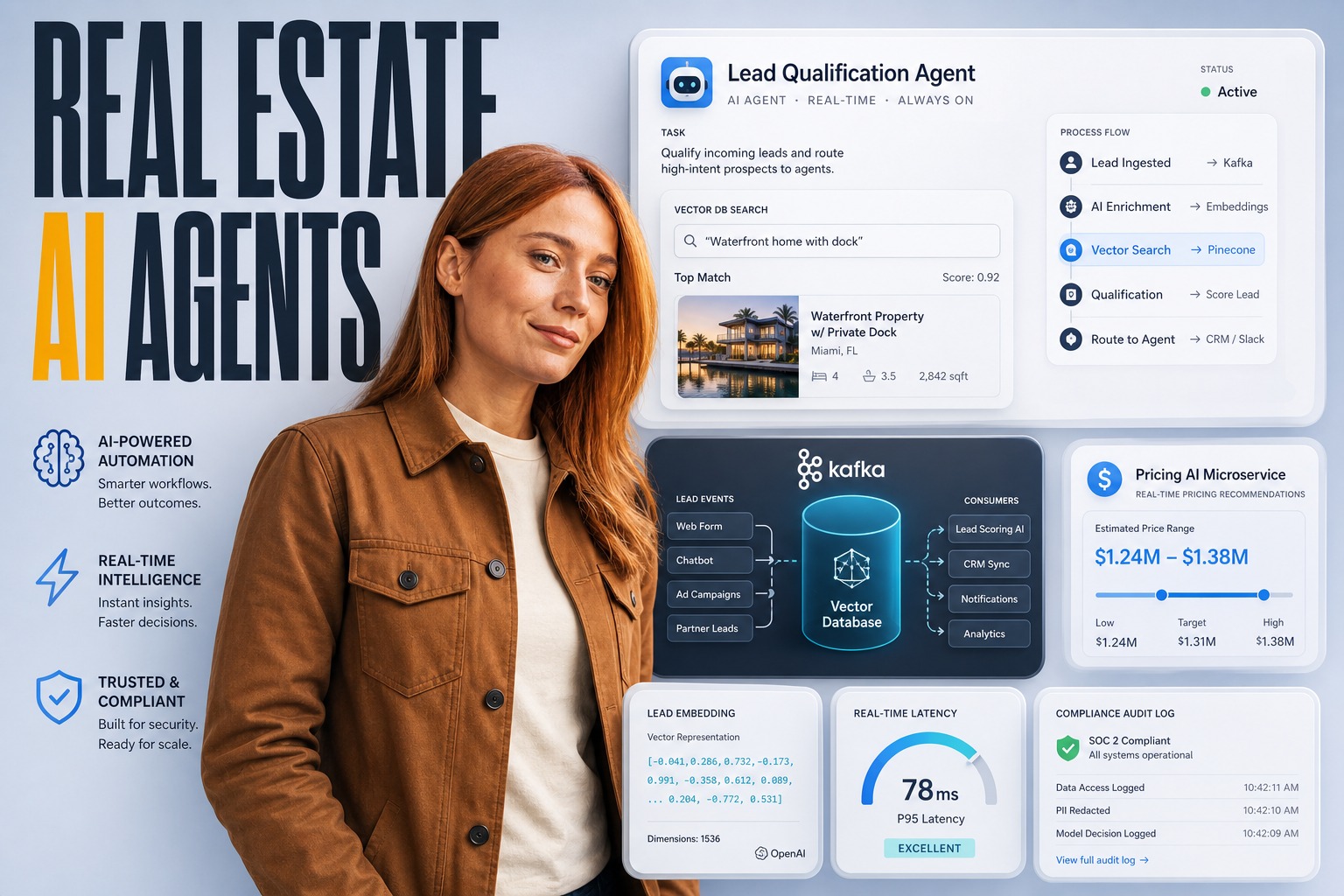
- Vector Database – Pinecone or Chroma for fast similarity lookup of listings, buyer personas, and historical pricing data.
- Transactional Data Store – PostgreSQL with TimescaleDB extensions for time‑series price trends.
- Message Bus – Kafka topics for event‑driven lead creation, property updates, and pricing alerts.
- Cache Layer – Redis with LRU eviction to keep hot listings and recent embeddings under 5 ms latency.
- Observability Stack – OpenTelemetry tracing, Prometheus metrics, and Grafana dashboards to monitor token usage, request latency, and error rates.
Data pipelines and flows
1. Ingestion: Webhook listeners capture lead submissions from a website, a 3rd‑party portal, or a call‑center voice‑to‑text service. The payload is placed on a Kafka “lead‑raw” topic.
2. Normalization: A Python worker reads the message, runs a validation schema (pydantic), enriches with GeoIP, and writes to PostgreSQL “leads” table.
3. Embedding creation: The same worker calls the Model Service to produce a 768‑dimensional embedding for the lead’s textual description, then upserts into the vector DB under the “lead‑embeddings” collection.
4. Agent execution: The Orchestration Layer receives a “qualify_lead” request via the API Gateway. It selects a Lead Qualification Agent (implemented with LangChain’s AgentExecutor) which:
- retrieves similar high‑value leads from the vector DB (RAG pattern),
- calls a pricing AI microservice to estimate budget‑aligned price range,
- uses a decision‑tree tool to set a lead score and trigger follow‑up tasks.
5. Response: The agent returns a JSON payload with lead score, recommended next action, and a short conversational reply. The API Gateway streams the response back to the front‑end within 800 ms on average.
Model orchestration patterns
- Tool‑use agents – Agents can invoke external APIs (e.g., Zillow API, internal pricing engine) as “tools”, passing structured arguments and receiving JSON.
- Retrieval‑Augmented Generation (RAG) – Embedding‑based similarity search pulls the top k relevant listings, which are concatenated to the LLM prompt, keeping the total token count under the model’s context window (typically 4 k tokens).
- Fine‑tuning vs. prompting – For domain‑specific language (e.g., “cap rate”, “NOI”), we fine‑tune a 7 B model on a curated corpus of MLS descriptions, then use few‑shot prompting for downstream agents.
APIs and integration
- External partners consume a GraphQL endpoint for property search, with resolvers delegating to the Orchestration Layer.
- Webhooks fire on “lead qualified” or “price anomaly” events, enabling downstream CRMs (Salesforce, HubSpot) to update in real time.
- Event streams support eventual consistency; idempotent consumer groups on Kafka guarantee exactly‑once processing even under retries.
Infrastructure and deployment
- Containers – All services are Dockerized, orchestrated by Kubernetes (GKE or AKS) with Helm charts for environment‑specific overrides.
- Serverless fallback – Low‑traffic functions (e.g., pricing‑AI inference) can run on Cloud Run or AWS Lambda, scaling to zero to reduce cost.
- Multi‑tenant isolation – Namespace‑based Kubernetes isolation plus per‑tenant encryption keys stored in Vault ensures data residency compliance.
- Scaling knobs – Horizontal pod autoscaling based on CPU > 70 % or queue depth > 5 k messages. Vector DB shards can be added on demand; each shard handles ~2 million embeddings with sub‑10 ms query latency.
- Cost levers – Use spot instances for model inference workers; cache embeddings aggressively to cut GPU usage by ~40 %.
Business impact & measurable ROI
Real‑world deployments of the pattern above have demonstrated the following gains:
- Lead conversion uplift: Automated qualification reduces manual triage time from 3 minutes to under 30 seconds, boosting qualified‑lead conversion by 18 % on average.
- Search latency reduction: Property search AI (embedding‑based retrieval) delivers results in ~650 ms versus 2.8 seconds for legacy SQL joins, cutting bounce rates by 22 %.
- Pricing accuracy: Pricing AI trained on 10 years of MLS data predicts market value within ± 3 % mean absolute error, a 2‑point improvement over rule‑based comps, enabling agents to price listings faster and reduce time‑on‑market.
- Operational cost saving: Serverless inference and embedding cache cut monthly GPU spend from $12,000 to $7,200 while maintaining throughput of 1,200 RPS during peak open‑house hours.
- Compliance risk mitigation: Centralized audit logs (OpenTelemetry) and deterministic idempotent pipelines simplify GDPR data‑subject‑request handling, cutting legal processing time from weeks to days.
Implementation strategy
Adopting AI agents for real estate at enterprise scale follows a predictable, low‑risk path:
- Phase 1 – Foundations: Set up Kubernetes cluster, CI/CD pipelines (GitHub Actions), and secure vault for secrets. Deploy PostgreSQL, Redis, and a vector DB instance.
- Phase 2 – Data onboarding: Build Kafka connectors for MLS feeds, CRM webhooks, and voice‑to‑text services. Normalize schemas and store raw & enriched records.
- Phase 3 – Model selection: Benchmark open‑source LLMs (Llama 2‑70B, Mistral‑7B) on domain prompts. Choose one to fine‑tune on 200 k annotated listings.
- Phase 4 – Agent prototyping: Use LangChain to create a Lead Qualification Agent and a Property Recommendation Agent. Validate end‑to‑end latency against SLA (≤ 1 second).
- Phase 5 – Integration & testing: Expose GraphQL search API, implement webhooks for CRM sync, and write contract tests (Pact) for downstream consumers.
- Phase 6 – Pilot rollout: Enable the agents for a single market segment (e.g., residential rentals). Gather metrics, iterate on prompts, and refine scoring thresholds.
- Phase 7 – Enterprise scale: Multi‑tenant rollout with namespace isolation, auto‑scaling policies, and regional failover (active‑active across two cloud zones).
Common pitfalls to watch out for:
- Over‑relying on a single LLM without fallback – implement a circuit‑breaker that swaps in a smaller, cheaper model when latency spikes.
- Embedding drift – schedule nightly re‑indexing of listings to keep vector similarity current.
- Unbounded token usage – enforce prompt truncation and monitor token‑per‑request metrics to stay within provider rate limits.
- Ignoring data residency – tag each tenant’s data with region metadata and enforce it at the storage layer.
Why Plavno’s approach works
Plavno builds AI‑first solutions that start with the same engineering rigor described above, then layers enterprise‑grade delivery on top. Our methodology combines:
The real competitive moat isn’t the model size; it’s the orchestration of tools, data, and compliance that lets an AI agent act like a seasoned broker at scale.
By grounding AI agents in a retrieval‑augmented pipeline and tying every decision to a traceable microservice, enterprises gain both speed and auditability – two non‑negotiables in regulated real‑estate markets.
Whether you’re looking to automate lead qualification, deliver hyper‑personalized property search, or inject pricing intelligence into every transaction, Plavno can design, build, and operate the end‑to‑end solution that turns AI agents into revenue‑generating assets.
Ready to prototype a real‑estate AI agent that cuts qualification time by 80 % and reduces search latency to sub‑second? Contact us to start a discovery sprint and see concrete ROI within weeks.