Industry challenge & market context
Enterprises that still rely on manual data entry or home‑grown OCR scripts hit three hard limits:
- Scalability: a single RPA bot can process ~200 pages/hour before queues back up, yet a typical Fortune 500 finance department ingests 10‑50 k pages daily.
- Accuracy: rule‑based parsers drop below 85 % F‑score on mixed‑format invoices, leading to costly rework and compliance risk.
- Speed to insight: extracting a contract clause and triggering a downstream approval often takes days, because the information never leaves the PDF.
Legacy stacks—document management systems coupled with static OCR and custom regex—cannot keep up with the velocity of digital supply chains, nor can they guarantee the auditability required by GDPR or SOX.
Technical architecture and how AI document processing works in practice
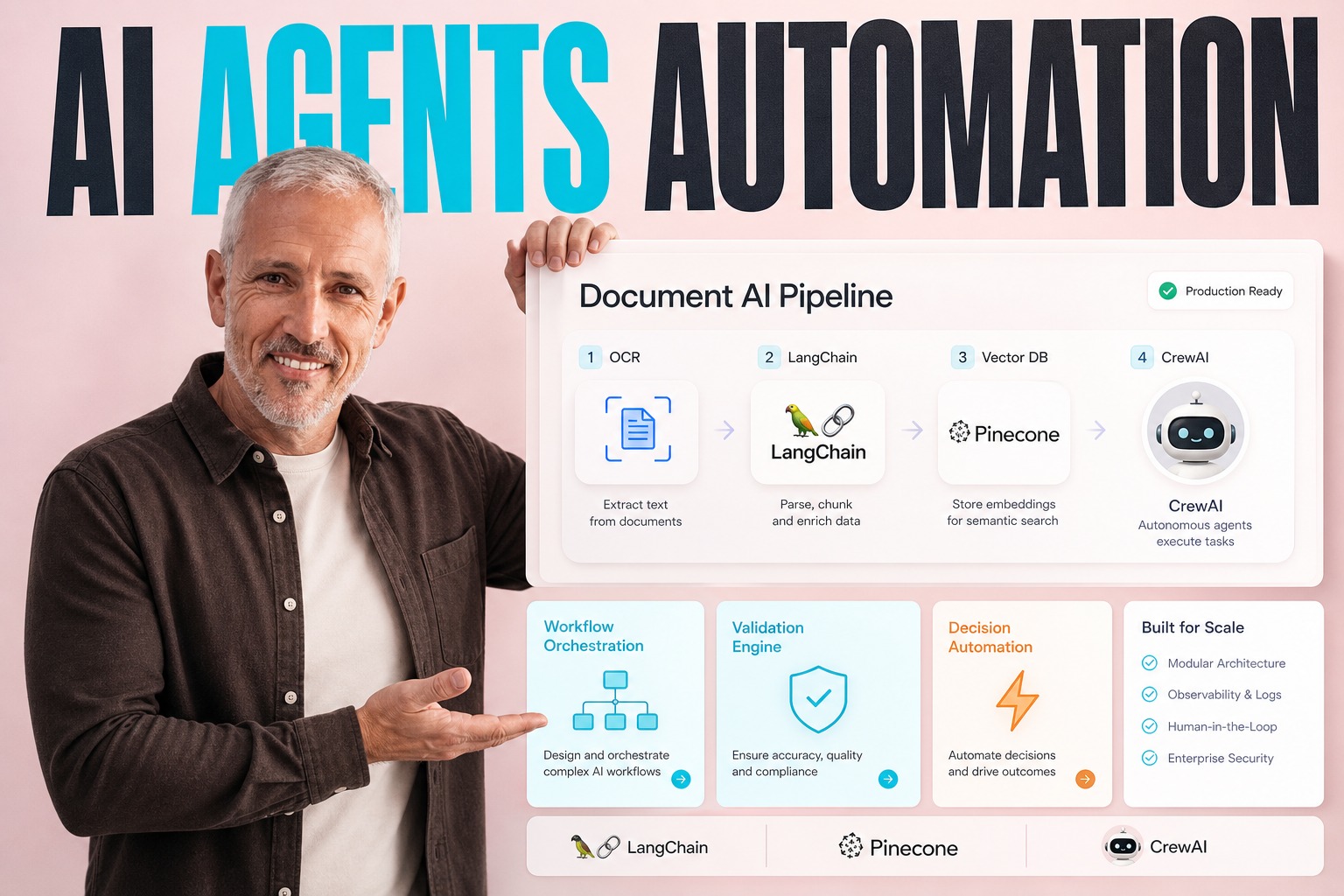
Building a production‑grade AI document processing pipeline requires stitching together several independent yet tightly orchestrated layers. Below is a reference architecture that scales from a sandbox prototype to a multi‑region, multi‑tenant service.
- Ingress layer – An API gateway (e.g., Kong or AWS API‑Gateway) exposing REST endpoints and a webhook sink for event‑driven uploads. Supports multipart/form‑data, S3 pre‑signed URLs, and GraphQL mutations for bulk ingestion.
- Orchestration – A workflow engine such as Temporal or Apache Airflow handles idempotent job creation, retry policies, and circuit‑breaker logic. Each document creates a unique
job_id stored in a PostgreSQL metadata DB. - Pre‑processing – Containerised micro‑service (Python, FastAPI) that runs image‑enhancement (deskew, de‑noise) and routes the file to an OCR AI backend. Popular choices: Tesseract 4.0 for low‑cost OCR, or Azure Form Recognizer / Google Document AI for higher accuracy (≈98 % on clean invoices).
- Extraction engine – Uses LangChain or LlamaIndex to invoke a data extraction AI model (e.g., OpenAI gpt‑4‑turbo with function calling or a fine‑tuned BERT). The model receives OCR text plus a schema prompt describing fields (invoice_number, line_items, total_amount) and returns JSON.
- Validation & enrichment – A rule engine (Drools or custom Python) cross‑checks extracted values against master data (vendor master, GL codes) stored in a Redis cache for low latency. Invalid rows are flagged and sent to a human‑in‑the‑loop UI built with React.
- Classification & routing – Embedding service creates dense vectors (Sentence‑Transformers) for each document, persisted in a vector DB (Pinecone or Milvus). Nearest‑neighbor search determines document type (contract, invoice, claim) and pushes a message onto a Kafka topic.
- Decision automation – An AI agent built with CrewAI or AutoGen consumes the classified message, calls external ERP/webhook APIs, and writes the final record into an SAP OData service or a Snowflake table. All calls are wrapped with a token‑bucket rate limiter to respect downstream SLA.
- Observability stack – OpenTelemetry agents instrument every micro‑service; logs go to Loki, metrics to Prometheus, and traces to Jaeger. Alerts on error‑rate > 2 % trigger a PagerDuty incident.
Data flow example: A supplier uploads a PDF via the web portal → API gateway acknowledges with a job token → Temporal schedules OCR → OCR AI returns raw text → LangChain extracts JSON → validation engine corrects vendor code → vector DB tags the document as an “invoice” → CrewAI agent posts the JSON to SAP → audit trail stored in immutable S3 bucket.
Even the best OCR engine is only the first step; without a downstream validation agent, 20 % of extracted amounts will still need manual correction.
The architecture is deliberately modular: you can swap Azure Form Recognizer for an on‑premise OCR stack without changing downstream agents, and you can replace the LLM with a fine‑tuned local model (e.g., Llama‑2‑70B) to stay within strict data‑residency regulations.
Business impact & measurable ROI of AI document processing
When the stack above runs on a mixed deployment—Kubernetes on AWS us‑east‑1 for the stateless services, and an on‑premise GPU node for the fine‑tuned extraction model—typical enterprise metrics look like:
- Processing throughput: 1 200 pages/minute at < 150 ms latency per page (including OCR and LLM extraction).
- Cost per processed page: $0.004 on spot‑instance pricing versus $0.02 for legacy RPA bots.
- Accuracy lift: F‑score improves from 0.84 (regex) to 0.96 (LLM + validation), cutting rework time by ~70 %.
- Time‑to‑decision: Contract‑review cycle drops from 48 h to under 5 min thanks to automated classification and downstream ERP triggers.
- Compliance gain: Immutable audit logs stored in S3 Object Lock satisfy 8‑year retention for SOX, while OpenTelemetry provides end‑to‑end traceability for every extracted field.
These levers translate directly into a measurable ROI:
- Annual operational savings of $1.2 M for a mid‑size insurer processing 2 M claim forms.
- Reduced audit penalties (estimated $250 k/year) due to consistent data lineage.
- Scalable headroom: adding a second GPU node increases throughput by 40 % with a linear cost increase, thanks to the stateless design.
The real business value emerges when you close the loop—extract, validate, classify, and automatically invoke downstream processes—all within a single, observable pipeline.
Implementation strategy
A pragmatic rollout minimizes risk while delivering early wins:
- 1️⃣ Proof of concept – Select a high‑volume, low‑complexity doc type (e.g., vendor invoices). Build a minimal pipeline: S3 upload → Azure Form Recognizer → simple JSON schema → store in DynamoDB.
- 2️⃣ Model enrichment – Introduce a fine‑tuned extraction model for multi‑line tables. Use LangChain function calling to enforce schema.
- 3️⃣ Validation layer – Add a Drools rule set for vendor code cross‑check. Surface exceptions in a Slack webhook for rapid feedback.
- 4️⃣ Classification & routing – Deploy a Sentence‑Transformers embedding service and a Milvus vector DB. Start routing to a Kafka topic.
- 5️⃣ Decision agents – Implement a CrewAI agent that calls your ERP’s OData endpoint. Wrap calls in a circuit breaker (Hystrix‑style) and add tracing.
- 6️⃣ Observability & governance – Enable OpenTelemetry, configure Loki/Prometheus dashboards, and enforce OAuth2 scopes on all APIs.
- 7️⃣ Scale‑out – Migrate stateless services to a Kubernetes cluster with Horizontal Pod Autoscaler (target CPU < 60 %). Deploy GPU‑enabled nodes for LLM inference.
- 8️⃣ Multi‑tenant rollout – Introduce tenant isolation via separate PostgreSQL schemas and per‑tenant S3 prefixes. Use Istio for mTLS between services.
Common pitfalls (and how to avoid them):
- Under‑estimating OCR preprocessing → leads to downstream extraction errors. Mitigate with automated image quality checks.
- Hard‑coding LLM prompts → breaks when schema evolves. Store prompts in a version‑controlled DB and inject at runtime.
- Ignoring rate limits of external APIs → cause cascading failures. Use token‑bucket throttling per endpoint.
- Missing idempotency keys on ERP writes → duplicate records on retry. Include
job_id in every downstream payload.
Why Plavno’s approach works
Plavno couples an engineering‑first methodology with enterprise‑grade delivery practices:
- Our teams build on top of proven frameworks—LangChain, CrewAI, and AutoGen—so you inherit battle‑tested patterns for tool use, function calling, and multi‑agent coordination.
- We design for hybrid deployment: core services run in Kubernetes on any cloud provider, while sensitive extraction models can stay on‑premise behind your firewall, satisfying data residency mandates.
- Security is baked in from day 0: OAuth2 token flow, fine‑grained API‑key scopes, encrypted S3 buckets, and audit‑trail integration with digital‑enterprise/software‑development‑consult.
- Our AI automation practice provides end‑to‑end pipeline orchestration, from document intake to decision execution, with a single source of truth for observability.
- When you need domain‑specific expertise—legal contract analysis, insurance claim triage, or supply‑chain invoice matching—we ship a pre‑trained “agent‑as‑a‑service” and then fine‑tune it on your corpora.
- We back every deployment with a Plavno Nova support SLA: 99.9 % uptime, 15‑minute MTTR, and a dedicated engineering liaison for continuous improvement.
Whether you choose outsourcing, outstaffing, or a managed AI development partnership, our flexible engagement model aligns technology risk with business outcomes.
AI document processing is no longer a research prototype; it is a production‑ready, cost‑effective engine for turning unstructured paperwork into actionable data. By adopting a modular, observable, and security‑first architecture, enterprises can shave weeks off their approval cycles, cut manual labor by up to 80 %, and stay compliant with modern governance standards. Ready to turn your piles of PDFs into a strategic asset? Contact us and let’s design the pipeline that fits your unique data landscape.