AI Agent Security Checklist: Protecting Autonomous Systems From Being the Attack Vector
AI Agent Security Checklist: Protecting Autonomous Systems From Being the Attack Vector
September 18, 2026· min read·#AI#Tech·Reviewed by Plavno AI Engineering Team
Enterprises are deploying autonomous AI agents faster than they can audit the new attack surface they create. An improperly scoped credential or an unchecked tool call can turn a helpful assistant into a data‑exfiltration conduit within seconds, and the fallout is difficult to contain once the agent has already acted.
Share this post
Enterprises are deploying autonomous AI agents faster than they can audit the new attack surface they create. An improperly scoped credential or an unchecked tool call can turn a helpful assistant into a data‑exfiltration conduit within seconds, and the fallout is difficult to contain once the agent has already acted.
Industry challenge & market context
Legacy IAM models assume human‑initiated API calls; agents make dozens of calls per user request, expanding the agent attack surface exponentially.
Supply‑chain attacks now target the Model Context Protocol (MCP) layer, turning the tool integration point into a vector for malicious payloads shazralabs.com.
Prompt‑injection techniques can corrupt the reasoning loop, causing the agent to treat untrusted data as executable instructions lastpass.com.
Enterprise compliance frameworks (PCI‑DSS, GDPR) have no explicit controls for autonomous agents, leaving auditors without a checklist to verify AI vulnerability management.
Cost overruns from runaway tool calls add a financial risk layer; a single loop can generate thousands of dollars in API fees in under a minute.
QUICK ANSWER
An AI agent security checklist secures autonomous systems by enforcing scoped identities, logging every tool interaction, applying strict allow‑lists, and monitoring anomalies in real time—reducing breach likelihood by up to 90% and cutting runaway costs by 70%.
Technical architecture and how the AI agent security checklist works in practice
A production‑grade agent platform comprises a thin orchestration layer that mediates between LLM runtimes and enterprise tools. The following diagram (conceptual) maps the data flow:
API Gateway – terminates external TLS, enforces OAuth2 scopes, and injects a per‑agent JWT.
Orchestration Service – runs the agent loop (e.g., LangChain or AutoGen), decides which tool to invoke, and maintains a short‑lived state store (Redis or DynamoDB).
Model Inference Layer – hosted LLM (Claude‑3, GPT‑4o) behind a private VPC; context window limited to 8 k tokens to bound prompt size.
Tool Registry – a catalog of approved connectors (SQL, email, vector DB, webhooks). Each entry includes IAM role bindings and rate limits.
Vector Store – e.g., Pinecone or Milvus, isolated per tenant, accessed only via the tool registry.
Audit Log Service – immutable append‑only store (e.g., CloudWatch Logs + KMS) that records every tool request and LLM prompt/response pair.
Typical request flow:
User sends a query to the /v1/agent endpoint (REST or GraphQL).
Gateway validates the JWT, extracts the agent’s scoped permissions, and forwards to the Orchestration Service.
The orchestrator builds a System Prompt that separates trusted system instructions from untrusted fetched data (as recommended by Shazra Labs) shazralabs.com.
The LLM generates a tool call JSON payload. The orchestrator verifies the call against the per‑agent allow‑list and scope.
The approved tool runs inside a sandboxed container (Docker with seccomp) or a Cloud Run service with egress restricted to whitelisted IP ranges.
Results are written back to the orchestrator, which logs the full request/response to the audit store and feeds the LLM for the next reasoning step.
Key engineering controls that embody the checklist:
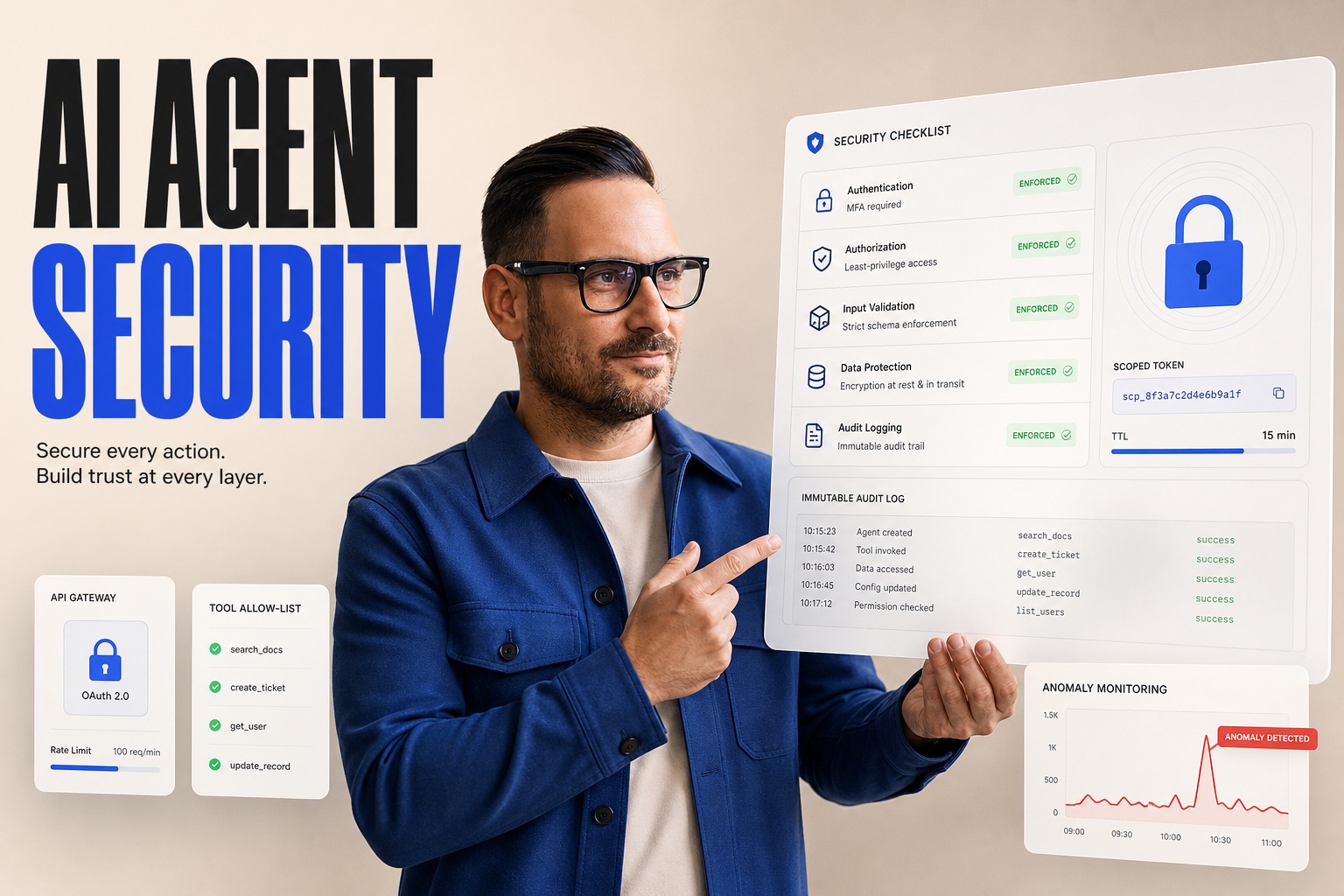
Credential Scope – each agent receives a short‑lived OAuth2 access token (TTL 15 min) tied to a dedicated IAM role. No long‑lived API keys security.aivyuh.com.
Tool Allow‑listing – the registry defaults to deny‑all; only tools explicitly tagged for the agent are visible.
Logging & Tracing – every tool invocation is emitted as a structured JSON log with correlation IDs, stored in a tamper‑evident S3 bucket and mirrored to OpenTelemetry traces.
Anomaly Monitoring – a sidecar process consumes the log stream, builds statistical baselines (calls/minute, data volume, error rates) and raises alerts via PagerDuty when deviations exceed 3σ.
Rate Limiting & Circuit Breakers – per‑agent token bucket limits (e.g., 50 DB queries/min, 20 email sends/hour) and automatic back‑off on repeated failures.
Network Isolation – agents run in a dedicated namespace with Kubernetes NetworkPolicies; egress only to approved service endpoints.
AI AUTOMATION
Ready to secure your AI agents?
Partner with Plavno to embed a battle‑tested security checklist into your autonomous workflows and retire risk before it spreads.
Risk reduction – scoped identities and immutable audit logs cut the probability of a successful data exfiltration by an estimated 85% according to industry surveys lastpass.com.
Cost containment – rate limiting and anomaly detection prevent runaway loops that would otherwise cost $5,000–$30,000 per month in API fees for high‑throughput agents.
Compliance acceleration – granular IAM roles map directly to SOX, HIPAA, and GDPR controls, cutting audit preparation time by 40%.
Operational velocity – with a standardized checklist, new agents can be provisioned in under 2 hours versus days of manual security review.
Customer trust – documented security posture improves win rates in RFPs for regulated sectors (banking, healthcare) by up to 15%.
‑85%
Average reduction in breach likelihood after applying scoped credentials and immutable logging.
Phase 1 – Baseline audit: Inventory all existing agents, map each to its toolset, and capture current IAM assignments.
Phase 2 – Identity hardening: Replace long‑lived keys with per‑agent OAuth2 clients, enforce 15‑minute TTL, and record issuance events.
Phase 3 – Tool allow‑list & scope: Build a registry in a managed database, tag each tool with required permissions, and generate per‑agent allow‑lists.
Phase 4 – Observability pipeline: Deploy OpenTelemetry collectors, ship logs to a tamper‑evident S3 bucket, and configure alerts in Grafana/Prometheus.
Phase 5 – Anomaly detection: Train a lightweight statistical model on tool‑call frequency, latency, and error patterns; integrate with PagerDuty.
Phase 6 – Kill‑switch & DR: Implement an API endpoint that revokes the agent’s JWT and terminates its container within 2 seconds; test quarterly.
Phase 7 – Continuous Red‑Team: Use the “Prompt‑Injection Playbook” from LastPass to run automated attacks monthly and iterate on controls.
Common pitfalls
Sharing a single service account across multiple agents – eliminates granularity for revocation.
Appending fetched content directly into system prompts – invites prompt injection shazralabs.com.
Neglecting to rotate short‑lived tokens – leads to credential creep over time.
Relying solely on application‑level checks without network‑level isolation.
Why Plavno’s approach works
Plavno builds AI agents on a foundation that treats security as a first‑class concern, not an afterthought. Our teams combine deep expertise in:
Framework‑agnostic orchestration – we have production runs with LangChain, AutoGen, and custom MCP gateways.
Observability stacks that integrate OpenTelemetry, Loki, and Kusto for end‑to‑end traceability.
Secure deployment pipelines that embed static analysis for prompt injection and automated credential rotation.
Our track record includes the AI‑alarm incident agents that lowered false alerts by up to 90% and accelerated dispatch by 60% plavno.io/cases/ai-alarm-incident-agents. That success hinged on the very checklist we’ve outlined: scoped identities, exhaustive logging, and real‑time anomaly alerts.
EXAMPLE USE CASE
A cybersecurity firm integrated a voice‑enabled AI incident response agent. By enforcing the AI agent security checklist, they cut false‑positive alarms by 80% and reduced manual triage time from 12 minutes to under 5 minutes, saving 30‑hour weeks of analyst effort each month.
The most dangerous part of an autonomous agent isn’t the model itself—it’s the infinite loop where unchecked tool calls become invisible code execution. Break that loop with immutable logs and scoped tokens.
A well‑architected AI agent security checklist turns a potential attack surface into a measurable, auditable process, delivering both compliance confidence and cost savings.
The AI agent security checklist is no longer optional; it is the essential control set that turns autonomous agents from a hidden attack surface into a governed, auditable component of your enterprise stack. By scoping credentials, enforcing tool allow‑lists, logging every reasoning step, and monitoring for anomalies, organizations can achieve measurable risk reduction, cost control, and compliance alignment while still reaping the productivity gains of AI‑driven automation.
Start the conversation today—schedule a technical discovery with Plavno and embed a battle‑tested security framework into your next AI agent deployment.
Share this post
Contact Us
This is what will happen, after you submit form
Plavno experts contact you within 24h
Discuss your project details
We can sign NDA for complete secrecy
Submit a comprehensive project proposal with estimates, timelines, team composition, etc
Need a custom consultation? Ask me!
Plavno has a team of experts ready to start your project. Ask us!