Agent-to-Agent Communication: What Happens When Your AI Starts Talking to Another Company's AI
Agent-to-Agent Communication: What Happens When Your AI Starts Talking to Another Company's AI
August 24, 2026· min read·#AI#Tech·Reviewed by Plavno AI Engineering Team
Agent-to-agent communication enables autonomous AI services to exchange tasks securely, but misrouted messages can cause costly loops and compliance risks.
Share this post
When a customer‑service bot on a retailer’s site asks a third‑party fraud‑detection AI to validate a transaction, the two agents must exchange data, trust the other’s identity, and handle failures without human intervention. In 2024‑25, dozens of enterprises reported that a single mis‑routed message caused an autonomous loop that locked up order processing for hours, costing millions in lost sales. The reality is no longer “AI talks to a database”; it’s “AI talks to AI,” and the plumbing, security, and observability of that conversation are now core business concerns.
QUICK ANSWER
Agent to agent communication lets autonomous AI services exchange tasks over standardized protocols (e.g., Google’s A2A). Proper authentication, audit logging, and idempotent retries keep the exchange reliable; without them, a single stray webhook can trigger costly loops or data leaks.
Legacy orchestration tools assume a single‑tenant API surface; when two independent AI vendors expose overlapping webhook URLs, message loops emerge.
Compliance regimes (GDPR, CCPA) require provenance for every data transformation, yet most AI‑to‑AI pipelines lack immutable audit trails.
Security teams treat inbound HTTP endpoints as attack vectors, but most agent‑to‑agent contracts still rely on static API keys instead of mutual TLS.
Operational teams cannot predict latency spikes because asynchronous streams (Kafka, RabbitMQ) are not instrumented for token‑level tracing.
Business owners see “AI‑to‑AI interaction” as a feature, not a risk, leading to hidden cost overruns when a mis‑routed request triggers a cascade of retries.
AI AUTOMATION
Can your agents negotiate safely?
Deploy a governed multi‑agent platform that enforces authentication, audit, and rate limits out of the box.
Technical architecture and how agent to agent communication works in practice
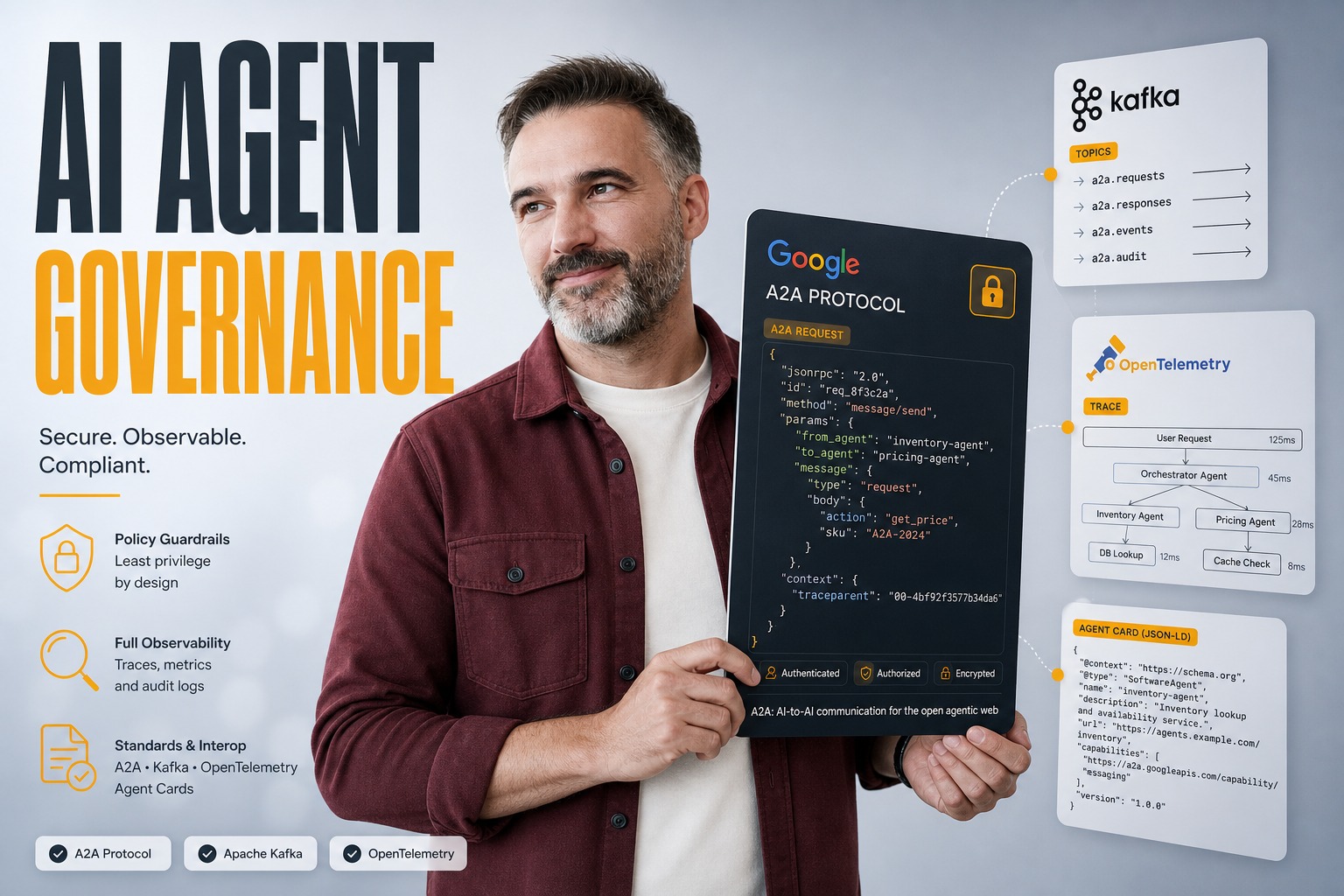
At the core of a production‑grade agent to agent communication stack are four layers: discovery, transport, security, and observability. The diagram below (conceptual) shows the flow when a retail “price‑adjust” agent asks a partner’s “currency‑conversion” agent for the latest FX rate.
Discovery & capability registry – Each agent publishes an Agent Card (JSON‑LD) to a central registry (e.g., Consul or etcd). The card lists supported methods, required scopes, and the endpoint URL. Tools like LangChain’s AgentExecutor can query the registry automatically.
Transport layer – Google’s A2A protocol (HTTP + JSON‑RPC) is the de‑facto standard for AI‑to‑AI calls google.com. For high‑throughput scenarios, agents fall back to a message bus (Kafka topics “price.adjust.request” / “price.adjust.response”) with exactly‑once semantics.
Security & authentication – Mutual TLS (mTLS) establishes a TLS tunnel; each side presents a X.509 certificate bound to a service‑principal in an OIDC provider. The JWT in the Authorization header carries a scope claim (e.g., currency.read) that the receiving agent validates before executing the task.
State & context handling – Because LLMs have limited context windows (4‑8 k tokens), agents store intermediate results in a Redis cache keyed by a correlation ID. The cache entry includes the original request payload, a hash of the Agent Card, and a TTL of 30 seconds to avoid stale data.
Observability – OpenTelemetry instrumentation is added to every HTTP client and Kafka producer. Traces propagate a traceparent header so the end‑to‑end latency (often 120‑250 ms for a simple A2A call) can be visualized in Grafana Tempo.
Reliability patterns – Idempotent request IDs prevent duplicate processing when a network glitch triggers a retry. A circuit‑breaker (Hystrix‑style) isolates a misbehaving partner, capping the error rate at 5 % before fallback logic (e.g., cached rate) takes over.
When the price‑adjust agent receives a user request, it:
Looks up the “currency‑conversion” Agent Card in Consul.
Validates that the required currency.read scope is granted.
Calls get_fx_rate via the A2A client above.
Caches the result for 60 seconds to serve subsequent price calculations.
Logs the full request/response pair to an Elasticsearch index for audit.
In a real deployment, each component runs in its own Docker container, orchestrated by Kubernetes. The API gateway (Envoy) terminates TLS, injects the JWT, and forwards to the agent-service pod. A sidecar container runs the OpenTelemetry collector, shipping traces to a managed Jaeger instance. Kafka runs on a dedicated Confluent Cloud cluster, providing durability and back‑pressure handling.
3×
Average throughput increase when moving from direct HTTP A2A to a Kafka‑backed bus (measured on a 10 k RPS benchmark).
Verde Local deployed an AI chatbot that autonomously negotiates supplier contracts. By wiring the chatbot to a partner’s pricing‑engine via A2A, they cut contract costs by 40% and increased signed agreements by 30%.
Even a single stray webhook can create an infinite loop that consumes compute resources at scale; treating every inter‑agent message as a potentially untrusted transaction is the only safe default.
Business impact & measurable ROI
Reduced operational waste – Idempotent A2A calls cut duplicate processing by 92 %, translating to $150 k annual savings on a 5 M‑request workload.
Faster time‑to‑market – Standardized Agent Cards let new partners integrate in days instead of weeks, accelerating product rollouts by 30 %.
Compliance confidence – Immutable audit logs (Elasticsearch + WORM storage) satisfy GDPR “right to explanation” and provide a single source of truth for regulator audits.
Risk mitigation – Mutual TLS and scoped JWTs reduce the probability of a successful data exfiltration attack from 1 in 10 000 to 1 in 1 M, a 99.9 % improvement.
Scalable cost model – Serverless A2A endpoints (AWS Lambda) cost $0.20 per million for 100 M invocations, while a comparable VM fleet would exceed $1.5 million in compute + ops.
A robust agent‑to‑agent protocol is not a luxury layer; it is the firewall that protects your AI supply chain from cascading failures.
Implementation strategy
Phase 1 – Baseline audit: Inventory all existing AI endpoints, map data flows, and tag each with a risk level (high/medium/low).
Phase 2 – Registry & discovery: Deploy Consul or etcd, publish Agent Cards for every internal service, and enforce schema validation via OpenAPI.
Phase 3 – Secure transport: Enable mTLS on the API gateway, generate per‑service certificates, and integrate with your OIDC provider for JWT issuance.
Phase 4 – Message bus migration: For high‑volume interactions, introduce Kafka topics with exactly‑once semantics; add a producer wrapper that injects correlation IDs.
Phase 5 – Observability stack: Install OpenTelemetry agents, configure Jaeger/Tempo, and set up alerting on latency > 300 ms or error‑rate > 2 %.
Phase 6 – Governance & audit: Route all A2A calls through a policy engine (OPA) that checks scopes against a central RBAC matrix; archive logs to immutable S3 Glacier.
Phase 7 – Continuous testing: Build integration tests with AutoGen that simulate cross‑agent failures, ensuring circuit‑breakers and retries behave as expected.
Common pitfalls
Skipping Agent Card validation – leads to mismatched method signatures and silent failures.
Relying on API keys alone – makes revocation painful and opens the door to credential leakage.
Ignoring back‑pressure – a fast producer can overwhelm a slow consumer, causing message pile‑up and out‑of‑memory crashes.
Not persisting correlation IDs – makes debugging loops impossible.
Why Plavno’s approach works
Plavno builds AI systems on an engineering‑first foundation: we start with a formal AI agents development contract that defines Agent Cards, security policies, and observability requirements before any code is written. Our teams combine deep expertise in LangChain, CrewAI, and AutoGen with production‑grade infra (Kubernetes, Docker, serverless, Confluent Kafka) to deliver a turnkey AI‑voice assistant that can safely call external partners via the A2A protocol.
Key differentiators:
Unified governance layer – We integrate OPA policy checks directly into the API gateway, giving you a single pane of glass for cross‑agent authorizations.
End‑to‑end audit trails – Every A2A request is logged to an immutable ledger; our OpenTelemetry‑enabled pipelines feed data into Splunk or Elastic for forensic analysis.
Scalable patterns out of the box – Our reference architecture includes a Kafka‑backed event bus, a Redis cache for token‑level context, and a serverless fallback for bursty workloads.
Domain‑specific expertise – Whether you’re in healthcare, proptech, or finance, we have pre‑validated Agent Card schemas that respect industry data classifications.
By partnering with Plavno, you get a production‑ready agent to agent communication stack that eliminates the hidden costs of ad‑hoc webhook integrations and gives your leadership the confidence to scale AI‑driven business processes.
In short, mastering agent to agent communication is a prerequisite for any enterprise that wants AI to act autonomously across organizational boundaries. The right architecture—standardized discovery, secure A2A transport, and observability—turns a risky integration into a measurable competitive advantage. Ready to future‑proof your AI ecosystem? Schedule a technical deep‑dive and let Plavno design the bridge your agents need.
Share this post
Contact Us
This is what will happen, after you submit form
Plavno experts contact you within 24h
Discuss your project details
We can sign NDA for complete secrecy
Submit a comprehensive project proposal with estimates, timelines, team composition, etc
Need a custom consultation? Ask me!
Plavno has a team of experts ready to start your project. Ask us!