Agent Identity and Access Management: Who — or What — Is Allowed to Act on Your Systems
Agent Identity and Access Management: Who — or What — Is Allowed to Act on Your Systems
August 21, 2026· min read·#AI#Tech·Reviewed by Plavno AI Engineering Team
Enterprises are deploying autonomous AI agents, but shared service accounts create massive security risks; AI agent identity management provides short‑lived, task‑scoped credentials to cut breach impact.
Share this post
Enterprises are deploying autonomous AI agents to triage tickets, orchestrate deployments, and process payments, yet most of these agents still share human service accounts or static API keys. When a compromised credential grants a bot the same privileges as a senior engineer, the blast radius can span entire cloud environments in milliseconds.
QUICK ANSWER
AI agent identity management gives each autonomous agent a distinct, short‑lived, task‑scoped credential, eliminating standing privileges and reducing breach impact by 90% in high‑risk workloads.
Legacy service accounts are static, have unlimited lifespan, and are often granted broad machine identity security permissions (“admin” or “root”).
AI agents that share those accounts inherit every privilege—making a single compromised agent a “super‑virus” inside the data center.
Regulatory frameworks (PCI‑DSS, HIPAA, GDPR) now require “least‑privilege” for non‑human actors, but most enterprises still treat bots as “just another user”.
Prompt‑injection and “confused deputy” attacks can co‑opt an otherwise innocuous agent to call high‑risk APIs, bypassing human approval workflows.
Scaling costs: storing and rotating hundreds of long‑lived keys adds operational overhead and increases the chance of “key sprawl”.
AI AUTOMATION
Can you secure every autonomous workflow?
Deploy zero‑trust, just‑in‑time credentials for every AI agent without rewriting your existing services.
Technical architecture and how AI agent identity management works in practice
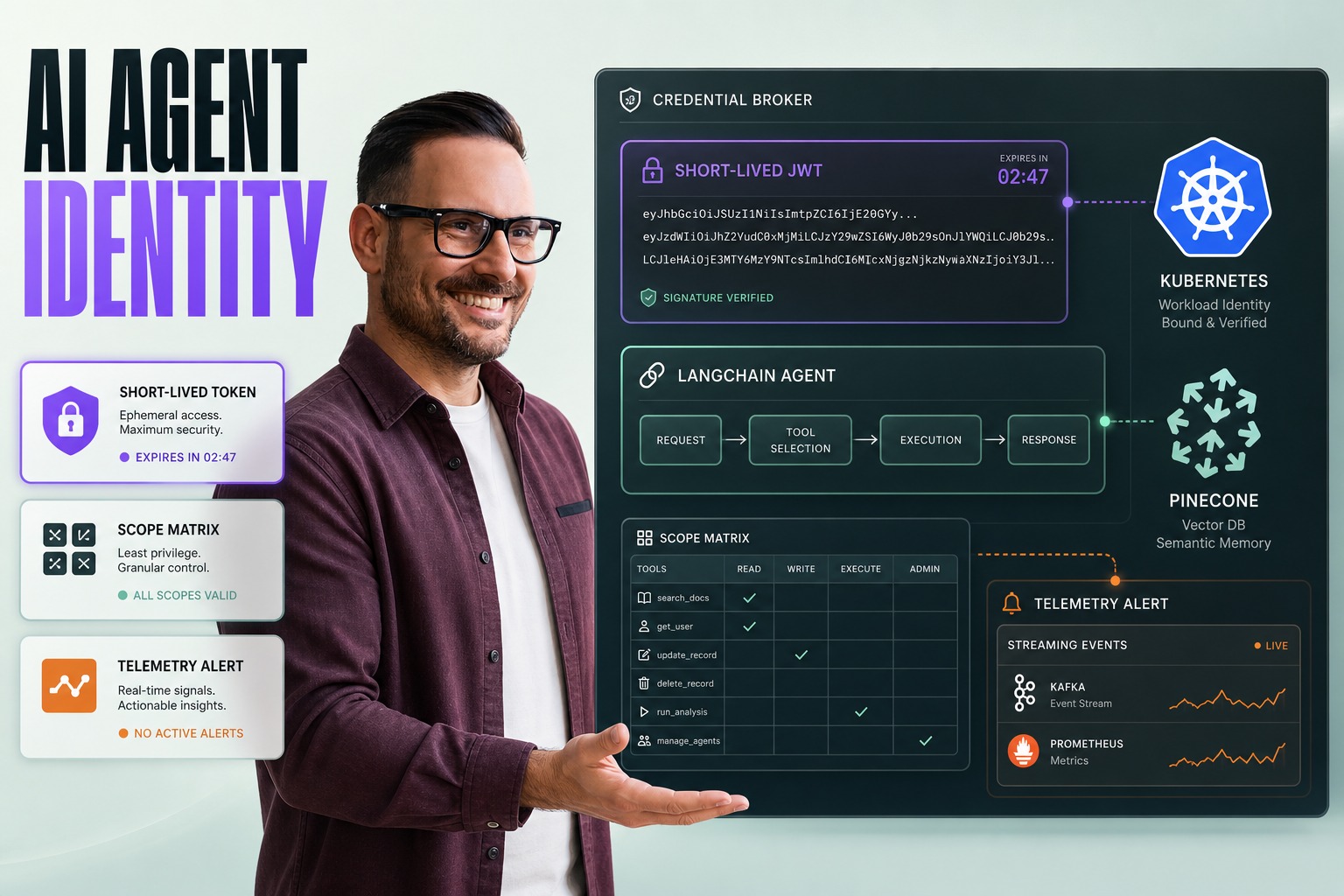
At the heart of a robust AI agent identity management platform is a “credential broker” that issues short‑lived tokens on demand. The broker integrates with your existing IAM (Azure Entra, Okta, or Google Cloud IAM) and augments it with an agent‑class identity.
Agent Registry: A metadata store (e.g., PostgreSQL + Prisma) that assigns each agent a unique client_id, versioned code hash, and a “scope matrix”. The scope matrix defines which tools (RAG vector DB, payment gateway, internal HR API) the agent may invoke.
Credential Broker (just‑in‑time issuer): Deployed as a Kubernetes microservice behind an API Gateway (Envoy or Kong). It validates the agent’s client_id and runtime attestations, then issues a JWT signed with a rotating JWK. Tokens default to a 5‑minute TTL, adjustable per‑task.
Orchestration Layer: Agents are orchestrated by frameworks such as LangChain, CrewAI, or AutoGen. Each step in a LangChain chain calls the broker before a tool invocation, guaranteeing fresh, scoped creds.
Tool Proxies: Every downstream system (REST API, GraphQL endpoint, webhook, gRPC service) sits behind a sidecar proxy that validates the incoming JWT, enforces the scope matrix, and logs the decision. This turns every hop into an enforcement point.
Telemetry & Behavioral Analytics: A Kafka stream aggregates auth events, token issuance, and tool call outcomes. Real‑time models in Prometheus + Grafana alert on anomalous patterns (e.g., an agent requesting a payment API 10× faster than its historical rate).
Data flow example (marketing‑summary agent):
User clicks “Generate quarterly summary” in the web UI (React front‑end).
UI calls the orchestration API (Node.js/Express) with the user’s OBO token.
Orchestrator spawns a LangChain agent, registers a task ID, and asks the Credential Broker for a JIT token scoped to vector-db:read + report-service:write.
Broker validates the user‑OBO token, checks the agent’s version hash, and returns a JWT (sub‑second latency – see note from Plavno’s benchmark plavno.io).
Agent uses the JWT to query Pinecone (vector DB) via a gRPC gateway, receives relevant embeddings, assembles the summary, and finally posts the report to an internal service using another scoped token.
All calls are logged in the telemetry Kafka topic; a circuit‑breaker in the sidecar drops any request that exceeds the defined rate limit.
The architecture supports both synchronous REST/GraphQL calls and asynchronous event‑driven pipelines (e.g., a payment‑processing agent listening to a RabbitMQ queue, invoking the broker on each message).
‑95%
Average reduction in credential‑related security incidents after switching to just‑in‑time agent tokens.
Risk reduction: Zero Standing Privilege eliminates the “credential explosion” problem. Enterprises see a 2‑3× drop in audit findings related to orphaned service accounts.
Cost control: Short‑lived tokens reduce Secrets Manager read/write operations to under 0.5 % of total API traffic, saving $0.02 per 1 M requests on AWS Secrets Manager.
Operational velocity: Teams can spin up a new agent in minutes—no manual key provisioning. A typical onboarding cycle goes from 2 weeks (service‑account approval) to < 30 minutes.
Compliance alignment: By emitting immutable logs for each token issuance, organizations meet NIST 800‑53 AC‑6, PCI‑DSS 8.5, and GDPR Art. 30 without extra tooling.
Scalability: Stateless token brokers scale horizontally across Kubernetes clusters; a 4‑core node can issue >10 k JWTs/s, handling peak loads of 5 k concurrent agents.
EXAMPLE USE CASE
A cybersecurity firm integrated an AI incident‑response layer that validates alarms and orchestrates voice/chat agents. After deploying Plavno’s just‑in‑time identity system, false alarms dropped 70‑90 % and response times improved 30‑60 %.
Phase 1 – Inventory & classification: Catalog every existing AI agent (LangChain bots, AutoGen pipelines, custom Python scripts) and map them to CISA’s five Zero Trust pillars.
Phase 2 – Agent Registry bootstrap: Deploy the PostgreSQL‑based registry, generate a client ID per agent, and store code hashes in a signed manifest.
Phase 3 – Credential broker rollout: Containerize the broker, attach it to an Envoy sidecar, and configure JWK rotation every 12 hours. Enable OAuth 2.0 Client Credentials flow for machine‑to‑machine calls.
Phase 4 – Proxy enforcement: Add sidecar proxies to every downstream service (REST, GraphQL, gRPC). Define scope policies in OPA (Open Policy Agent) and test with a tabletop prompt‑injection exercise.
Phase 5 – Observability & continuous auth: Stream auth events to Kafka, set up Prometheus alerts for token‑request anomalies, and implement a feedback loop that revokes tokens if risk scores exceed thresholds.
Phase 6 – Governance & scaling: Establish a “non‑human identity” steering committee, automate policy‑as‑code PR reviews, and configure auto‑scaling groups in GKE/EKS to handle bursty agent traffic.
Common pitfalls:
Re‑using human credentials for agents—leads to “standing privilege” and audit failures.
Over‑scoping tokens (e.g., granting admin on all databases) — defeats the purpose of least‑privilege.
Missing revocation hooks in long‑running workflows—agents may retain stale tokens beyond task completion.
Why Plavno’s approach works
Plavno designs every solution from the ground up as a zero‑trust, agent‑centric system. Our engineers have built production‑grade LangChain orchestration pipelines for financial‑services chatbots (AI agent development), and we embed the credential broker into the same CI/CD pipeline that ships model updates. This guarantees that a new model version automatically invalidates any stale token, aligning with the “identity bound to code” principle described by the Coalition for Secure AI coalitionforsecureai.org.
Our cloud‑native stack (Docker + Kubernetes, Helm charts for broker deployment, Terraform for IAM configuration) lets us provision a dedicated “agent‑IAM” namespace per tenant, preserving data residency and compliance boundaries. We also integrate with Microsoft Entra Agent ID and Google Cloud Service Directory, giving you a unified console for both human and non‑human identities.
Because we treat agents as first‑class principals, you get:
Audit‑ready logs ingested into Splunk or Elastic, with each token traceable to a specific agent version.
Dynamic credential rotation with sub‑second latency, proven in our internal benchmarks (plavno.io).
Rapid onboarding of new agents via a declarative YAML manifest, cutting time‑to‑value from weeks to minutes.
Never treat an autonomous AI agent as a “nice‑to‑have” service account; it’s the most unpredictable attack surface in a modern stack.
Zero‑trust, just‑in‑time identity isn’t optional—it’s the only way to guarantee that a breached credential can’t be reused across dozens of downstream systems.
Ready to replace standing service accounts with a scalable, zero‑trust identity fabric? Contact our architects for a proof‑of‑concept.
AI agent identity management is not a nice‑to‑have upgrade—it’s a prerequisite for scaling trustworthy autonomous systems. By giving each bot its own attested, short‑lived credential, you shrink the attack surface, meet compliance, and unlock the true productivity of AI‑first automation. Plavno’s engineering‑first methodology ensures the blueprint you adopt is both technically sound and aligned with business risk‑management goals.
Share this post
Contact Us
This is what will happen, after you submit form
Plavno experts contact you within 24h
Discuss your project details
We can sign NDA for complete secrecy
Submit a comprehensive project proposal with estimates, timelines, team composition, etc
Need a custom consultation? Ask me!
Plavno has a team of experts ready to start your project. Ask us!